India and European Union Bilateral Trade Pact
Source:The Hindu ↗
Why It Matters
This trade pact is significant for India's foreign economic policy, offering expanded market access, boosting export competitiveness, and solidifying strategic partnerships with major Western economies.
Summary
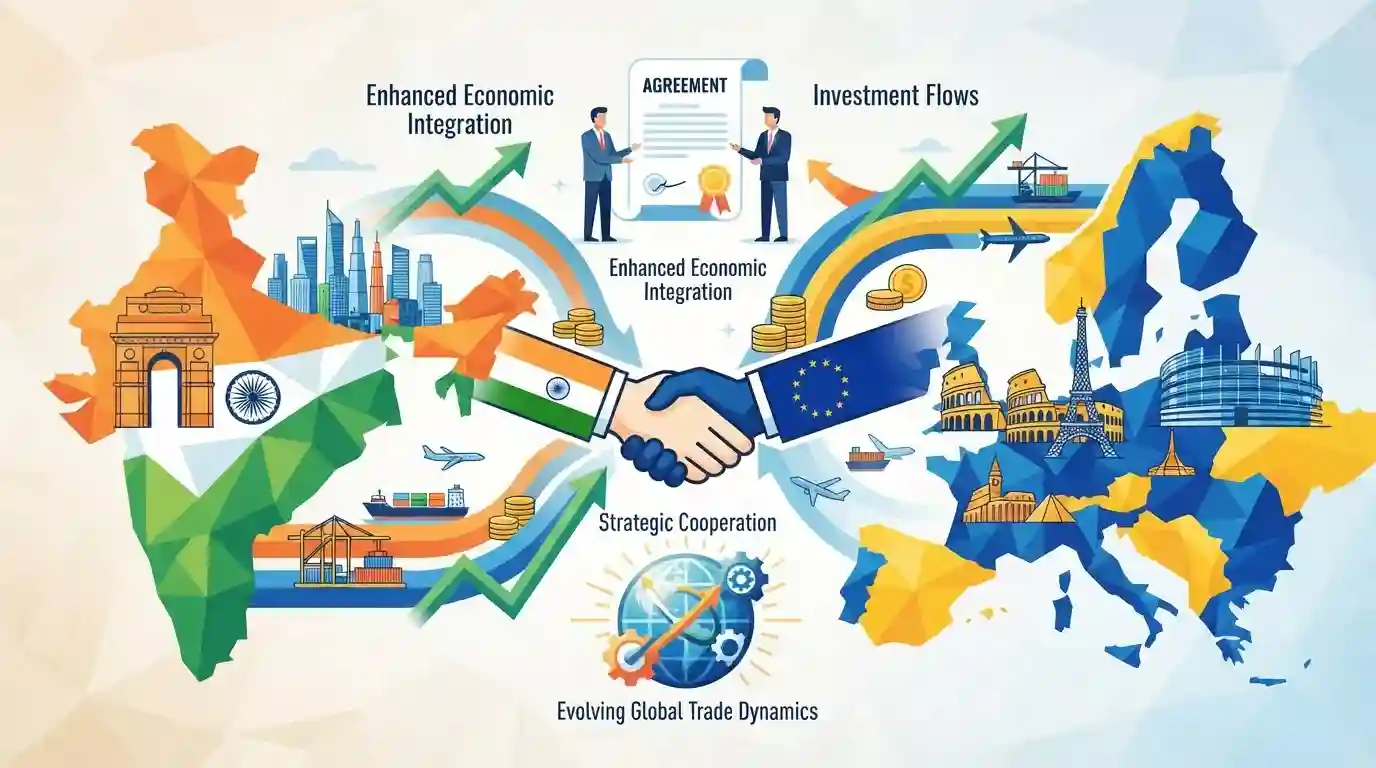
India and the European Union are expected to sign a comprehensive bilateral trade pact, enhancing economic integration, investment flows, and strategic cooperation between the two regions amidst evolving global trade dynamics.
Key Points
- India and the European Union are poised to sign a landmark bilateral trade pact.
- The agreement aims to boost economic ties, reduce trade barriers, and enhance cooperation in goods, services, and investments.
- Deepens geopolitical and economic integration between India and European nations amid shifting global trade dynamics.
Important Terms
India-EU Free Trade Agreement

A comprehensive bilateral agreement between India and the European Union aimed at significantly reducing tariffs, easing market access, and boosting economic cooperation and investment flows across sectors.
UPSC context
UPSC GS Paper II & III: International Relations, bilateral agreements, and India's economic diplomacy with major trading blocs.
European Union
A politico-economic union of 27 member states located primarily in Europe, operating as a single internal market and functioning as one of India's largest trading partners.
UPSC context
UPSC GS Paper II: Important international institutions, groupings, and multilateral relations affecting India's strategic and economic interests.
India-EU Trade and Investment Agreement
A broad economic framework previously referred to in negotiations encompassing trade in goods, services, investment, and intellectual property rights between India and the EU bloc.
UPSC context
UPSC GS Paper III: Indian Economy, international trade agreements, and foreign direct investment dynamics.
Prelims Trap
India and the European Union have been continuously negotiating the Broad-based Trade and Investment Agreement (BTIA) since 2007 without interruption.
Aspirants often confuse the BTIA launched in 2007 with the relaunched talks, assuming continuous uninterrupted negotiations since 2007 rather than a major stall and relaunch.
Static Concepts Connected
What are the key pillars and historical phases of India-EU trade negotiations?
- BTIA Launch: Launched in 2007 as the Broad-based Trade and Investment Agreement (BTIA) covering goods, services, and investment.
- 2013 Stalling: Stalled in 2013 due to major differences over market access, data security status, intellectual property rights, and duty cuts on autos and wines.
- 2021 Relaunch: Negotiations were officially relaunched in 2021 with a renewed mandate to address contemporary issues like digital trade, supply chains, and sustainability.
Cross-Topic Patterns
India-EU FTA meets EU CBAM regulations
Modern FTAs increasingly embed supply chain resilience, green transition standards, and carbon border adjustment mechanism (CBAM) accommodations, linking trade pacts directly to climate negotiations.
Trade Pacts and Indo-Pacific Security Architecture
Bilateral trade negotiations with Western blocs parallel India's Indo-Pacific security architectures, creating a synchronized economic and strategic security network.

India-EU FTA negotiations + EU's CBAM carbon tax compliance will likely feature in a multi-statement Mains or Prelims question.
Linked PYQs · 2
Linked PYQs · 2
- 2025MainsGS3
What are the challenges before the Indian economy when the world is moving away from free trade and multilateralism to protectionism and bilateralism? How can these challenges be met?
- 2023MainsGS2
‘The expansion and strengthening of NATO and a stronger US-Europe strategic partnership works well for India.’ What is your opinion about this statement ? Give reasons and examples to support your answer.
