India and European Union Resume Phased Free Trade Negotiations
Source:The Hindu ↗
Why It Matters
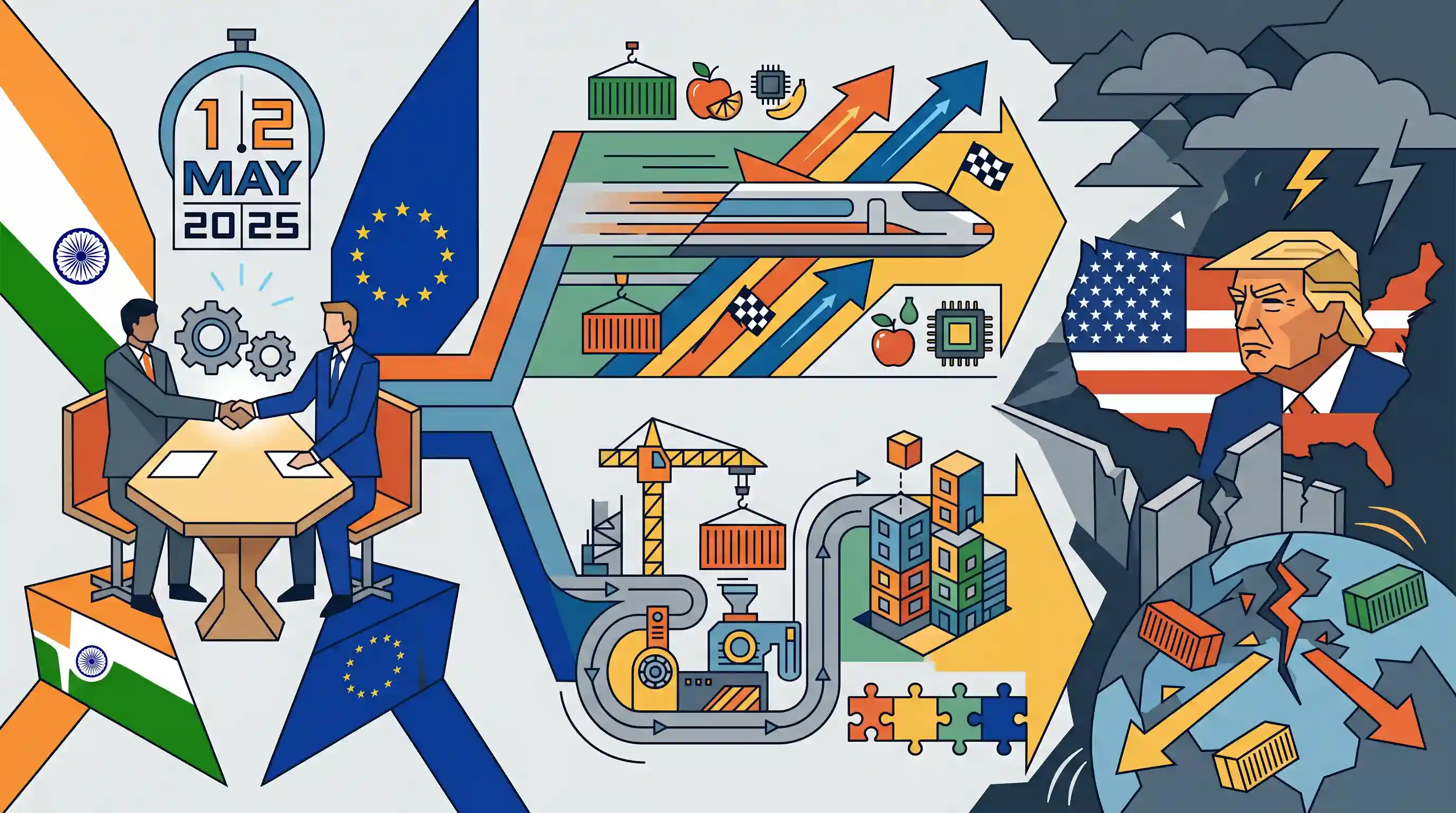
The India-EU FTA (historically negotiated as BTIA) is a crucial pillar of India's foreign trade policy. The shift to a 'two-phase' agreement highlights how global protectionism and trade wars (e.g., US tariff hikes) are actively reshaping bilateral trade negotiations and forcing pragmatic, staggered approaches to economic diplomacy.
Summary
India and the European Union will resume Free Trade Agreement (FTA) negotiations on May 12, 2025. Negotiators have agreed to split the agreement into two phases, aiming to conclude the first phase rapidly. This phased approach is a strategic adaptation to current global trade uncertainties, largely stemming from protectionist US tariff policies under President Donald Trump.
Key Points
- India and the European Union are set to begin the next round of Free Trade Agreement (FTA) negotiations starting May 12, 2025.
- Both parties aim to conclude the first phase of the agreement as early as possible.
- The FTA is being negotiated in two phases as a strategic response to an uncertain global trade environment.
- The staggered, two-phase approach is particularly driven by global market uncertainties triggered by U.S. tariff actions under President Donald Trump's administration.
Important Terms
India-EU Free Trade Agreement (FTA)

A comprehensive trade deal between India and the 27-member EU bloc, aiming to liberalize trade in goods, services, and investments while addressing modern regulatory issues.
UPSC context
GS Paper 2 (Bilateral Agreements) and GS Paper 3 (Liberalization effects); tests understanding of strategic economic diversification and market access.
Broad-based Trade and Investment Agreement (BTIA)
The original framework for India-EU trade negotiations launched in 2007, covering goods, services, and investment; it stalled in 2013 before being revitalized as the current FTA.
UPSC context
GS Paper 2; significant for historical context of India-EU relations and identifying long-standing sticking points in trade diplomacy.
European Union (EU)
A 27-nation political and economic union in Europe that operates as a single market, serving as one of India's largest trading partners and a key source of FDI.
UPSC context
GS Paper 2 (Global Groupings); essential for analyzing India's foreign policy and its engagement with major economic power centers.
Carbon Border Adjustment Mechanism (CBAM)
The EU's landmark tool to put a fair price on the carbon emitted during the production of carbon-intensive goods entering the EU, often viewed as a trade barrier by India.
UPSC context
GS Paper 3 (Environment & Economy); tests awareness of green protectionism and its impact on Indian exports like steel and aluminum.
Non-Tariff Barriers (NTBs)
Trade restrictions such as quotas, licenses, and technical standards that restrict imports/exports through mechanisms other than simple duties or taxes.
UPSC context
GS Paper 3 (Indian Economy); critical for understanding modern trade hurdles beyond customs duties in FTA negotiations.
Phased Approach
A strategy where a trade deal is split into segments to allow faster implementation of less controversial areas while continuing talks on sensitive sectors.
UPSC context
GS Paper 2; relevant for studying pragmatic trade negotiation tactics in the face of global protectionist pressures.
Rules of Origin
Criteria used to determine the national source of a product, essential for deciding which goods qualify for lower duties under a free trade agreement.
UPSC context
GS Paper 3 (External Sector); tests technical knowledge of how FTAs prevent third-party countries from exploiting trade concessions.
Prelims Trap
The India-EU FTA is negotiated as a single comprehensive treaty covering trade, investments, and GIs.
Since 2022, negotiations were relaunched across three independent parallel tracks (Trade, Investment Protection, and GIs). They are not a single combined treaty.
Static Concepts Connected
What is an "Early Harvest Scheme" (phased approach) in trade negotiations?
- Definition: A precursor agreement where trading partners liberalize tariffs on a limited set of agreed goods/services before concluding a full FTA.
- Strategic Objective: To build trust, resolve easy issues, and generate immediate economic momentum before tackling highly sensitive sectors like dairy or IP.
- Recent Example: India and Australia signed the ECTA as an early harvest deal before continuing negotiations for a full CECA.
What are India's primary defensive interests in the EU FTA?
- Agriculture & Dairy: Shielding domestic smallholder farmers from highly subsidized European dairy and agricultural products.
- Automobiles: Protecting the domestic auto and auto-components manufacturing sector from a flood of tariff-free EU imports.
- Intellectual Property: Resisting "data exclusivity" and strict patent extensions (TRIPS-Plus) that could harm India's generic pharmaceutical industry.
Cross-Topic Patterns
US Protectionism & EU Trade Realignment
U.S. protectionism is forcing both India and the EU to secure alternative supply chains, directly linking GS2 (effect of developed country policies) with GS3 (effects of liberalization).
CBAM friction in EU-India Trade
While negotiating this FTA, India concurrently opposes the EU's Carbon Border Adjustment Mechanism (CBAM) at the WTO. Environmental standards increasingly act as hidden non-tariff barriers in trade talks.

Expect a GS2 mains question in 2026 contrasting the stalled multilateral WTO system with India's aggressive push for phased bilateral FTAs.
Linked PYQs · 2
Linked PYQs · 2
- 2017PrelimsGS1
'Broad-based Trade and Investment Agreement (BTIA)' is sometimes seen in the news in the context of negotiations held between India and
- 2025MainsGS3
What are the challenges before the Indian economy when the world is moving away from free trade and multilateralism to protectionism and bilateralism? How can these challenges be met?
