India EU Summit Agenda Covers FTA Defence and Mobility Agreements
Source:Indian Express ↗
Why It Matters
The India-EU strategic partnership and the negotiations over the Broad-based Trade and Investment Agreement (BTIA) are critical areas in India's foreign policy and trade strategy. Understanding the nuances of FTAs, defence partnerships, and mobility agreements with the EU is highly relevant for GS Paper 2 (International Relations) and Prelims.
Summary
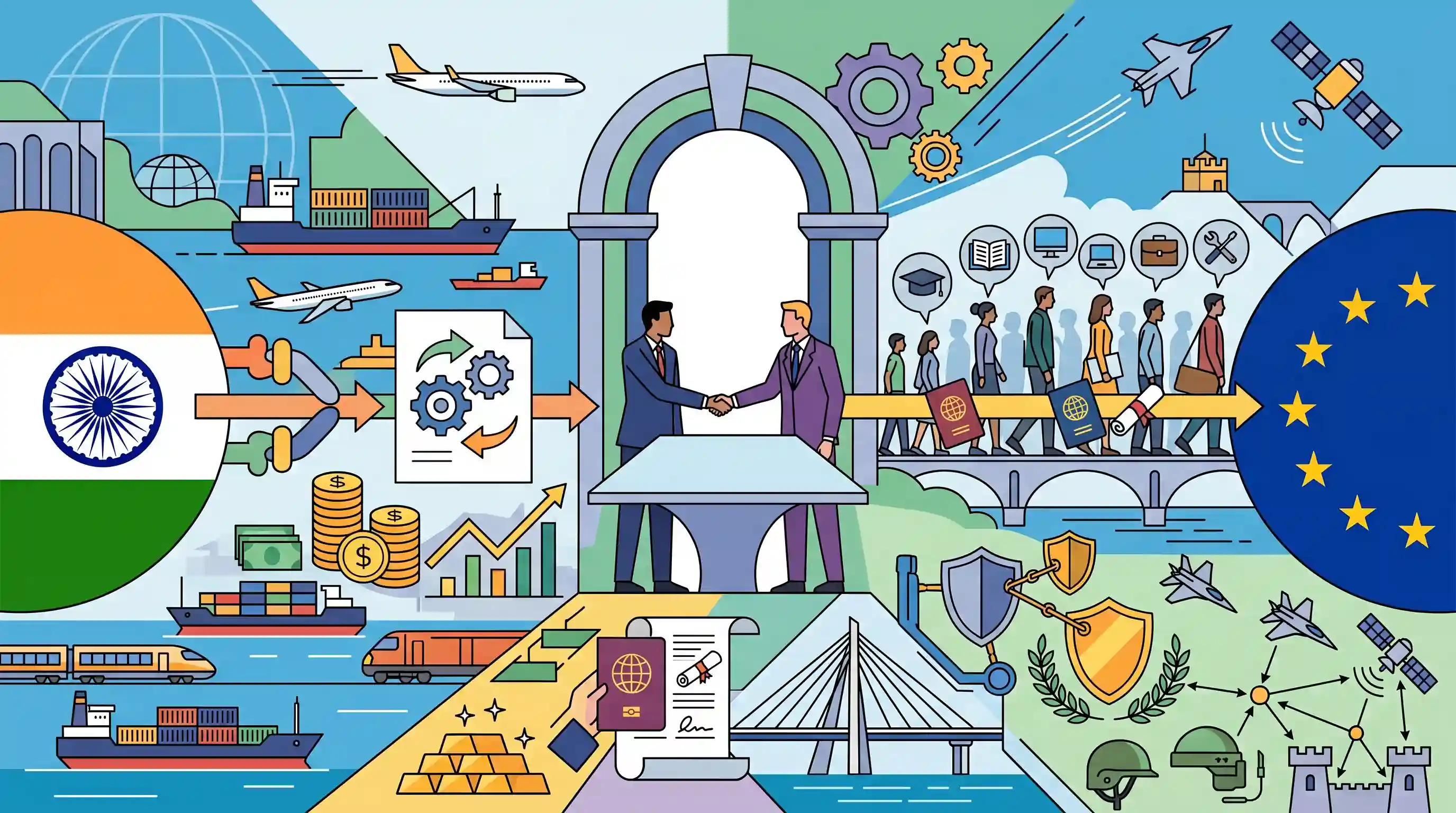
The upcoming India-European Union summit, scheduled for January 27, aims to reinvigorate the strategic partnership between the two regions. The high-level agenda focuses on advancing negotiations for the long-stalled Free Trade Agreement (FTA), formally known as the Broad-based Trade and Investment Agreement (BTIA). Additionally, the summit will address strengthening defence cooperation and finalizing mobility agreements to ease the migration of skilled professionals and students. This engagement reflects a mutual desire to build resilient supply chains, enhance bilateral trade, and align on broader geopolitical and security interests.
Key Points
- India and the European Union are scheduled to hold a summit on January 27 to deepen their strategic partnership.
- A major focus of the talks will be the resumption and advancement of the long-pending Free Trade Agreement (FTA), also known as the Broad-based Trade and Investment Agreement (BTIA).
- The agenda also prominently features enhanced defence cooperation and strategic ties amid shifting global geopolitics.
- Deals on migration and mobility are expected to be on the table to facilitate the legal movement of professionals, students, and skilled workers between India and the EU.
Important Terms
Broad-based Trade and Investment Agreement (BTIA)

The specific name for the proposed India-EU Free Trade Agreement, covering trade in goods, services, and investment to reduce tariffs and non-tariff barriers.
UPSC context
GS-II (Bilateral Relations) and GS-III (Economy); central to trade negotiations with India's third-largest trading partner.
Migration and Mobility Partnership Agreement (MMPA)
A framework designed to facilitate legal migration for students and professionals while establishing mechanisms to combat irregular migration and human trafficking.
UPSC context
GS-II (International Relations/Indian Diaspora); addresses skilled labor mobility and security concerns in Europe.
Free Trade Agreement (FTA)
A formal treaty between nations to eliminate or reduce trade barriers like tariffs and quotas, fostering economic integration and supply chain resilience.
UPSC context
GS-III (Economic Development); tests knowledge of trade architecture and India's shift toward strategic trade engagement.
Strategic Partnership
A high-level diplomatic framework (established 2004) that guides India-EU cooperation on security, climate change, and technology beyond simple commercial interests.
UPSC context
GS-II (Groupings and Agreements); tests understanding of multi-dimensional ties with global powers.
European Union (EU)
A political and economic union of 27 member states that acts as a single market and a major global regulatory power.
UPSC context
GS-II (International Organizations); vital for understanding global governance and India's Western outreach.
Prelims Trap
The BTIA is a newly proposed 2026 trade framework, and India's first Trade and Technology Council (TTC) is with the USA.
BTIA is not new; negotiations began in 2007. Also, India's first-ever TTC was formed with the EU, not the United States.
Static Concepts Connected
What is the Broad-based Trade and Investment Agreement (BTIA)?
- Bilateral FTA: A comprehensive free trade agreement being negotiated between India and the EU, covering goods, services, and cross-border investments.
- Historical context: Negotiations initially began in 2007 but stalled in 2013 over disputes regarding auto tariffs, data security, and visa access, before being formally relaunched.
What is the EU's Carbon Border Adjustment Mechanism (CBAM)?
- Carbon tax: An environmental tariff imposed on carbon-intensive imports (e.g., steel, aluminum, cement, fertilizers) entering the European Union.
- Core objective: Aims to prevent 'carbon leakage' by ensuring imported goods face the same carbon costs as goods produced within the EU under strict climate laws.
- Trade barrier: Acts as a significant non-tariff barrier for Indian exports. Developing nations argue it violates the UN principle of Common but Differentiated Responsibilities (CBDR).
Cross-Topic Patterns
Climate Policy vs. WTO Trade Equity
The EU's Carbon Border Adjustment Mechanism (CBAM) bridges environmental policy and trade barriers. Expect UPSC to link carbon taxation with the principle of Common but Differentiated Responsibilities (CBDR).
Demographic Dividend & Mobility Pacts
Mobility pacts like the MMPA act as the foreign policy tool for India to monetize its demographic dividend, providing skilled labor to offset Europe's rapidly aging workforce.
Tech Diplomacy & Supply Chains
The India-EU Trade and Technology Council (TTC) mirrors Quad working groups, signifying a shift in trade diplomacy from pure tariffs to semiconductor, AI, and supply chain security.

A 2026 prelims question will likely link BTIA, CBAM, and the TTC to test the modern complexities of the India-EU strategic partnership.
Linked PYQs · 1
Linked PYQs · 1
- 2017PrelimsGS1
'Broad-based Trade and Investment Agreement (BTIA)' is sometimes seen in the news in the context of negotiations held between India and
