European Defence Rearmament Offers Strategic Export Openings for India
Source:Indian Express ↗
Why It Matters
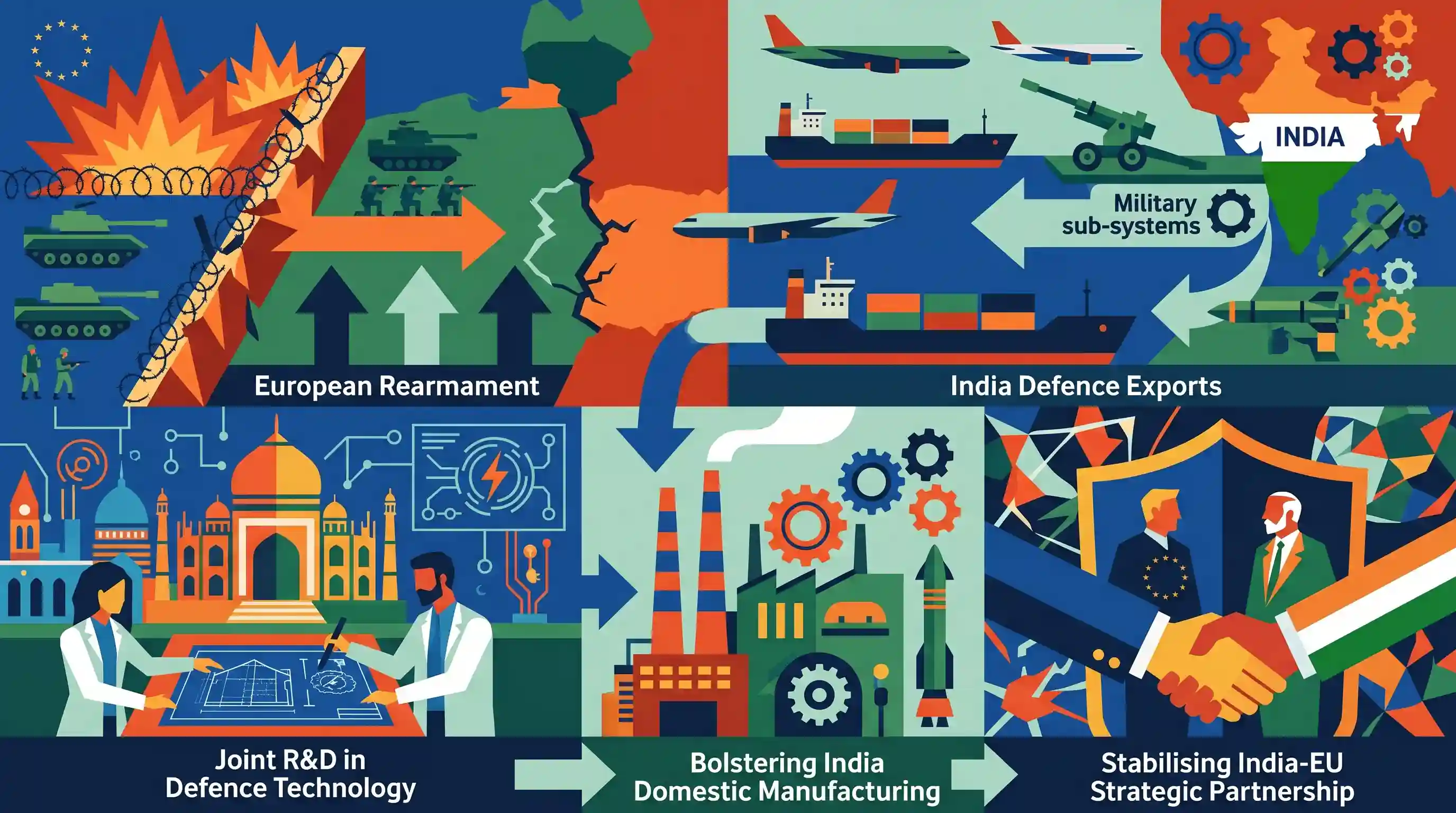
It illustrates how global geopolitical shifts—specifically Europe's security recalibration—offer India a dual opportunity to enhance its defence manufacturing exports and solidify strategic ties with a key global partner.
Summary
The ongoing rearmament of Europe, driven by the security imperatives following the Ukraine war, opens up strategic opportunities for India. As European nations seek to rapidly build up their military capabilities, India can leverage this demand to boost its defence exports, including artillery and critical sub-systems. Furthermore, the situation provides a platform for India and the European Union to collaborate on joint research and development in defence technology. Deepening these defence ties will not only bolster India's domestic manufacturing but also serve as a vital stabilising force in the overall India-EU strategic partnership during times of global uncertainty.
Key Points
- The geopolitical shifts caused by the Russia-Ukraine war have triggered a significant rearmament drive across Europe.
- This rearmament presents a critical opportunity for India to scale up its defence exports by supplying equipment and sub-systems to European nations.
- Beyond direct exports, India and the EU can mutually benefit from establishing joint research and development (R&D) initiatives for advanced defence technologies.
- Deepening defence cooperation will act as a stabilising force, reinforcing the broader India-EU strategic partnership amidst global turbulence.
Important Terms
European Union (EU)

A 27-nation political and economic union in Europe; India's largest trading partner and a key strategic partner in trade, technology, and climate.
UPSC context
GS Paper 2: Bilateral groupings and agreements affecting India's interests; critical for discussing trade (FTA) and strategic autonomy.
NATO
A military alliance of 32 North American and European countries committed to collective defense under Article 5 of the North Atlantic Treaty.
UPSC context
GS Paper 2: International relations and global security architecture; relevant for India's strategic balancing between the West and Russia.
Permanent Structured Cooperation (PESCO)
An EU treaty-based framework (2017) for member states to jointly develop defense capabilities, invest in shared projects, and enhance military readiness.
UPSC context
GS Paper 2 & 3: Defense industrial cooperation; tests knowledge of India's shift from military buyer to co-development partner.
European Defence Fund (EDF)
An EU initiative providing financial incentives for member states to foster defense research and development, from prototypes to joint procurement.
UPSC context
GS Paper 3: Science and Technology; relevant for India's aim to tap into European R&D for indigenous manufacturing.
European Defence Readiness Strategy (EDIS)
A 2024/2025 EU blueprint aiming for full defense readiness by 2030, targeting €800 billion in investment and 1.5% GDP defense expenditure.
UPSC context
GS Paper 3: Security and Defense Exports; provides context for the "Rearming of Europe" and Indian export opportunities.
India-EU Security and Defence Partnership
A formal 2026 agreement elevating India-EU ties to include operational intelligence sharing, maritime security, and joint defense manufacturing.
UPSC context
GS Paper 2: Current events of international importance; marks a shift from economic-only ties to hard-security collaboration.
Security of Information Agreement (SoIA)
A proposed legal framework between India and the EU to enable the secure exchange of classified intelligence and technical data.
UPSC context
GS Paper 2: Security; critical for deeper intelligence-sharing and high-tech defense co-production.
Prelims Trap
100% FDI in the defence sector is permitted under the automatic route to boost exports.
FDI up to 74% is allowed under the automatic route. Beyond 74% and up to 100% requires prior government approval, conditional on access to modern technology.
Static Concepts Connected
What are the FDI rules and targets for India's defence manufacturing?
- FDI Limits: 74% under automatic route; up to 100% via government route for access to modern/state-of-the-art technology.
- Export Target: The government has set an ambitious target of ₹50,000 crore ($5 billion) in defence exports by 2028-29.
- Policy Push: Facilitated by Positive Indigenisation Lists and dedicated Defence Industrial Corridors in Uttar Pradesh and Tamil Nadu.
What is the significance of the EU-India Trade and Technology Council (TTC)?
- Strategic Setup: India is only the second country after the US to establish a TTC with the EU.
- Core Mandate: Focuses on resolving trade frictions and collaborating on secure supply chains, AI, and dual-use technologies.
- Security Link: Acts as the technological backbone for advancing the broader EU-India Security and Defence Partnership.
Cross-Topic Patterns
Dual-use Tech & Wassenaar Arrangement
Supplying European nations links directly to India's Wassenaar Arrangement membership, which validates its export controls and enables seamless dual-use technology transfers to NATO states.
Private Sector & Indigenisation
The pivot to private sector dominance (45% of exports) illustrates the success of the iDEX initiative and liberalised FDI in bridging critical global supply chain gaps.

Expect a multi-statement Prelims 2026 question linking India's defence FDI limits, the EU-India TTC, and Wassenaar Arrangement compliance.
Linked PYQs · 2
Linked PYQs · 2
- 2023MainsGS2
‘The expansion and strengthening of NATO and a stronger US-Europe strategic partnership works well for India.’ What is your opinion about this statement ? Give reasons and examples to support your answer.
- 2014MainsGS3
Foreign Direct Investment (FDI) in the defence sector is now set to be liberalized. What influence this is expected to have on Indian defence and economy in the short and long run?
