Strategic Importance of India EU Free Trade Agreement
Source:Indian Express ↗
Why It Matters
India-EU relations and FTA negotiations are long-standing UPSC topics. The geopolitical angle (US protectionism acting as a catalyst for India-EU ties) directly addresses GS2 themes on the effect of policies of developed countries on India's interests.
Summary
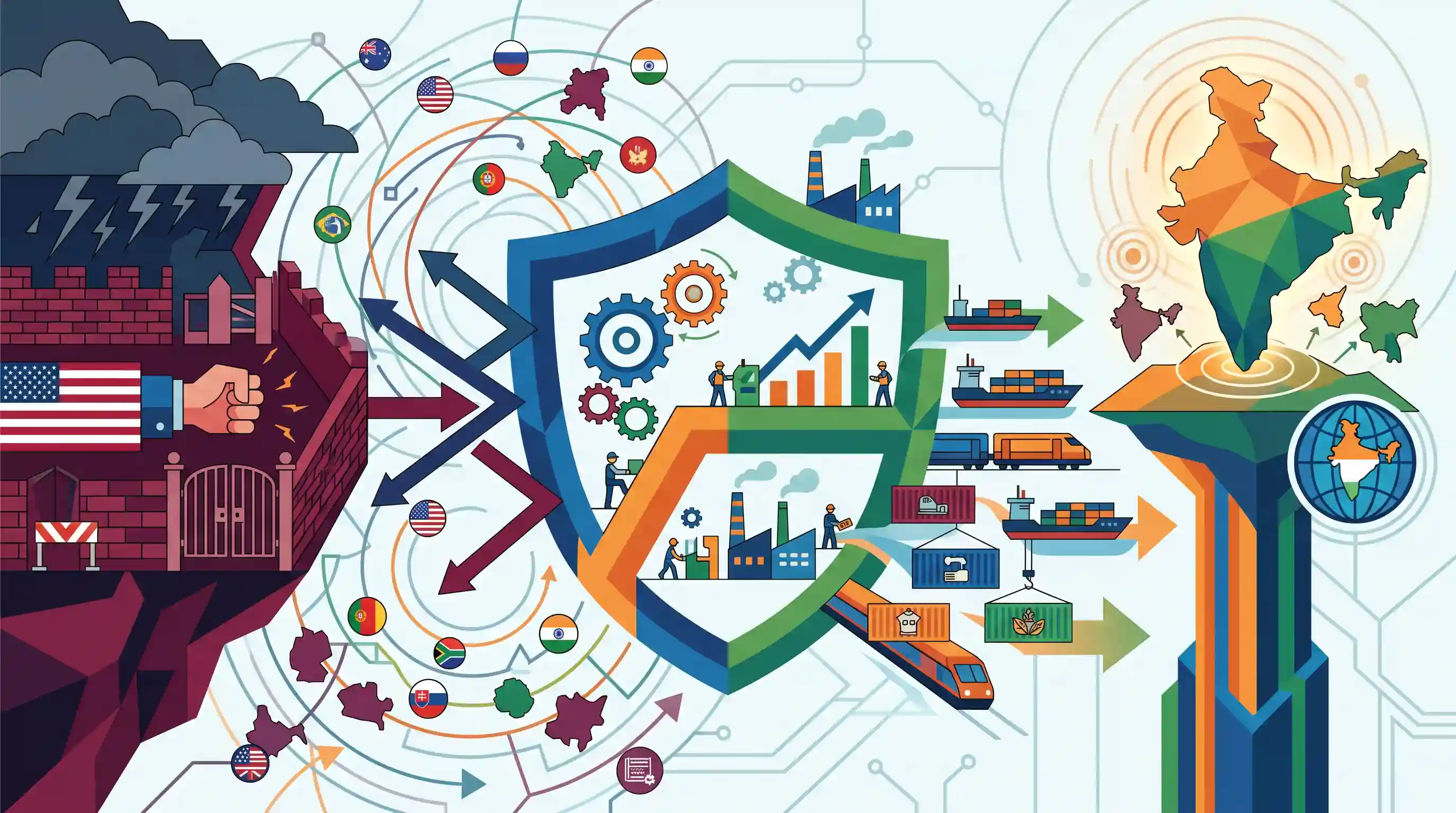
The article argues for the urgent finalization of the India-European Union Free Trade Agreement (FTA) amidst shifting global trade dynamics. With the specter of increased protectionism in the United States under Donald Trump, the author posits that an FTA with the EU is a strategic imperative for India. The agreement would not only shield India from global trade volatility but also strengthen its domestic economy by boosting exports and manufacturing. Furthermore, deepening economic ties with the EU would enhance India's regional stature and global geopolitical leverage, making it a critical pillar of its foreign economic policy.
Key Points
- Global Trade Uncertainties: A potential shift toward protectionism and 'America First' trade policies in the US under Donald Trump necessitates India finding stable and robust alternative markets.
- Strategic Importance of India-EU FTA: Finalizing the Free Trade Agreement with the European Union is critical for India to secure preferential access to one of the world's largest consumer markets.
- Domestic Economic Benefits: The FTA promises to strengthen India internally by boosting exports in labor-intensive sectors, increasing foreign direct investment (FDI), and driving job creation.
- Geopolitical Positioning: Strengthening trade ties with the EU enhances India's strategic autonomy and solidifies its role in global supply chain diversification strategies (like China+1), bolstering its regional and global influence.
Important Terms
Free Trade Agreement (FTA)

A pact between two or more nations to reduce or eliminate barriers to trade, such as tariffs and quotas, on goods and services.
UPSC context
GS Paper III (Economy) and GS Paper II (International Relations); critical for understanding India’s export growth and global integration.
Broad-based Trade and Investment Agreement (BTIA)
The specific name for the comprehensive trade agreement negotiated between India and the European Union since 2007, covering goods, services, and investment.
UPSC context
GS Paper II (Bilateral Agreements); a frequent topic in Prelims and Mains regarding India-EU economic diplomacy.
Protectionism
Economic policy of restricting imports through tariffs, quotas, or regulations to shield domestic industries from foreign competition.
UPSC context
GS Paper II; tests the impact of policies of developed countries (like the US 'America First' policy) on India's interests.
Carbon Border Adjustment Mechanism (CBAM)
An EU policy that imposes a carbon tax on carbon-intensive imports like steel and aluminum to ensure a level playing field for European manufacturers.
UPSC context
GS Paper III (Environment/Economy); a major non-tariff barrier and 'green protectionism' issue in recent trade negotiations.
Non-Tariff Barriers (NTBs)
Trade constraints not based on tariffs, such as quality standards, environmental regulations, or complex certification requirements (e.g., EUDR, CBAM).
UPSC context
GS Paper III; essential for analyzing why Indian exports face hurdles despite lower duties in advanced markets.
Strategic Autonomy
India's foreign policy objective to maintain independent decision-making and diversify partnerships to avoid over-dependence on any single global power.
UPSC context
GS Paper II (International Relations); evaluates India’s geopolitical positioning amidst the US-China rivalry and global trade volatility.
Prelims Trap
The India-EU FTA negotiations were initiated recently as part of India's post-COVID trade diversification strategy.
Negotiations for the India-EU Broad-based Trade and Investment Agreement (BTIA) actually began in 2007. They stalled in 2013 and were only relaunched in 2022.
Static Concepts Connected
What are the primary contentious issues historically stalling the India-EU BTIA?
- Tariff Reductions: The EU demands significant tariff reductions on European automobiles, dairy, and wines/spirits, which India protects.
- Sustainability Clauses: The EU insists on linking trade to strict labor, environment, and human rights standards, which India views as non-trade barriers.
- Data Security: The EU has historically not recognized India as a 'data secure' nation, hindering Indian IT and ITES service exports.
What is the 'China Plus One' strategy?
- Definition: A global business strategy where multinational companies diversify their manufacturing and supply chains outside of China.
- Key Drivers: Driven by the US-China trade war, COVID-19 supply chain shocks, and rising labor costs in China.
- India's Response: India uses initiatives like the PLI scheme and new FTAs to position itself as the primary alternative destination.
Cross-Topic Patterns
CBAM colliding with BTIA negotiations
The EU's Carbon Border Adjustment Mechanism (CBAM) acts as a de facto non-tariff barrier, making climate policy a central, contentious pillar of the BTIA trade negotiations.
High-tech PLIs vs. Labor-intensive FTAs
While India's domestic PLI schemes target high-tech sectors, securing FTAs with Western markets is heavily relied upon to revive traditional labor-intensive sectors like textiles and leather.

The interplay of US protectionism, EU's CBAM, and India's BTIA negotiations will likely feature as a GS3 Mains question on trade strategy.
Linked PYQs · 3
Linked PYQs · 3
- 2017PrelimsGS1
'Broad-based Trade and Investment Agreement (BTIA)' is sometimes seen in the news in the context of negotiations held between India and
- 2011MainsGS2
Compared to the South Asian Free Trade Area (SAFTA), the Bay of Bengal Initiative for Multisectoral Technical and Economic Cooperation Free Trade Area (BIMSTEC FTA) seems to be more promising." Critically evaluate.
- 2017PrelimsGS1
Consider the following statements: 1. India has ratified the Trade Facilitation Agreement (TFA) of WTO. 2. TFA is a part of WTO's Bali Ministerial Package of 2013. 3. TFA came into force in January 2016. Which of the statements given above is/are correct?
