India and European Union to sign trade pact in December
Source:The Hindu ↗
Why It Matters
Bilateral trade agreements like the India-EU FTA significantly influence India's export competitiveness, foreign direct investment inflows, and macroeconomic integration with developed economies, making it a crucial topic for GS Paper 3.
Summary
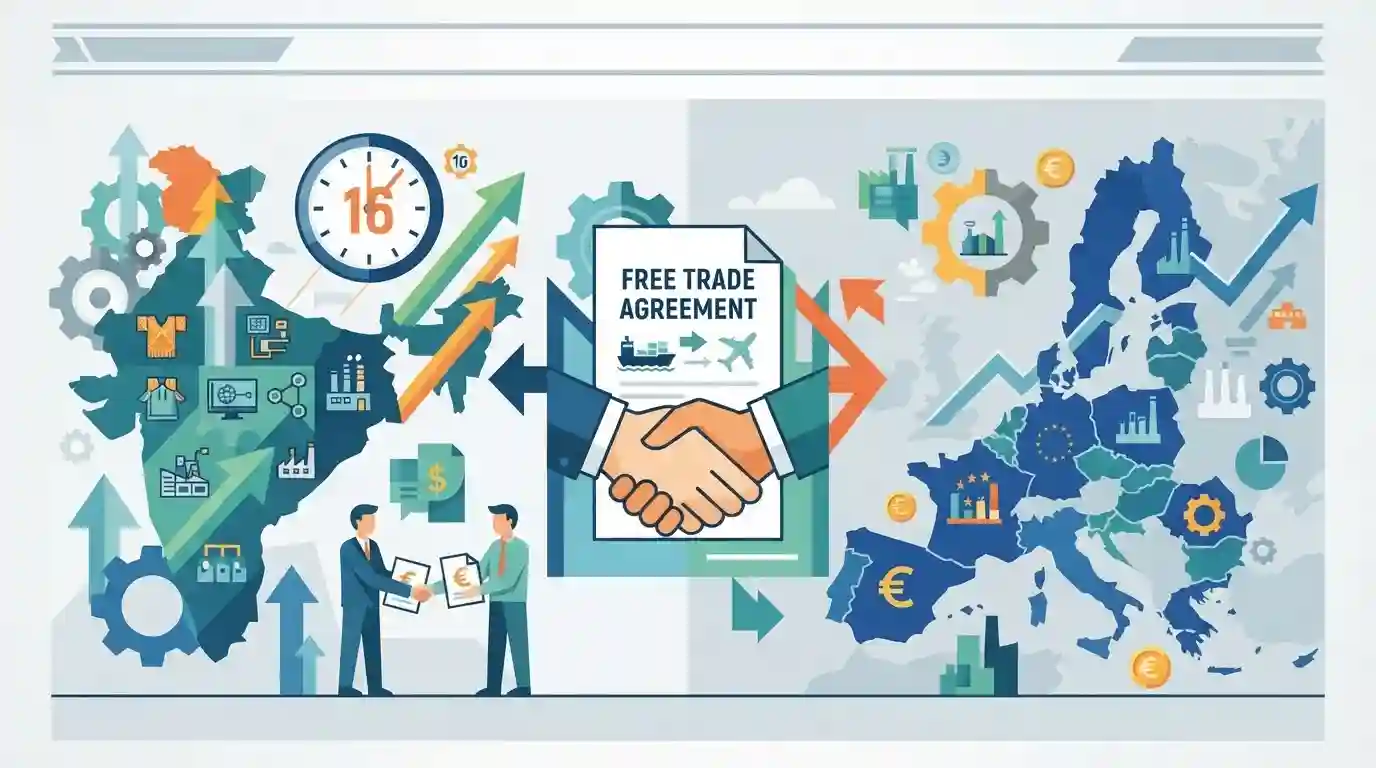
India and the European Union are set to sign a landmark Free Trade Agreement (FTA) on December 16, marking a significant milestone in bilateral economic cooperation, boosting market access, and strengthening strategic partnership amid global protectionist trends.
Key Points
- India and the European Union are scheduled to sign a comprehensive Free Trade Agreement (FTA) on December 16.
- The agreement aims to boost bilateral trade, enhance market access, and deepen economic and strategic ties between India and European nations.
- The pact addresses long-standing negotiations covering tariffs, services, investments, and regulatory standards.
Important Terms
India-EU Free Trade Agreement

A comprehensive bilateral trade pact between India and the European Union designed to eliminate or reduce customs duties, boost market access, and deepen strategic and economic cooperation.
UPSC context
UPSC Prelims/Mains (GS III): Important for international trade agreements, bilateral relations, and India's export competitiveness.
Free Trade Agreement (FTA)
An international treaty between two or more countries to reduce or eliminate barriers to trade in goods and services, such as tariffs and quotas.
UPSC context
UPSC Prelims/Mains (GS III): Essential for understanding globalization, trade policy, and export-led growth.
European Union
An economic and political union of 27 European member states that operates as a single market and a major trading block globally.
UPSC context
UPSC Prelims/Mains (GS II & III): Crucial for international relations, trade geopolitics, and regional economic groupings.
India-EU Free Trade Agreement Joint Committee
An institutional government-to-government body established under the FTA to oversee implementation, review trade provisions, and resolve bilateral trade disputes.
UPSC context
UPSC Prelims/Mains (GS III): Relevant for studying institutional mechanisms of trade pacts and bilateral economic governance.
Static Concepts Connected
What are the fundamental differences between an FTA, Customs Union, and Common Market?
- Free Trade Area: Eliminates or reduces tariffs between member countries while each member maintains independent external tariffs against non-members.
- Customs Union: An FTA plus a common external tariff applied to all non-member countries trading with the bloc.
- Common Market: A customs union that also allows free movement of labor and capital among member states.
Cross-Topic Patterns
India-EU FTA meets CBAM green tariffs
The India-EU FTA intersects with the EU's Carbon Border Adjustment Mechanism (CBAM), forcing Indian exporters to navigate stringent green tariffs alongside traditional market access gains.

India-EU FTA tariff concessions + EU's CBAM carbon tax compliance likely to be tested together in Prelims/Mains.
Linked PYQs · 2
Linked PYQs · 2
- 2025MainsGS3
What are the challenges before the Indian economy when the world is moving away from free trade and multilateralism to protectionism and bilateralism? How can these challenges be met?
- 2018MainsGS3
How would the recent phenomena of protectionism and currency manipulations in world trade affect macroeconomic stability of India?
