India and European Union Free Trade Agreement Roadmap
Source:The Hindu ↗
কেন এটি গুরুত্বপূর্ণ
The India-EU FTA is a major milestone in India's external trade strategy, impacting export competitiveness, market access, foreign investment inflows, and geopolitical economic alignments amid shifting global trade dynamics.
সারসংক্ষেপ
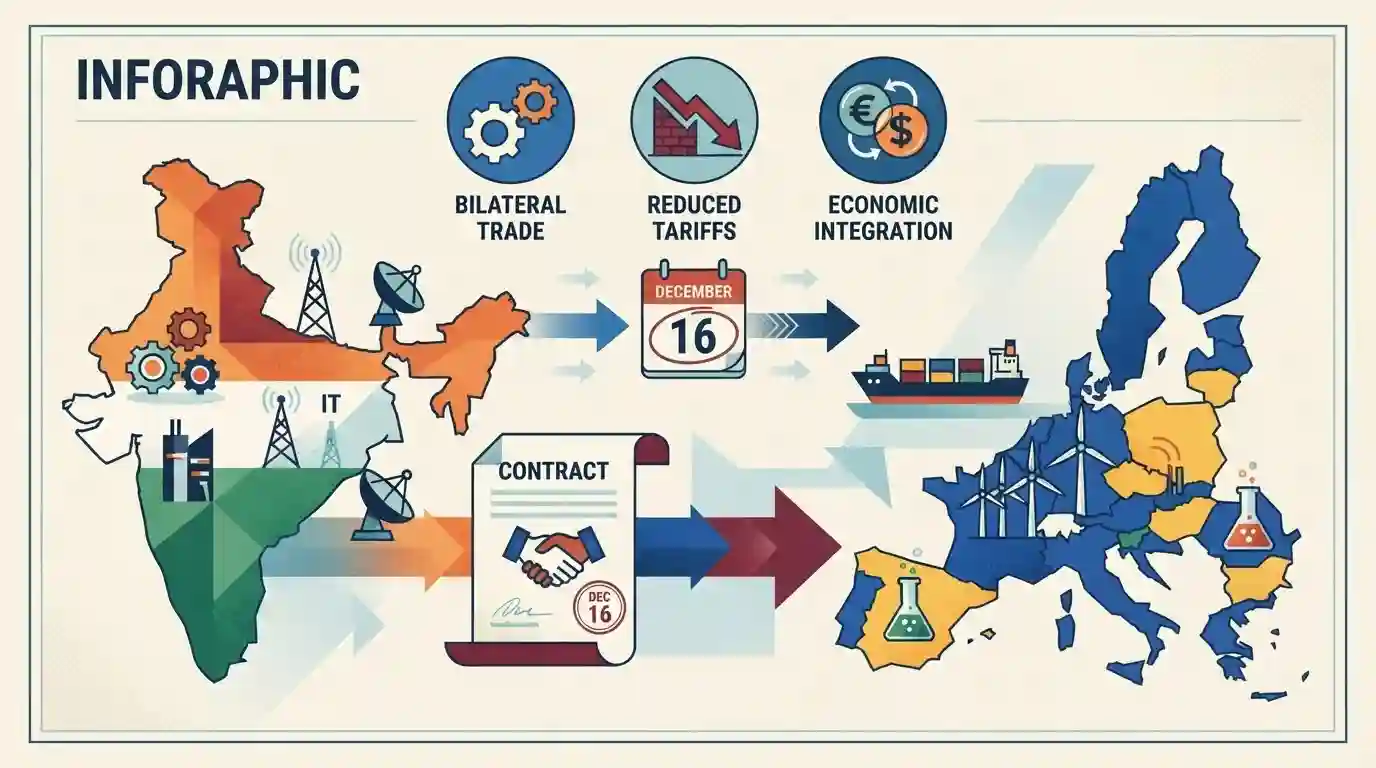
India and the European Union are set to sign a landmark Free Trade Agreement (FTA) on December 16, designed to enhance bilateral trade, reduce tariff and non-tariff barriers, and boost economic integration between the two economies.
মূল বিষয়
- India and the European Union are scheduled to sign a Free Trade Agreement (FTA) on December 16.
- The trade pact aims to boost bilateral commerce, investment flows, and economic cooperation between India and EU member nations.
- The agreement is expected to address key market access issues, reduction of tariffs, and enhanced regulatory cooperation.
গুরুত্বপূর্ণ শব্দ
India-EU Free Trade Agreement

A comprehensive trade pact between India and the European Union aimed at reducing tariff and non-tariff barriers, enhancing bilateral trade, and boosting economic integration across two major global economies.
UPSC context
UPSC GS Paper II & III: Important international groupings, bilateral agreements, and their impact on India's economy and foreign trade.
Free Trade Agreement (FTA)
An international treaty between two or more countries to reduce or eliminate import and export barriers, fostering deeper economic integration and market access.
UPSC context
UPSC GS Paper III: Effects of liberalization on the Indian economy, trade policy, and global competitiveness.
European Union
A politico-economic union of 27 European member states operating a single internal market and standardized system of laws, representing a major trading partner for India.
UPSC context
UPSC GS Paper II: Bilateral, regional, and global groupings and agreements involving India and/or affecting India's strategic and economic interests.
প্রিলিমস ফাঁদ
India signed a bilateral Free Trade Agreement with individual European Union member countries like Germany and France.
Aspirants often confuse FTAs with Customs Unions; the EU member states maintain a common commercial policy, allowing the European Commission to negotiate trade deals on behalf of all 27 nations.
সংযুক্ত স্থির ধারণা
What is the difference between a Free Trade Agreement (FTA), Customs Union, and Common Market?
- Free Trade Area: Eliminates tariffs and quotas among members; each country maintains its own independent external tariff against non-members (e.g., India-UAE CEPA).
- Customs Union: Combines an FTA with a common external tariff applied to all non-member countries, alongside a unified trade policy (e.g., EU Customs Union).
- Common Market: A customs union that additionally allows the free movement of labour and capital across member state borders, deepening economic integration.
আন্তঃবিষয় প্যাটার্ন
FTA Tariffs vs EU CBAM Rules
The India-EU FTA intersects with the EU's Carbon Border Adjustment Mechanism (CBAM), creating compliance challenges for Indian steel and aluminium exporters despite tariff concessions.
Bilateral FTAs and Strategic Autonomy
Stalled for over a decade, the India-EU FTA revival parallels India's broader post-pandemic pivot toward high-standard bilateral trade pacts with Western economies.

India-EU FTA tariff elimination timelines vs EU non-tariff barriers (like CBAM) is a prime candidate for an analytical mains question.
সংযুক্ত PYQ · 2
সংযুক্ত PYQ · 2
- 2025MainsGS3
What are the challenges before the Indian economy when the world is moving away from free trade and multilateralism to protectionism and bilateralism? How can these challenges be met?
- 2018MainsGS3
How would the recent phenomena of protectionism and currency manipulations in world trade affect macroeconomic stability of India?
