India EU Free Trade Agreement negotiations and market access
Source:The Hindu ↗
Why It Matters
The India-EU FTA (historically negotiated as the BTIA) is one of India's most significant ongoing trade negotiations. It is crucial for UPSC aspirants to track its progress as it intersects both GS-II (International Relations) and GS-III (Economy), specifically addressing India's strategy to boost labour-intensive exports and integrate into global value chains.
Summary
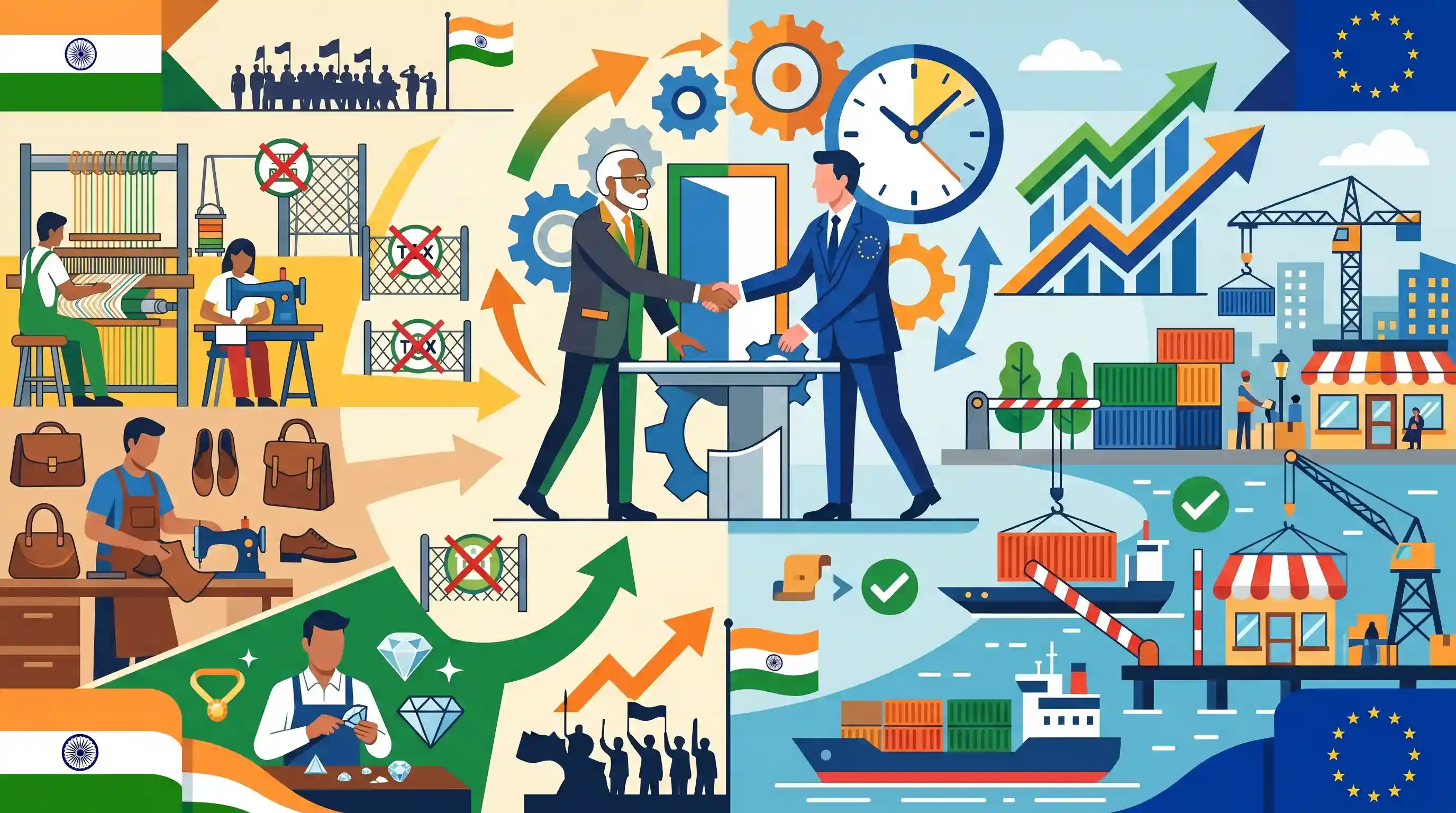
Commerce and Industry Minister Piyush Goyal is scheduled to visit Brussels to give a 'decisive push' to the long-pending India-EU Free Trade Agreement (FTA) negotiations. This high-level engagement comes ahead of India's Republic Day, where top EU leaders are expected to be the chief guests. A major priority for India in these talks is securing zero-duty access to the European market for its vital labour-intensive sectors, such as textiles, apparel, leather, and gems, to boost domestic manufacturing and exports.
Key Points
- Commerce and Industry Minister Piyush Goyal is visiting Brussels to accelerate the conclusion of the India-EU Free Trade Agreement (FTA).
- The diplomatic push precedes the potential visit of EU Commission President Ursula von der Leyen and EU Council President Antonio Costa as chief guests for India's Republic Day.
- India's core demand in the negotiations is securing zero-duty market access for its labour-intensive sectors, including textiles, leather, apparel, and gems.
- The FTA aims to deepen bilateral economic ties, reduce trade barriers, and boost India's manufacturing exports to the European market.
Important Terms
India-EU Free Trade Agreement (FTA)

A comprehensive pact aimed at eliminating tariffs and non-tariff barriers to boost trade in goods and services between India and the 27-member EU bloc.
UPSC context
GS Paper II & III: Tests India's trade diplomacy, export promotion strategies, and efforts to diversify global supply chains.
European Union (EU)
A political and economic union of 27 European countries that operates as a single market and unified trade negotiator on the global stage.
UPSC context
GS Paper II: Relevant to 'Regional and Global Groupings'; tests understanding of India's second-largest trading partner.
European Commission
The executive branch of the EU responsible for proposing laws and conducting international trade negotiations on behalf of the entire union.
UPSC context
GS Paper II: Tests knowledge of supranational decision-making processes in international trade and governance.
European Council
An EU institution consisting of the heads of state or government of member countries that defines the union's overall political direction.
UPSC context
GS Paper II: Crucial for identifying where political impetus for strategic partnerships originates within the EU.
Carbon Border Adjustment Mechanism (CBAM)
An EU-proposed carbon tax on imports of carbon-intensive goods (like steel and cement) intended to prevent carbon leakage and promote cleaner production.
UPSC context
GS Paper III: Tests knowledge of green protectionism and its impact on India's industrial manufacturing and exports.
Trade and Technology Council (TTC)
A strategic bilateral forum launched in 2023 to deepen coordination between India and the EU on trade, trusted technology, and security.
UPSC context
GS Paper II: Highlights the evolution of strategic ties beyond traditional trade to include tech-security cooperation.
Prelims Trap
"The India-EU Free Trade Agreement includes a binding $100 billion foreign investment commitment."
Conflates the EU with EFTA. The India-EFTA TEPA has a binding $100B investment target, whereas the India-EU FTA lacks such binding FDI commitments.
Static Concepts Connected
What is the Generalised Scheme of Preferences (GSP) in international trade?
- Preferential access: A preferential tariff system where developed countries grant reduced or zero tariffs to imports from eligible developing nations.
- Non-reciprocal basis: Unlike Free Trade Agreements, the developing country does not have to lower its own tariffs in return.
- WTO exemption: It acts as a legal exception to the WTO's Most-Favored-Nation (MFN) principle under the "Enabling Clause".
How does the European Union (EU) differ from EFTA?
- European Union (EU): A political and economic union of 27 member states that operate a single internal market and customs union.
- EFTA: An intergovernmental organization of four non-EU states (Iceland, Liechtenstein, Norway, Switzerland) that participate in the European single market but retain independent trade policies.
- India's trade stance: India signed the TEPA with EFTA in 2024, but is still negotiating a broader FTA with the 27-member EU bloc.
Cross-Topic Patterns
FTAs navigating Climate Protectionism (CBAM)
The India-EU FTA negotiations specifically address the EU's Carbon Border Adjustment Mechanism (CBAM), setting a critical precedent for how developing nations handle unilateral "green" trade barriers alongside free trade pacts.
Republic Day signaling Geoeconomics
Inviting top EU leaders as Republic Day chief guests aligns India's highest diplomatic platforms directly with pending geoeconomic objectives, reflecting a shift from pure strategic to trade-heavy diplomatic signaling.

Expect a comparative Prelims question differentiating the India-EFTA TEPA and India-EU FTA, particularly regarding investment targets.
Linked PYQs · 2
Linked PYQs · 2
- 2017PrelimsGS1
'Broad-based Trade and Investment Agreement (BTIA)' is sometimes seen in the news in the context of negotiations held between India and
- 2017MainsGS3
Account for the failure of manufacturing sector in achieving the goal of labour-intensive exports. Suggest measures for more labour-intensive rather than capital-intensive exports.
