India and European Union Free Trade Agreement Negotiations
Source:Indian Express ↗
Why It Matters
The EU is one of India's largest trading partners. Securing an FTA is critical for boosting exports, attracting FDI, and setting a precedent for how India navigates new-age, non-tariff barriers linked to climate and labor standards in future trade agreements.
Summary
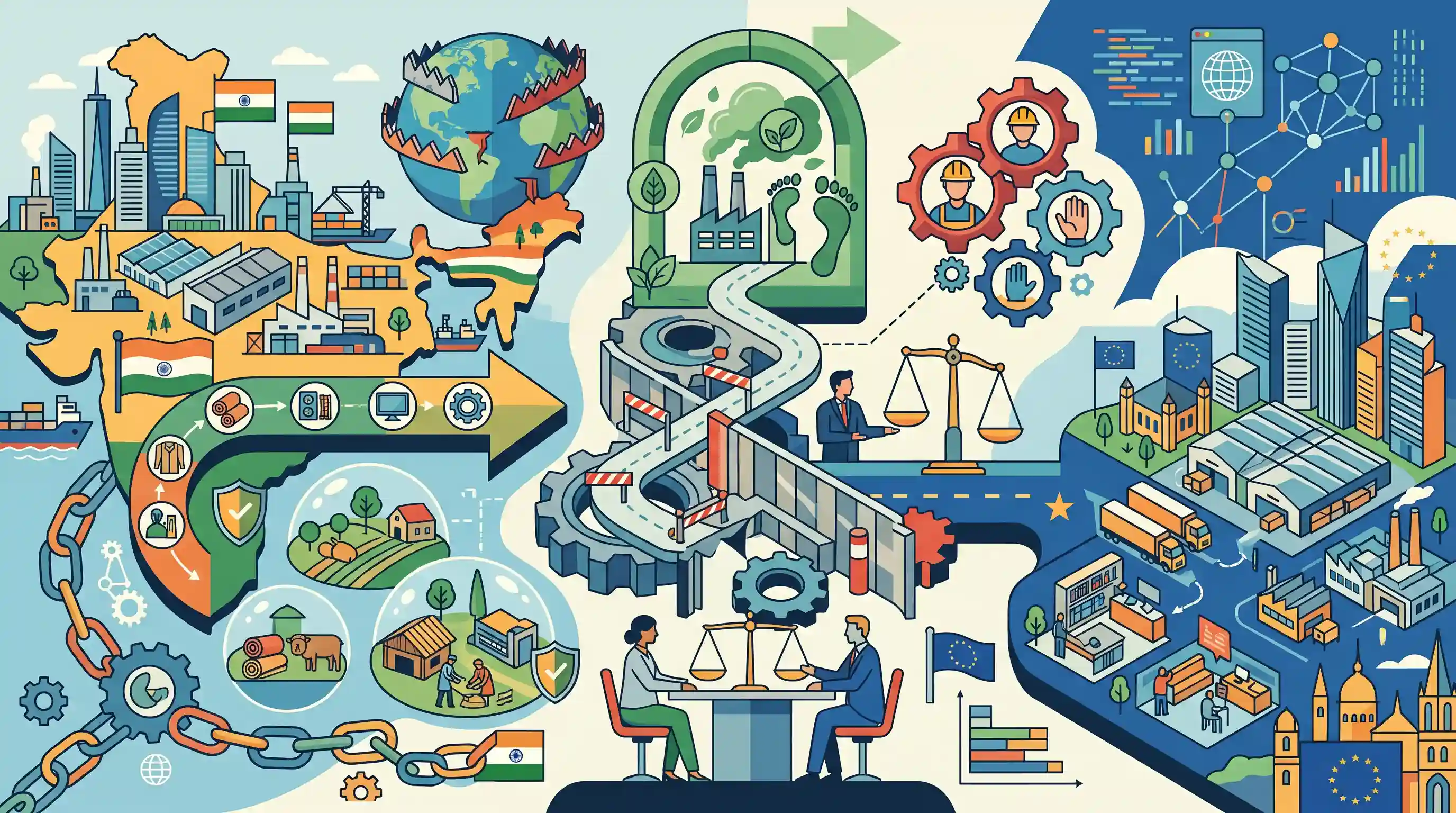
The article examines the complexities and strategic imperatives of the ongoing India-EU Free Trade Agreement negotiations. It highlights the 'how-tos' and 'how-not-tos' of trade diplomacy, stressing that while the EU offers a massive market for Indian exports, its stringent regulatory landscape—including environmental mechanisms like CBAM and labor standards—poses significant hurdles. The piece advises a pragmatic approach, suggesting that India must skillfully balance protecting sensitive domestic sectors with pursuing broader market access and integration into global value chains amid rising global protectionism.
Key Points
- The India-EU FTA negotiations (historically termed BTIA) represent a strategic opportunity to deepen economic integration and capitalize on supply chain diversification strategies like China-Plus-One.
- Developing countries face challenges in negotiating FTAs with developed regions like the EU due to the inclusion of non-trade issues, such as environmental regulations (e.g., CBAM) and labor standards, which can act as non-tariff barriers.
- India must strategically balance defensive domestic interests in sectors like dairy and automobiles with offensive interests seeking greater market access for goods and service professionals (Mode 4).
- The article underscores the need for pragmatic negotiations, avoiding past rigidities that stalled the BTIA in 2013, to successfully conclude agreements amidst rising global protectionism.
Important Terms
Broad-based Trade and Investment Agreement (BTIA)

A comprehensive trade agreement between India and the EU covering goods, services, and investment; negotiations were relaunched in 2022 to modernize bilateral economic ties.
UPSC context
GS Paper II (International Relations); tests understanding of bilateral groupings and trade diplomacy between India and major blocs.
Carbon Border Adjustment Mechanism (CBAM)
An EU environmental policy levying a carbon tax on imported carbon-intensive goods (like steel and aluminum) to ensure they face the same carbon costs as EU-made products.
UPSC context
GS Paper III (Economy/Environment); crucial for questions on trade barriers, climate-linked trade policies, and impacts on Indian exports.
Free Trade Agreement (FTA)
A formal pact between nations to reduce or eliminate tariffs and non-tariff barriers, facilitating the free flow of goods and services while protecting domestic interests.
UPSC context
GS Paper III (Indian Economy); tests knowledge of trade liberalisation, market access, and strategic economic integration.
Global Value Chains (GVCs)
The international fragmentation of production where different stages of a product's lifecycle (design, assembly, marketing) are spread across multiple countries to maximize efficiency.
UPSC context
GS Paper III (Economy); relevant for topics on manufacturing, the 'Make in India' initiative, and global trade resilience.
Carbon Leakage
The phenomenon where businesses relocate production to countries with laxer emission constraints to avoid carbon costs, which mechanisms like CBAM aim to prevent.
UPSC context
GS Paper III (Environment/Economy); tests the logic behind international environmental regulations and their intersection with global trade.
Rules of Origin (RoO)
Criteria used to determine the national source of a product, ensuring that FTA benefits apply only to goods produced within member countries and preventing 'trade diversion'.
UPSC context
GS Paper III (Economy); a technical aspect of trade agreements often tested regarding trade transparency and domestic protection.
Prelims Trap
The Carbon Border Adjustment Mechanism (CBAM) is a multilateral climate agreement negotiated under the UNFCCC.
CBAM is a unilateral European Union regulation to tax carbon-intensive imports, not a multilateral UN/UNFCCC framework. UPSC often swaps unilateral policies with global treaties.
Static Concepts Connected
What are the four modes of services supply under WTO's GATS?
- Mode 1 (Cross-border): Services supplied from one country to another (e.g., telemedicine, software services).
- Mode 2 (Consumption abroad): Consumers traveling to another country to use a service (e.g., tourism, studying abroad).
- Mode 3 (Commercial presence): A company setting up a foreign branch or subsidiary (e.g., foreign banks operating in India).
- Mode 4 (Natural persons): Individuals traveling temporarily to another country to provide services (e.g., Indian IT professionals in the EU).
What are the common types of Non-Tariff Barriers (NTBs)?
- Sanitary & Phytosanitary (SPS): Measures taken to protect human, animal, or plant life/health (e.g., strict chemical residue limits on Indian mangoes).
- Technical Barriers (TBT): Technical regulations, testing, and certification procedures that make exporting cumbersome.
- Quotas and Licensing: Limits on the volume or value of goods that can be imported.
- Environmental & Labor Standards: Imposing strict ecological or worker-rights criteria that developing countries struggle to meet (e.g., CBAM).
Cross-Topic Patterns
Climate Policies as Non-Tariff Barriers
The EU's CBAM bridges 'Environment' and 'Economy', illustrating how unilateral climate mitigation policies of developed nations act as de facto non-tariff barriers, impacting India's steel and aluminum exports.
Geopolitics of Supply Chain Resilience
FTAs are increasingly geopolitical tools for de-risking. The India-EU FTA aligns with the broader push for secure supply chains alongside initiatives like the Quad, IPEF, and the China-Plus-One strategy.

A 2026 prelims question will likely mix EU's CBAM with WTO's GATS Mode 4 to test your grasp on modern non-tariff trade barriers.
Linked PYQs · 2
Linked PYQs · 2
- 2017PrelimsGS1
'Broad-based Trade and Investment Agreement (BTIA)' is sometimes seen in the news in the context of negotiations held between India and
- 2025MainsGS3
What are the challenges before the Indian economy when the world is moving away from free trade and multilateralism to protectionism and bilateralism? How can these challenges be met?
