India EU Free Trade Agreement Negotiations and Non Tariff Barriers
Source:The Hindu ↗
Why It Matters
The India-EU FTA represents a cornerstone of India's contemporary economic diplomacy. For UPSC aspirants, understanding the bottlenecks in these negotiations—particularly the use of environmental standards like CBAM and EUDR as non-tariff trade barriers—is crucial. These issues overlap significantly with GS-II (Bilateral and Regional Agreements) and GS-III (Economy, Trade Dynamics, and Climate Change).
Summary
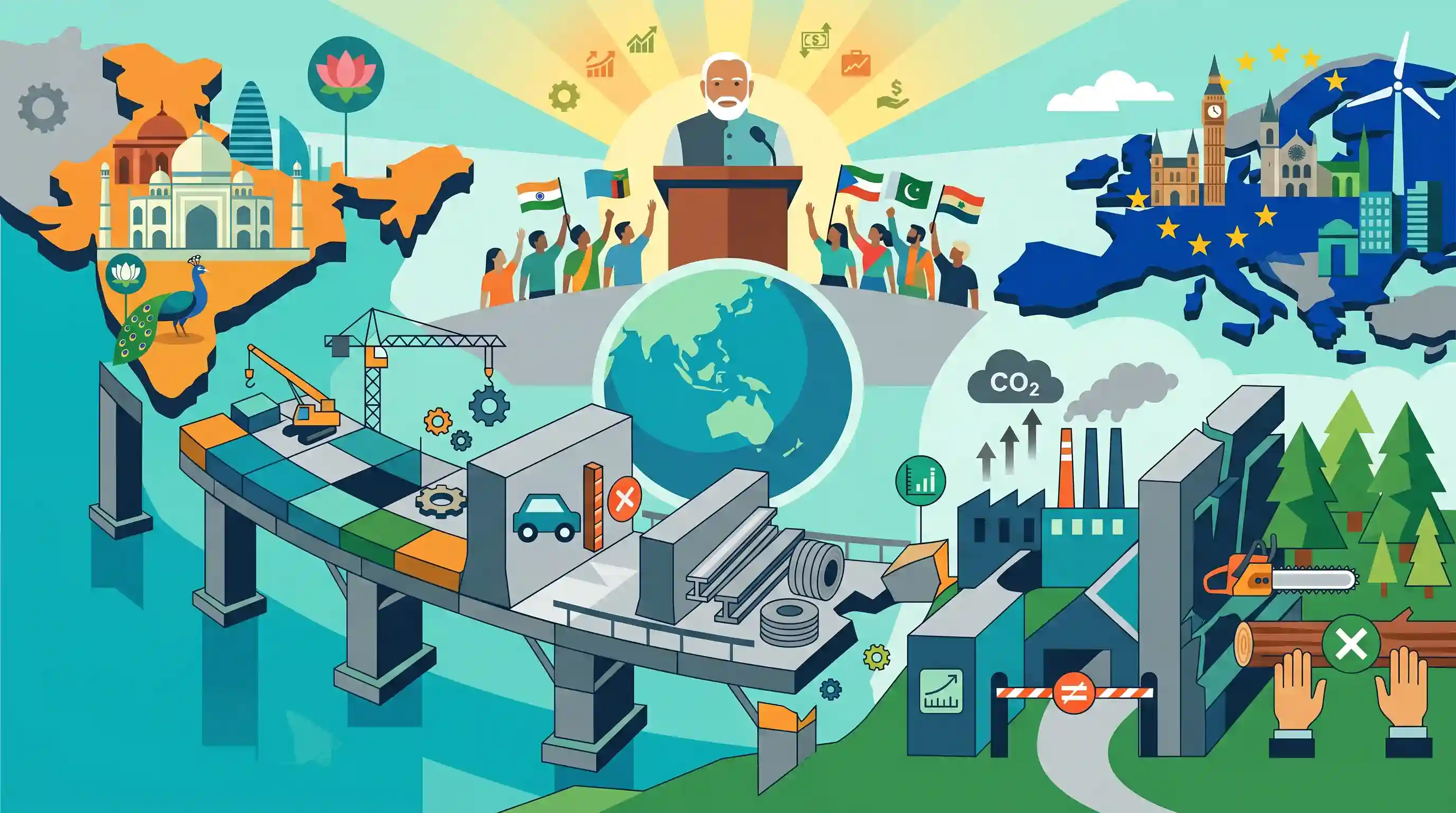
India and the European Union have made notable progress in their Free Trade Agreement (FTA) negotiations, successfully concluding 10 of the 20 chapters and reaching a broad consensus on several others. However, significant challenges remain, primarily driven by sensitive trade issues in the steel and automotive sectors, along with the EU's introduction of new non-tariff barriers such as the Carbon Border Adjustment Mechanism (CBAM) and the Deforestation Regulation (EUDR). Commerce Minister Piyush Goyal emphasized that finalizing a high-quality, mutually beneficial deal is the priority, rather than adhering strictly to predetermined deadlines. Meanwhile, India continues to assert its leadership on the global stage, championing the interests of developing nations as the 'Voice of the Global South' at UNCTAD.
Key Points
- India and the EU have successfully concluded 10 out of 20 chapters in their Free Trade Agreement (FTA) negotiations, with 4-5 more broadly decided.
- Key unresolved issues stem from trade sensitivities in the steel and auto sectors, as well as new EU regulations acting as non-tariff barriers, specifically CBAM and EUDR.
- Indian and EU leadership have prioritized securing a 'good deal' over rushing to finalize the agreement by a set deadline.
- Commerce Minister Piyush Goyal utilized his diplomatic trip to project India as the 'Voice of the Global South' at UNCTAD, while concurrently pursuing FTA talks with New Zealand.
Important Terms
India-EU Free Trade Agreement (FTA)

A proposed comprehensive trade pact to liberalize goods and services. Currently, 10 of 20 chapters are concluded, though sensitive sectors like steel, automobiles, and carbon regulations remain under discussion.
UPSC context
GS Paper 2: Bilateral Agreements. Tests understanding of trade diplomacy, market access, and hurdles in high-quality trade deals.
Carbon Border Adjustment Mechanism (CBAM)
An EU policy placing a carbon price on carbon-intensive imports (like steel and aluminum) to match costs paid by EU domestic producers under their emissions trading system.
UPSC context
GS Paper 3: Environment and Economy. Tests knowledge of 'carbon leakage' and climate-linked trade barriers.
EU Deforestation Regulation (EUDR)
An EU regulation requiring companies to prove that products like coffee, rubber, and leather were not produced on land deforested after December 2020.
UPSC context
GS Paper 3: Environment. Impacts Indian agricultural exports; tests awareness of international environmental standards as trade barriers.
UNCTAD
A United Nations body focused on trade, investment, and development issues to integrate developing countries into the global economy on an equitable basis.
UPSC context
GS Paper 2: International Institutions. Relevant for India's advocacy for developing nations and global trade reform.
Global South
Nations in Africa, Asia, and Latin America characterized by shared histories of colonialism and ongoing development challenges, often seeking a greater voice in global governance.
UPSC context
GS Paper 2: International Relations. Central to India’s 'strategic autonomy' and leadership as a 'Vishwa Bandhu' (friend to the world).
Non-Tariff Barriers (NTB)
Trade restrictions such as technical standards, regulations, or quotas that limit imports without using traditional taxes, often criticized as forms of protectionism.
UPSC context
GS Paper 3: Indian Economy. Key topic for understanding modern trade disputes and the complexity of global supply chains.
Prelims Trap
"CBAM and EUDR are environmental guidelines mandated by the WTO to reduce global carbon leakage."
CBAM and EUDR are unilateral domestic regulations of the European Union, not multilateral WTO mandates. This distinction is central to India's opposition.
Static Concepts Connected
What are Non-Tariff Barriers (NTBs) in international trade?
- Definition: Trade restrictions that do not take the form of traditional import duties, such as quotas, embargoes, or strict regulatory standards.
- WTO Framework: The WTO allows Sanitary and Phytosanitary (SPS) and Technical Barriers to Trade (TBT) measures provided they are non-discriminatory and scientifically justified.
- New Age NTBs: Unilateral environmental laws like the EUDR and CBAM act as de facto NTBs, imposing heavy compliance costs on developing nations' exports.
What is UNCTAD and what is its role in global trade?
- Establishment: The United Nations Conference on Trade and Development is a permanent intergovernmental body established by the UN General Assembly in 1964.
- Core Mandate: It promotes the integration of developing countries into the world economy, focusing on trade, investment, and sustainable development.
- Key Publications: It publishes authoritative data, including the annual Trade and Development Report and the World Investment Report.
Cross-Topic Patterns
Green Protectionism vs. WTO Rules
EU's CBAM and EUDR illustrate how domestic climate regulations are acting as non-tariff barriers, sparking intense debates on 'green protectionism' under WTO frameworks.
Global South Diplomacy at UNCTAD
India’s pushback against unilateral Western trade measures at UNCTAD aligns perfectly with its recent G20 Presidency mandate to champion developing-nation interests.

Expect a 2026 multi-statement question linking CBAM's WTO-compatibility with EUDR's impact on India's agri-exports.
Linked PYQs · 3
Linked PYQs · 3
- 2014MainsGS2
The aim of Information Technology Agreements (ITAs) is to lower all taxes and tariffs on information technology products by signatories to zero. What impact would such agreements have on India's interests?
- 2011MainsGS2
Compared to the South Asian Free Trade Area (SAFTA), the Bay of Bengal Initiative for Multisectoral Technical and Economic Cooperation Free Trade Area (BIMSTEC FTA) seems to be more promising." Critically evaluate.
- 2018PrelimsGS1
Consider the following countries: 1. Australia 2. Canada 3. China 4. India 5. Japan 6. USA Which of the above are among the 'free-trade partners' of ASEAN?
