European Commission Advances India EU Free Trade Agreement Tariff Cuts
Source:Indian Express ↗
Why It Matters
The India-EU Free Trade Agreement is a crucial pillar of India's external economic strategy. Understanding the tariff elimination frameworks, market access expansion, and strategic geopolitical alignments helps aspirants analyze modern trade dynamics, protectionism vs. free trade, and India's export growth targets.
Summary
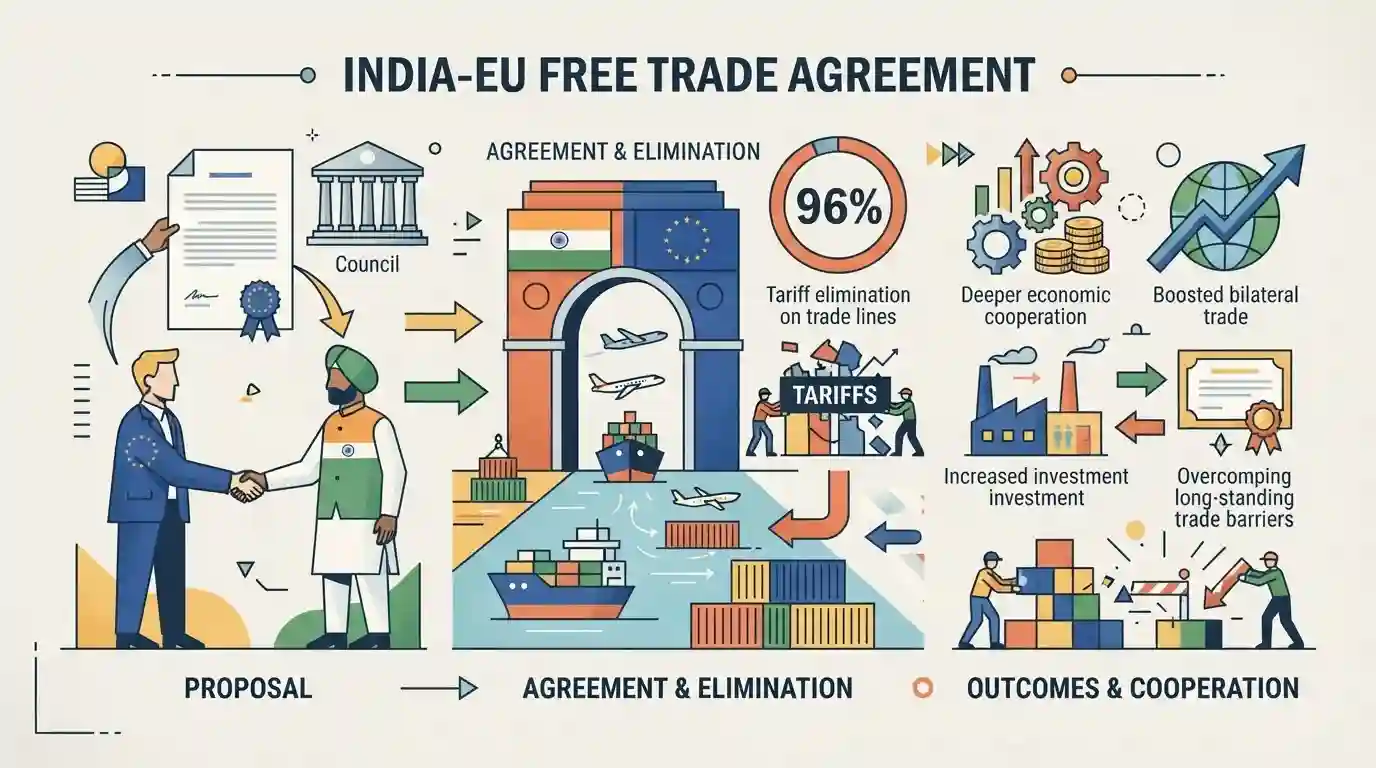
The European Commission has taken a significant step forward by proposing Council approval for the India-EU Free Trade Agreement, which targets the elimination of tariffs on 96% of trade lines. This pact aims to deepen economic cooperation, boost bilateral trade and investment, and overcome long-standing trade barriers between India and the European Union.
Key Points
- The European Commission has proposed council approval for the India-EU Free Trade Agreement (FTA).
- The proposed agreement aims to eliminate tariffs on 96% of trade lines, significantly boosting market access for Indian goods in the European Union.
- This development marks a major milestone in bilateral economic diplomacy, fostering deeper integration between two of the world's largest democratic markets.
- It addresses long-standing negotiations on trade, services, and investment barriers, aligning with global trends toward strategic bilateralism.
Important Terms
India-EU Free Trade Agreement

A landmark economic agreement between India and the European Union aimed at eliminating tariffs on the vast majority of bilateral trade lines to boost economic cooperation, investment, and market access.
UPSC context
Important for GS Paper II (International Relations) and GS Paper III (Economy - International Trade, Bilateral Groupings).
Broad-based Trade and Investment Agreement (BTIA)
The overarching framework of negotiations initiated between India and the European Union in 2007 to cover comprehensive trade in goods, services, investment, and related regulatory issues.
UPSC context
Important for GS Paper II (Bilateral Relations with the EU) and GS Paper III (Global Trade Agreements).
European Commission
The politically independent executive arm of the European Union responsible for proposing legislation, implementing decisions, upholding EU treaties, and conducting trade negotiations on behalf of member states.
UPSC context
Important for GS Paper II (International Institutions, Groupings & Agreements) and IR syllabus.
European Union Council
The institution of the European Union comprising government ministers from each member state, which defines the general political direction and priorities of the EU and approves international trade agreements.
UPSC context
Important for GS Paper II (Global Groupings and Governance structures).
European Union (EU)
A unique economic and political union of 27 European countries that form a single market and customs union, acting as one of India's largest and most crucial trading partners.
UPSC context
Important for GS Paper II (International Relations, Regional Groupings) and GS Paper III (Global Economy).
Prelims Trap
eliminates all tariffs across all sectors immediately with zero exemptions
Aspirants often assume FTAs automatically eliminate 100% of tariffs instantly; however, trade agreements typically feature phased reductions, sensitive lists, and exceptions (here, targeting 96-99% rather than totality).
Static Concepts Connected
What are the major forms of Economic Integration in international trade?
- Free Trade Area: Free Trade Area: Elimination of internal tariffs among member nations, but each country maintains independent external trade policies against non-members (e.g., NAFTA/USMCA).
- Customs Union: Customs Union: Free trade area characteristics plus a common external tariff applied to all non-member countries (e.g., EU Customs Union).
- Common Market: Common Market: Customs union features plus the free movement of factors of production such as labor and capital among member states.
- Economic Union: Economic Union: Common market integration plus harmonization of macroeconomic and monetary policies (e.g., Eurozone).
Cross-Topic Patterns
Free Trade Agreements vs. EU Non-Tariff Barriers
India-EU trade negotiations often intersect with non-trade concerns like the Carbon Border Adjustment Mechanism (CBAM) and strict EU labor/environmental standards, posing compliance challenges for Indian MSMEs.
Strategic Bilateralism and Changing Regional Architecture
The modern push for plurilateral and bilateral economic pacts runs parallel to India's recalibration of its footprint in regional blocs like RCEP or Indo-Pacific economic frameworks.

India-EU FTA tariff elimination scope + CBAM interplay likely to appear in Mains GS-2/GS-3 as a comparative economic diplomacy question.
Linked PYQs · 2
Linked PYQs · 2
- 2025MainsGS3
What are the challenges before the Indian economy when the world is moving away from free trade and multilateralism to protectionism and bilateralism? How can these challenges be met?
- 2017PrelimsGS1
'Broad-based Trade and Investment Agreement (BTIA)' is sometimes seen in the news in the context of negotiations held between India and
