Strategic Imperatives of India EU Digital Technology Partnership
Source:Indian Express ↗
Why It Matters
The intersection of geopolitics and technology is a rapidly growing area in the UPSC syllabus. The India-EU Trade and Technology Council represents a major shift in India's tech diplomacy, making it highly relevant for Mains GS2 (Bilateral Relations) and GS3 (Science & Tech, Cyber Security, AI regulation). Questions on data privacy frameworks (like GDPR vs DPDP) and international technology agreements are highly probable.
Summary
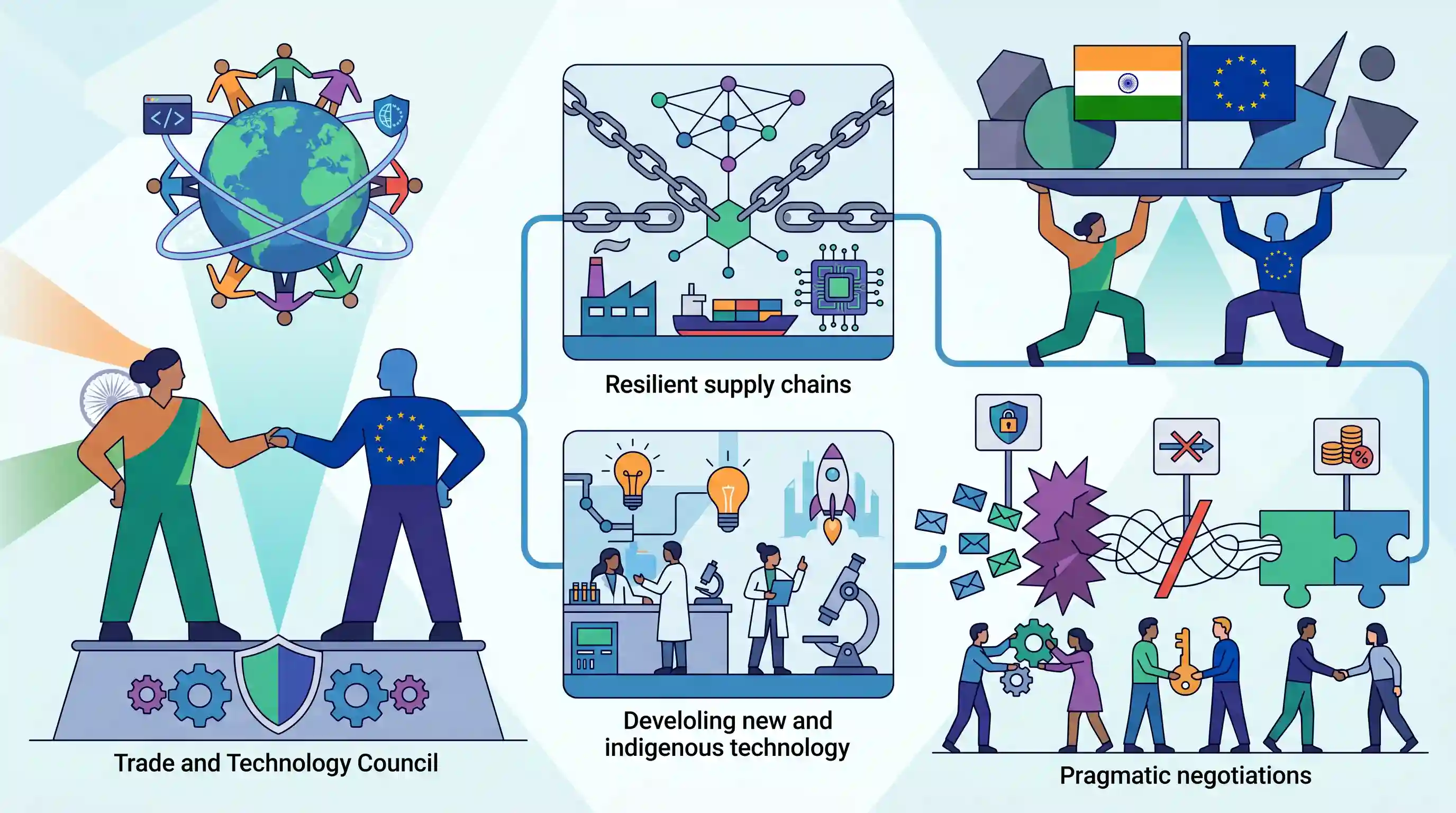
The article emphasizes the strategic imperative for India and the European Union to build a robust digital technology partnership. Driven by the need to establish a 'democratic tech coalition', the collaboration seeks to set global standards for digital governance, artificial intelligence, and resilient supply chains. The India-EU Trade and Technology Council (TTC) serves as a key platform for this agenda. However, the author cautions that shared democratic values alone are insufficient; the partnership demands honest, pragmatic negotiations to resolve significant regulatory frictions, such as differing approaches to data protection, cross-border data flows, and trade tariffs. Addressing these bottlenecks is essential to transition the alliance from rhetorical ambition to a functional geopolitical counterbalance.
Key Points
- India and the European Union have prioritized digital technology as a core pillar of their strategic partnership, highlighted by the establishment of the Trade and Technology Council (TTC).
- The partnership aims to forge a 'democratic tech coalition' to establish global standards for emerging technologies (like AI) that respect democratic values and human rights, distinguishing itself from authoritarian models.
- However, forging this alliance requires overcoming substantial regulatory divergences, particularly regarding data privacy (EU's GDPR vs India's DPDP Act) and cross-border data flows.
- Honest and pragmatic negotiations are necessary to reconcile these differences, as well as to address mutual trade concerns and supply chain resilience in critical technologies.
Important Terms
Trade and Technology Council (TTC)

A strategic bilateral platform established in 2023 for India and the EU to coordinate high-level policy on trade, trusted technology, and digital security.
UPSC context
GS II (Bilateral Groupings); tests understanding of strategic mechanisms for global digital governance and supply chain resilience.
Broad-based Trade and Investment Agreement (BTIA)
A comprehensive free trade agreement under negotiation since 2007 covering goods, services, and investment to deepen India-EU economic integration.
UPSC context
GS II (International Agreements); tests knowledge of trade bottlenecks, economic diplomacy, and India's evolving FTA strategy.
Digital Personal Data Protection Act (DPDP)
India’s 2023 legislation regulating digital personal data processing, establishing the rights of "Data Principals" and obligations of "Data Fiduciaries."
UPSC context
GS II/III (Governance/Security); tests understanding of India’s digital legal framework and its impact on the data economy.
General Data Protection Regulation (GDPR)
The EU’s 2018 legal framework setting stringent global standards for personal data protection, privacy, and extraterritorial regulatory compliance.
UPSC context
GS III (IT/Cybersecurity); essential for analyzing global regulatory benchmarks that affect Indian industry and data sovereignty.
Information Technology Agreement (ITA)
A WTO-led 1996 agreement to eliminate tariffs on IT products; currently the subject of disputes regarding India's import duties on ICT goods.
UPSC context
GS II/III (WTO/S&T); tests knowledge of international trade rules impacting 'Atmanirbhar Bharat' and high-tech manufacturing.
Prelims Trap
"India's DPDP Act covers both digital and structured manual data, mirroring the scope of the EU's General Data Protection Regulation (GDPR)."
India’s DPDP Act exclusively regulates digital personal data. In contrast, the EU’s GDPR applies to both digital data and structured non-digital personal data (e.g., manual filing systems).
Static Concepts Connected
What is the India-EU Trade and Technology Council (TTC)?
- Strategic Mechanism: A high-level coordination platform designed to tackle strategic challenges at the nexus of trade, trusted technology, and geopolitical security.
- Exclusive Tie-up: India is only the second country globally, following the United States, to establish a Trade and Technology Council with the European Union.
- Core Pillars: Operates via three tracks: Strategic Tech & Digital Governance, Green & Clean Energy Tech, and Trade & Resilient Value Chains.
What are the key regulatory differences between India's DPDP Act and the EU's GDPR?
- Data Scope: The DPDP Act applies exclusively to digital personal data, whereas the GDPR also covers structured non-digital personal data.
- Age of Consent: India’s DPDP strictly mandates 18 years for consent with parental oversight, while GDPR allows member states flexibility between 13 to 16 years.
- Cross-border Flows: DPDP relies on a negative list (allowing transfers unless explicitly restricted), whereas GDPR generally relies on an adequacy decision for cross-border data transfers.
Cross-Topic Patterns
Data sovereignty vs. BTIA trade negotiations
Diverging privacy frameworks (GDPR vs DPDP) act as regulatory friction, often spilling over as non-tariff bottlenecks in the broader India-EU Broad-based Trade and Investment Agreement (BTIA) negotiations.
Democratic tech alliances vs. authoritarian AI
The TTC mirrors tech objectives seen in the Quad, emphasizing human-centric AI standards and resilient supply chains to counterbalance Chinese dominance in critical and emerging technologies.

Expect a GS2 comparative mains question contrasting India's DPDP with the EU's GDPR, focusing on cross-border flows and tech geopolitics.
Linked PYQs · 4
Linked PYQs · 4
- 2017PrelimsGS1
'Broad-based Trade and Investment Agreement (BTIA)' is sometimes seen in the news in the context of negotiations held between India and
- 2014MainsGS2
The aim of Information Technology Agreements (ITAs) is to lower all taxes and tariffs on information technology products by signatories to zero. What impact would such agreements have on India's interests?
- 2025MainsGS2
India-Africa digital partnership is achieving mutual respect, co-development and long-term institutional partnerships. Elaborate.
- 2023MainsGS3
Introduce the concept of Artificial Intelligence (AI). How does Al help clinical diagnosis? Do you perceive any threat to privacy of the individual in the use of Al in healthcare?
