India EU comprehensive economic partnership signals freer global trade
Source:Indian Express ↗
Why It Matters
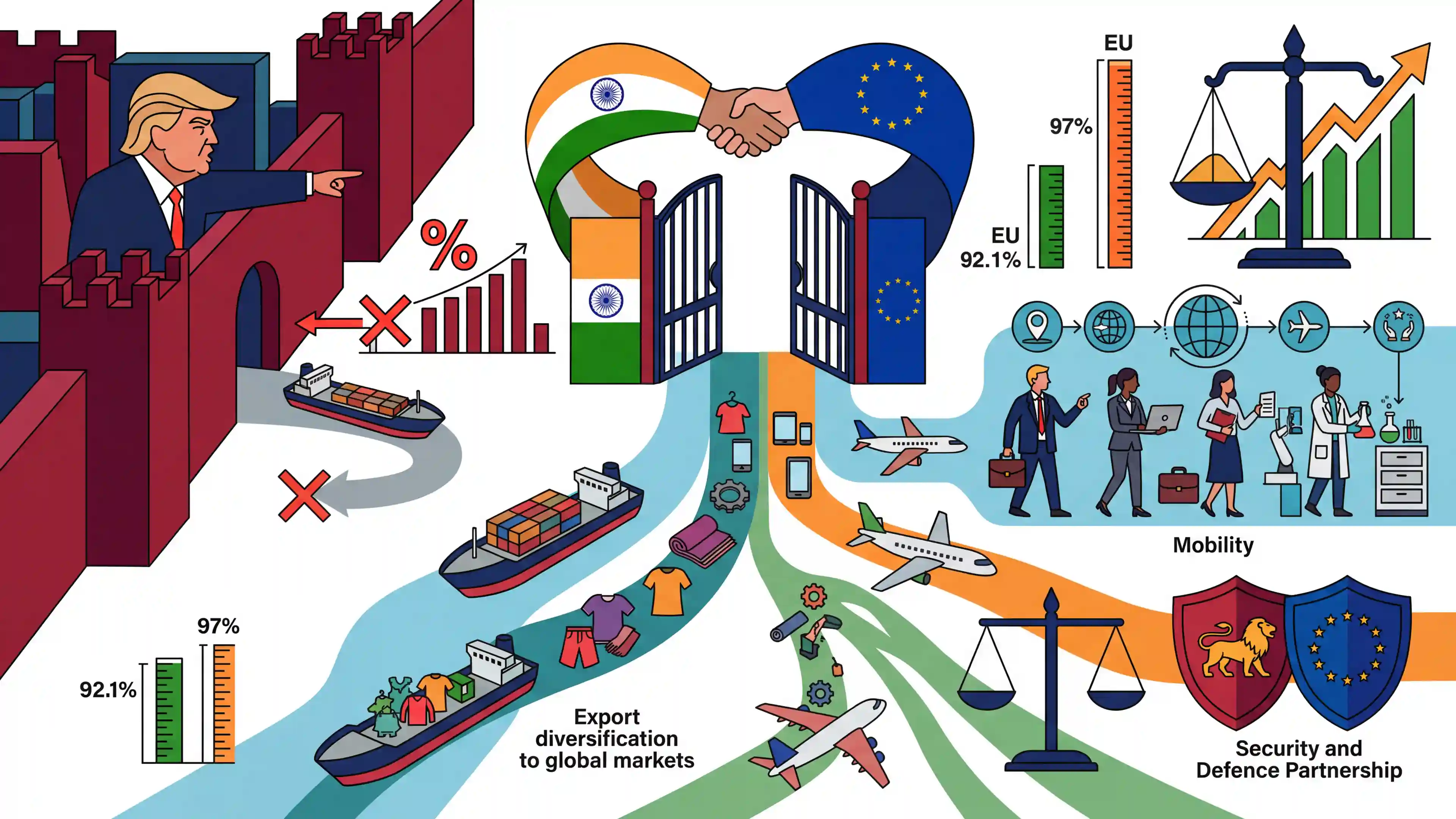
As global trade faces headwinds from rising protectionism and tariff wars, India's shift toward bilateral Free Trade Agreements (FTAs) is a critical survival and growth strategy. The India-EU pact—referred to historically as the Broad-based Trade and Investment Agreement (BTIA), which has previously appeared in Prelims—has profound implications for India's labour-intensive manufacturing, service sector mobility, and overall economic integration. It demonstrates how bilateralism is being used to bypass the stalling of multilateral WTO frameworks.
Summary
The conclusion of the long-pending India-EU Free Trade Agreement marks a pivotal moment in India's trade policy, signaling a definitive retreat from protectionism. Covering 2 billion people and a quarter of global GDP, the deal offers extensive tariff liberalisation, with the EU opening 97% of its tariff lines and India 92.1%. Crucially, the agreement helps India diversify its export markets ahead of potential 50% tariffs threatened by the US under Donald Trump. Beyond boosting labour-intensive exports like garments and securing access for 144 services sectors, the deal establishes a mobility framework for Indian professionals and includes a robust Security and Defence Partnership. Ultimately, the FTA positions India to better navigate an increasingly fragmented and protectionist global trade environment.
Key Points
- India and the EU have concluded negotiations for a comprehensive Free Trade Agreement, creating a massive trade zone encompassing 2 billion people and 25% of global GDP.
- The agreement provides a vital buffer for India's export markets, helping to diversify away from the US amidst threats of a 50% tariff levy by the incoming Trump administration.
- Under the tariff liberalisation plan, the EU will offer preferential access across 97% of tariff lines while India will open 92.1%, using phased reductions while protecting sensitive domestic sectors like dairy.
- India's labour-intensive industries (such as ready-made garments) and 144 services subsectors (including IT/ITeS and education) stand to secure significant market access in Europe.
- A new mobility framework will ease the movement of Indian professionals to the EU, mitigating uncertainties surrounding US H-1B visas.
- The concurrent Security and Defence Partnership will boost bilateral cooperation in areas like maritime security, counter-terrorism, and cybersecurity.
- The successful conclusion of this deal, initiated in 2007, signals a strategic shift for India from protectionist hesitation toward actively embracing freer global trade.
Important Terms
Broad-based Trade and Investment Agreement (BTIA)

The official name for the India-European Union comprehensive trade negotiations initiated in 2007, covering trade in goods, services, and investment to enhance bilateral market access.
UPSC context
Relevant for GS Paper II (Bilateral Groupings) and GS Paper III (Effects of Liberalization on the Economy).
Security and Defence Partnership
A 2026 framework established to institutionalize EU-India cooperation in maritime security, cyber defence, counter-terrorism, and defence manufacturing, reflecting a transition to a strategic operational partnership.
UPSC context
Key for GS Paper II (International Relations - Global Groupings) and GS Paper III (Security Challenges).
Protectionism
An economic policy of restricting imports through tariffs, quotas, or subsidies to shield domestic industries from foreign competition, often contrasted with free trade.
UPSC context
Tests conceptual understanding in GS Paper III (Indian Economy) and current global trade trends.
Free Trade Agreement (FTA)
A pact between two or more countries to reduce or eliminate trade barriers like tariffs and quotas, facilitating easier cross-border exchange of goods and services.
UPSC context
Core topic for GS Paper III (Economy) regarding trade policy and balance of payments.
Mobility Framework
A legal template (finalized 2026) to streamline visa procedures and ease the movement of Indian students, researchers, and skilled professionals across European Union member states.
UPSC context
Significant for GS Paper II (Effect of policies of developed countries on India's interests).
Tariff Liberalisation
The process of reducing or eliminating customs duties (tariffs) on imported goods to encourage competitive pricing and broader market access between trading partners.
UPSC context
Relevant for GS Paper III (Economy) under industrial policy and trade reforms.
Prelims Trap
The India-EU FTA mandates immediate and symmetric zero-tariff access across all tariff lines for both parties.
FTAs usually feature asymmetric liberalisation and negative/exclusion lists. India protects sensitive sectors like dairy and phases out tariffs gradually, avoiding a 100% symmetric zero-tariff regime.
Static Concepts Connected
What are the four modes of services supply under WTO GATS?
- Mode 1: Cross-border supply, where the service itself crosses the border without physical movement of persons (e.g., telemedicine, software consulting).
- Mode 2: Consumption abroad, where the consumer travels to the supplying country to consume the service (e.g., tourism, foreign education).
- Mode 3: Commercial presence, where a service provider establishes a physical branch or subsidiary in another country (e.g., foreign bank branch).
- Mode 4: Presence of natural persons, where individuals temporarily travel to another country to provide a service (e.g., IT professionals onsite).
How does a Free Trade Agreement (FTA) differ from a Customs Union?
- Free Trade Agreement: Members eliminate internal tariffs but maintain their own independent, individual external tariffs against non-member countries.
- Customs Union: Members eliminate internal trade barriers AND adopt a unified, common external tariff policy against all non-member countries.
- Common Market: A step beyond a customs union that additionally allows the free movement of capital and labor among member nations.
Cross-Topic Patterns
FTAs as Geopolitical Hedging
The India-EU deal directly hedges against unilateral US protectionism, demonstrating how export diversification is actively utilized for macroeconomic stability and foreign policy autonomy in a fragmented global order.
Convergence of Trade and Defence
Modern FTAs are transcending pure economics. The concurrent India-EU Security and Defence Partnership mirrors the broader trend of fusing supply chain resilience with strategic and maritime alignments.

Expect a multi-statement question on WTO GATS Mode 4 mobility frameworks, comparing India's recent FTAs with the EU, UK, and Australia.
Linked PYQs · 5
Linked PYQs · 5
- 2017PrelimsGS1
'Broad-based Trade and Investment Agreement (BTIA)' is sometimes seen in the news in the context of negotiations held between India and
- 2025MainsGS3
What are the challenges before the Indian economy when the world is moving away from free trade and multilateralism to protectionism and bilateralism? How can these challenges be met?
- 2018MainsGS3
How would the recent phenomena of protectionism and currency manipulations in world trade affect macroeconomic stability of India?
- 2017MainsGS3
Account for the failure of manufacturing sector in achieving the goal of labour-intensive exports. Suggest measures for more labour-intensive rather than capital-intensive exports.
- 2023PrelimsGS1
Consider the following statements: Statement-I: India accounts for 3.2% of global export of goods. Statement-II: Many local companies and some foreign companies operating in India have taken advantage of India's 'Production-linked Incentive' scheme. Which one of the following is correct in respect of the above statements?
