India and EU Target Free Trade Agreement Implementation by Early 2027
Source:Indian Express ↗
Why It Matters
The India-EU FTA represents a monumental shift in India's trade policy and economic diplomacy. As multilateral trade frameworks weaken, understanding how India navigates complex bilateral pacts with major economic blocs—while balancing strategic autonomy, green standards (like CBAM), and domestic red lines—is of paramount importance for both GS Paper 2 (International Relations) and GS Paper 3 (Indian Economy & Environment).
Summary
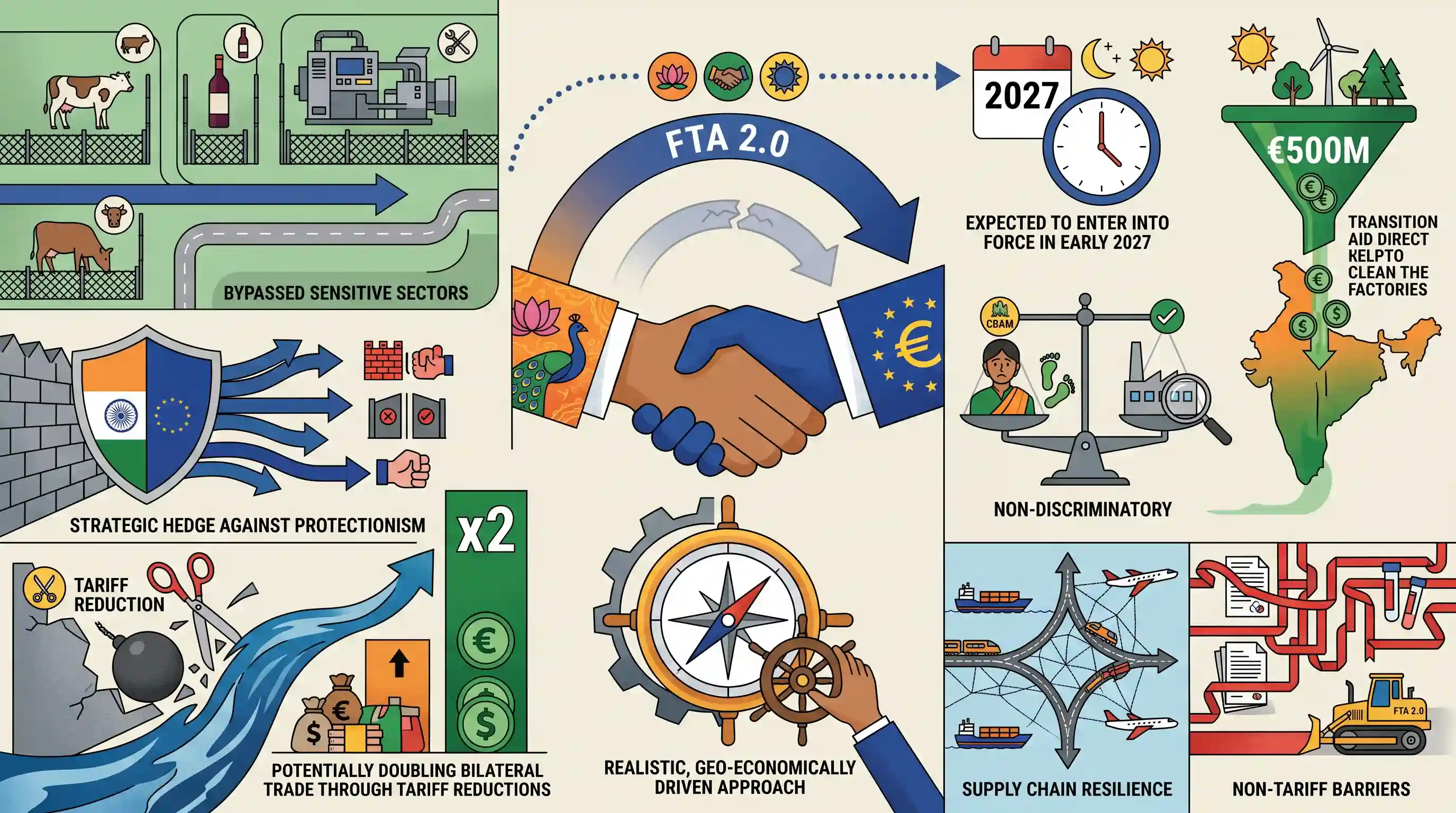
The article discusses the concluded India-EU Free Trade Agreement (FTA), expected to enter into force in early 2027. EU Ambassador Hervé Delphin explains how this 'FTA 2.0' succeeded through a realistic, geo-economically driven approach that bypassed sensitive sectors. The agreement serves as a strategic hedge against protectionism, promising to potentially double the $180 billion bilateral trade through massive tariff reductions. Ambassador Delphin also addresses Indian concerns over green standards like the Carbon Border Adjustment Mechanism (CBAM), emphasizing that they are non-discriminatory and highlighting a €500 million EU package to aid India's green transition.
Key Points
- Conclusion & Timeline: The India-EU FTA was concluded on January 27, 2026, after nearly two decades of negotiation. It is currently undergoing legal vetting and is expected to be signed by the end of 2026 and enter into force in early 2027 (Q1).
- Tariff Liberalization & Economic Impact: The EU has agreed to remove or reduce duties on over 99% of Indian exports, while India will fully or partially eliminate tariffs on close to 97% of EU exports. This is projected to potentially double the current $180 billion bilateral trade.
- Strategic Hedging: In an era of global fragmentation, the FTA serves as a strategic hedge against supply chain vulnerabilities and economic protectionism, prioritizing trusted partnerships and rule-based open trade.
- The 'FTA 2.0' Approach: Negotiations succeeded because both sides recognized changed geo-economic realities, avoided sensitive sectors like agriculture where they were not ready to open up, set early red lines, and prioritized substantial gains over theoretical perfection.
- CBAM & Green Standards: Addressing India's concerns that green regulations act as non-tariff barriers, EU Ambassador Hervé Delphin clarified that CBAM and deforestation rules are non-discriminatory. He highlighted simplification of reporting for MSMEs and a €500 million EU support package over the next two years for India's industrial decarbonization.
- Ecosystem Integration: The partnership incorporates technology transfer and localized ecosystem building (e.g., semiconductors, clean tech) supported by innovation hubs, a startup partnership, and the Trade and Technology Council (TTC).
Important Terms
India-EU Free Trade Agreement (FTA)

A comprehensive bilateral pact seeking to eliminate tariffs on over 97% of trade, deepen services access, and build resilient supply chains between India and the 27-nation EU bloc.
UPSC context
GS Paper II: Bilateral agreements and groupings affecting India's interests; trade policy.
Carbon Border Adjustment Mechanism (CBAM)
A landmark EU trade-climate tariff imposing a carbon tax on imports of carbon-intensive goods to prevent "carbon leakage" and align imports with EU domestic environmental compliance.
UPSC context
GS Paper III: Environmental pollution and degradation; GS Paper II: Foreign policies affecting India's trade.
Trade and Technology Council (TTC)
A bilateral coordination forum established in 2022 to enhance EU-India strategic cooperation, trusted trade, and digital standards on semiconductors, AI, and secure supply chains.
UPSC context
GS Paper II: Bilateral groupings and agreements involving India; GS Paper III: Technology development.
Horizon Europe
The European Union’s flagship €95.5 billion research and innovation funding program (2021–2027), which India is exploring potential association with to boost scientific collaborative research.
UPSC context
GS Paper III: Science and Technology—developments, international collaborations, and funding.
EU Legal Mobility Gateway Office
An official initiative established to streamline and facilitate the legal migration and movement of professional talent, particularly in the ICT sector, between India and the EU.
UPSC context
GS Paper II: Indian diaspora, migration policies, and bilateral services trade.
Prelims Trap
The 2026 India-EU FTA mandates complete tariff elimination across all trade sectors, including agriculture, dairy, and textiles.
The breakthrough in the 2026 negotiations was achieved specifically by adopting an 'FTA 2.0' approach that deliberately excluded highly sensitive sectors like agriculture and dairy from complete tariff elimination.
Static Concepts Connected
What are 'Rules of Origin' and 'Self-Certification' in international trade?
- Rules of Origin (RoO): The criteria used to determine the national source of a product, ensuring FTA tariff benefits apply only to partner countries and prevent third-party trade diversion.
- Self-Certification: A modern facilitation measure allowing registered exporters to declare a product's origin themselves on commercial documents, bypassing bureaucratic government-issued paper certificates.
What is 'Carbon Leakage' and how does the Carbon Border Adjustment Mechanism (CBAM) address it?
- Carbon Leakage: The phenomenon where businesses move production to countries with laxer emission rules to avoid carbon costs, shifting emissions rather than reducing them globally.
- CBAM Function: An EU border measure that requires importers of carbon-intensive goods (like steel, cement, fertilizer) to buy certificates corresponding to the carbon price paid under the EU ETS.
- Sectoral Scope: Sectors currently covered include iron, steel, aluminium, cement, fertilisers, electricity, and hydrogen; agricultural goods are currently excluded.
Cross-Topic Patterns
Green protectionism vs WTO principles
CBAM-style environmental levies test the legal boundaries of GATT Article XX (environmental exceptions) against the climate principle of Common but Differentiated Responsibilities (CBDR).
Friendshoring and trusted tech corridors
Integrating the Trade and Technology Council (TTC) with the FTA shows how geopolitical "friendshoring" of strategic tech (AI, chips) now supersedes classical cost-optimization in trade.

Expect a multi-statement question on India-EU FTA's exclusions (agriculture) coupled with the scope of CBAM-covered industrial sectors.
Linked PYQs · 2
Linked PYQs · 2
- 2025MainsGS3
What are the challenges before the Indian economy when the world is moving away from free trade and multilateralism to protectionism and bilateralism? How can these challenges be met?
- 2025PrelimsGS1
Consider the following statements : Statement I: Article 6 of the Paris Agreement on climate change is frequently discussed in global discussions on sustainable development and climate change. Statement II: Article 6 of the Paris Agreement on climate change sets out the principles of carbon markets. Statement III : Article 6 of the Paris Agreement on climate change intends to promote inter-country non-market strategies to reach their climate targets. Which one of the following is correct in respect of the above statements?
