Advanced biofuel adoption and ethanol blending expansion in India
Source:The Hindu ↗
Why It Matters
Ethanol blending and SAF are central to India's strategy for achieving energy independence and meeting its COP26 'Panchamrit' climate commitments. The topic intersects agriculture (sugarcane economics) and environment (decarbonization), making it highly relevant for GS3.
Summary
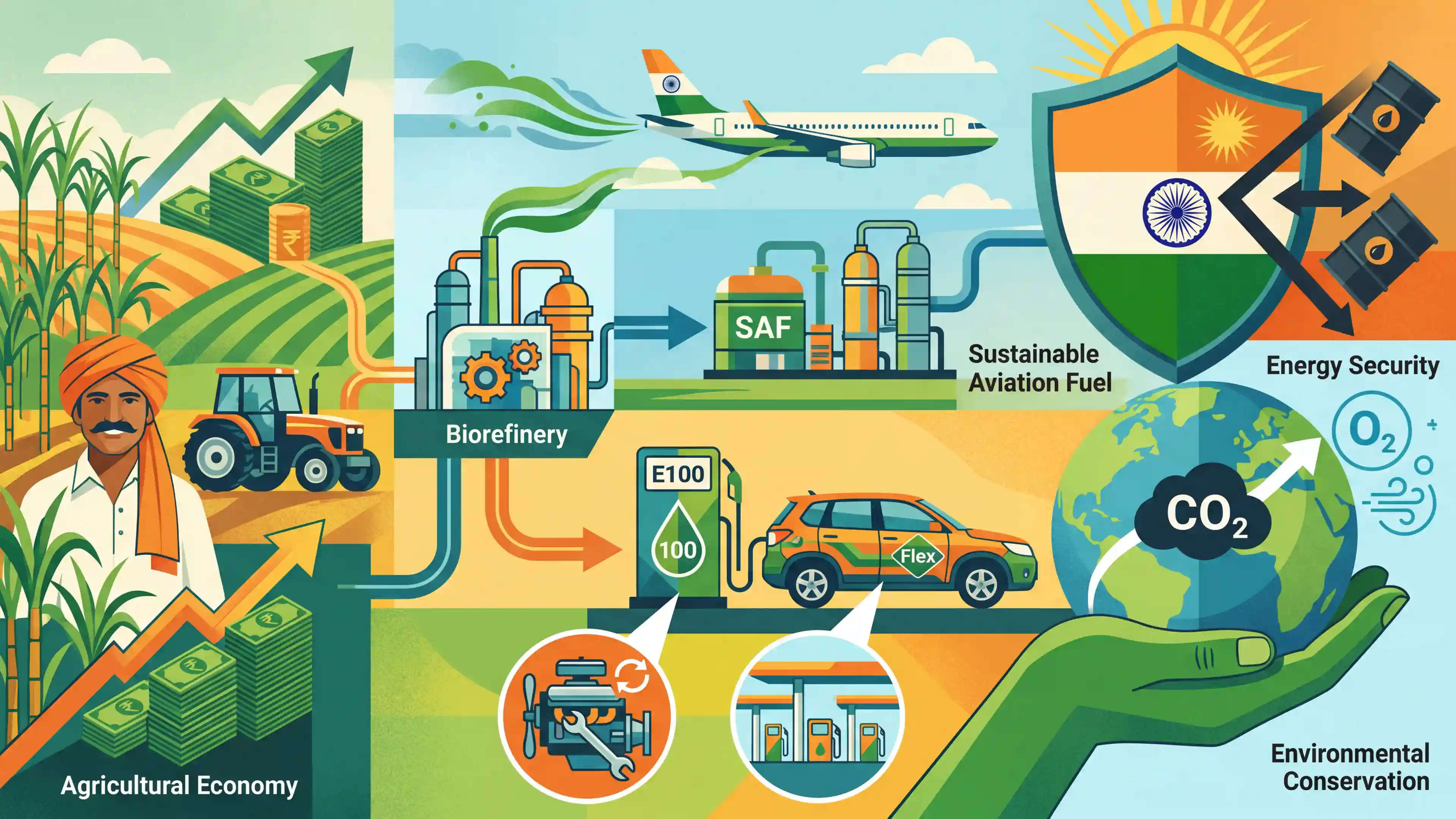
India is pushing the boundaries of its renewable energy transition by exploring E100 (100% ethanol) flex-fuel vehicles and Sustainable Aviation Fuel (SAF). Driven by the Ethanol Blended Petrol (EBP) programme, sugarcane is heavily utilized as the primary feedstock, which also aids the agricultural economy. While ethanol and SAF are crucial for energy security and reducing greenhouse gas emissions, the large-scale rollout of E100 requires engine modifications and extensive fueling infrastructure.
Key Points
- India is advancing its ethanol blending targets, moving beyond the E20 mandate (20% blending by 2025) to explore E100 (100% ethanol) usage through the introduction of Flex Fuel Vehicles (FFVs).
- Sugarcane acts as the primary feedstock for India's ethanol production, providing an economic buffer for farmers by diverting surplus sugar stock and stabilizing prices.
- Sustainable Aviation Fuel (SAF) is emerging as a critical component for decarbonizing the aviation sector, with ethanol presenting a viable precursor for SAF production.
- The transition requires significant investments in vehicle engine modifications, widespread E100 dispensing infrastructure, and careful management of food vs. fuel dynamics in agriculture.
Important Terms
Global Biofuels Alliance (GBA)

An India-led international forum launched at the 2023 G20 New Delhi Summit to foster global biofuel trade, technology transfer, and standardized certification among producers and consumers.
UPSC context
GS2/GS3; Tests knowledge of India's leadership in global climate diplomacy and energy transition through major multilateral platforms like the G20.
National Policy on Biofuels
A policy framework (2018, amended 2022) targeting 20% ethanol blending in petrol by 2025-26 and promoting advanced (2G) biofuels from agricultural residues to reduce oil imports.
UPSC context
GS3; Tests understanding of India's energy security strategies, emission reduction targets (Panchamrit), and policy-driven shifts in the fuel mix.
Ethanol Blended Petrol (EBP) Programme
A central scheme launched in 2003 to blend ethanol (derived from sugarcane, maize, and food grains) with petrol to lower crude oil dependency and support the agricultural economy.
UPSC context
GS3; Relevant for topics on agricultural diversification, energy self-reliance, and the economic impact of biofuel mandates on farmers.
Sustainable Aviation Fuel (SAF)
A renewable, non-fossil jet fuel alternative produced from biomass or waste (e.g., used cooking oil) that can reduce lifecycle greenhouse gas emissions by up to 80%.
UPSC context
GS3; Focuses on decarbonization of 'hard-to-abate' sectors and India's technology-led approach to achieving net-zero targets in civil aviation.
Oil Marketing Companies (OMCs)
State-owned entities (like IOCL, BPCL, and HPCL) that manage the procurement of ethanol from distilleries and handle the blending and distribution infrastructure across India.
UPSC context
GS3; Tests awareness of the operational mechanisms and logistics required to implement national energy mandates and their commercial impact.
Ministry of Petroleum and Natural Gas (MoPNG)
The nodal government body responsible for the exploration, production, and distribution of petroleum and natural gas, including the implementation of ethanol and SAF blending policies.
UPSC context
GS2; Tests administrative knowledge regarding the departmental roles in managing India's critical energy infrastructure and regulatory frameworks.
Prelims Trap
Flex Fuel Vehicles (FFVs) are designed to run exclusively on 100% ethanol fuel and cannot utilize traditional gasoline.
FFVs have modified engines that can run on any blend of gasoline and ethanol—from pure gasoline to 100% ethanol (E100). They offer flexibility, not an exclusive restriction.
Static Concepts Connected
What are the four generations of biofuels based on feedstock?
- First Generation (1G): Produced from edible crops like sugarcane, rice, and maize. Their heavy use triggers the 'food vs. fuel' debate and inflates food prices.
- Second Generation (2G): Derived from non-edible agricultural waste, stubble, and lignocellulosic biomass, avoiding direct competition with food security.
- Third Generation (3G): Extracted from specially cultivated algae, which requires minimal land and fresh water while offering higher energy yields.
- Fourth Generation (4G): Utilizes genetically engineered crops or algae, often combined with carbon capture and storage techniques to achieve carbon negativity.
Why is reliance on sugarcane for ethanol ecologically challenging in India?
- High Water Footprint: Sugarcane is highly water-intensive, consuming roughly 3,000 litres of water to produce just 1 litre of ethanol, severely stressing groundwater reserves.
- Cropping Pattern Skew: Assured returns via FRP (Fair and Remunerative Price) encourage farmers in semi-arid regions to cultivate sugarcane, displacing ecologically suitable, drought-resistant pulses and millets.
Cross-Topic Patterns
Biofuels + GBA Diplomacy
India's E100 and SAF push grounds its leadership in the Global Biofuels Alliance (GBA), interlinking domestic energy transition directly with international climate diplomacy and Global South advocacy.
SAF + CORSIA Framework
The move toward Sustainable Aviation Fuel (SAF) connects to CORSIA (Carbon Offsetting and Reduction Scheme for International Aviation), highlighting India's evolving commitments under UN ICAO climate frameworks.
Ethanol + Cropping Pattern Skew
The 'food vs. fuel' debate connects biofuel mandates to agricultural subsidies (MSP/FRP). Over-incentivizing sugarcane and maize for ethanol risks nutritional security and depletes groundwater in semi-arid zones.

Expect a single multi-statement question interlinking 2G/3G biofuel feedstocks, FFV engine mechanics, and the Global Biofuels Alliance.
Linked PYQs · 4
Linked PYQs · 4
- 2009PrelimsGS1
In the context of alternative sources of energy, ethanol as a viable bio-fuel can be obtained from
- 2025PrelimsGS1
Consider the following statements : Statement I: Of the two major ethanol producers in the world, i.e., Brazil and the United States of America, the former produces more ethanol than the latter. Statement II: Unlike in the United States of America where corn is the principal feedstock for ethanol production, sugarcane is the principal feedstock for ethanol production in Brazil. Which one of the following is correct in respect of the above statements?
- 2023MainsGS3
Discuss several ways in which microorganisms can help in meeting the current fuel shortage.
- 2022MainsGS3
Do you think India will meet 50 percent of its energy needs from renewable energy by 2030 ? Justify your answer. How will the shift of subsidies from fossil fuels to renewables help achieve the above objective ? Explain.
