India Enters Top 100 in Global SDG Rankings for First Time
Source:The Hindu ↗
Why It Matters
The SDG Index is a critical marker of India's socio-economic progress on global platforms. Understanding the specific areas of global regression (like nitrogen management and biodiversity) provides important fodder for GS-3 Environment and Agriculture answers, while the focus on Global Financial Architecture reform is highly relevant for GS-2 IR questions concerning developing nations' fiscal challenges and multilateralism.
Summary
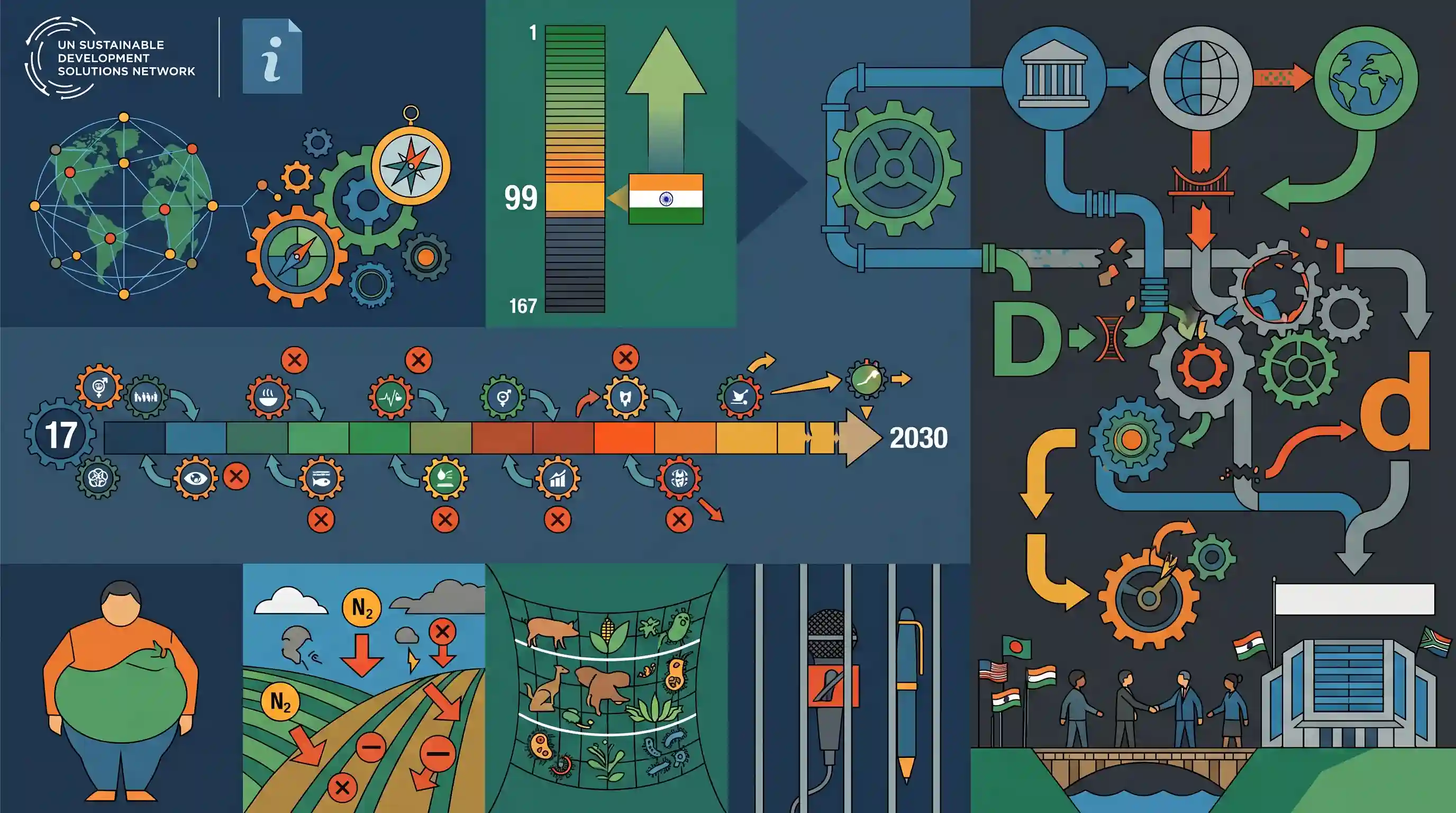
India has ranked 99th out of 167 nations in the 2025 Sustainable Development Report, entering the top 100 for the first time. Produced by the UN Sustainable Development Solutions Network, the report highlights that global SDG progress has largely stalled, with only 17% of targets on track for 2030. Key regressions were noted in obesity, sustainable nitrogen management, biodiversity, and press freedom. The report underlines the pressing need for reforming the global financial architecture to enable better funding for developing countries, serving as a preamble to the Fourth International Conference on Financing for Development (FfD4).
Key Points
- India entered the top 100 of the global Sustainable Development Goals (SDG) rankings for the first time, placing 99th out of 167 countries in the 2025 index.
- Only 17% of SDG targets are on track globally to be met by 2030, hampered by conflict, limited fiscal space, and structural vulnerabilities.
- Global regression was recorded in targets related to obesity (SDG 2), sustainable nitrogen management (SDG 2), biodiversity loss (SDG 15), and press freedom (SDG 16).
- The UN Sustainable Development Solutions Network's report stresses the urgent need for Global Financial Architecture reform ahead of the upcoming FfD4 in Spain.
- The United States ranked last globally (193rd) on the index measuring commitment to multilateralism and the UN system.
Important Terms
Sustainable Development Goals (SDGs)

A set of 17 global objectives adopted by the UN in 2015 to end poverty, protect the planet, and ensure prosperity for all by 2030.
UPSC context
GS Paper II (Social Justice) & III (Economics/Environment); tests knowledge of global governance and developmental targets.
Agenda 2030
The official UN framework (2015–2030) titled "Transforming our world," encompassing the 17 SDGs and 169 targets to promote sustainable global development.
UPSC context
GS Paper III (Sustainable Development); essential for understanding the timeline and structural commitment of international developmental policy.
Fourth International Conference on Financing for Development (FfD4)
A 2025 UN summit in Spain aimed at reforming global financial systems and mobilizing resources to bridge the $4 trillion annual SDG funding gap.
UPSC context
GS Paper II (International Institutions); critical for topics on global financial architecture reform and North-South cooperation.
UN Sustainable Development Solutions Network (SDSN)
A global initiative launched in 2012 to mobilize scientific and technical expertise to support the implementation of the SDGs and the Paris Agreement.
UPSC context
GS Paper II (International Agencies); the primary body behind the influential Sustainable Development Report and global SDG indexing.
Global Financial Architecture
The set of institutions and rules governing global monetary and financial flows; its reform is vital for providing fiscal space to developing nations.
UPSC context
GS Paper III (Economy/Investment Models); explores the challenges developing nations face in accessing sustainable and affordable credit.
Sustainable Development Report (SDR)
A comprehensive annual assessment of progress on the SDGs for all UN Member States, featuring the SDG Index and Dashboards.
UPSC context
UPSC Prelims (Reports/Indices); tracks India’s relative performance and specific areas of regression or progress in global rankings.
Prelims Trap
"The annual Sustainable Development Report is officially published by the United Nations Development Programme (UNDP)."
The Sustainable Development Report is published by the UN Sustainable Development Solutions Network (SDSN), an independent global network, not the UNDP or UNEP.
Static Concepts Connected
What is the UN Sustainable Development Solutions Network (SDSN)?
- Origin: Established in 2012 under the auspices of the UN Secretary-General.
- Mandate: Mobilizes global scientific and technological expertise to promote practical problem solving for sustainable development and the SDGs.
- Key Publications: Produces the annual Sustainable Development Report (SDR) and the World Happiness Report.
What are the key milestones in the UN's Financing for Development (FfD) framework?
- Monterrey Consensus: The 2002 conference set the landmark initial framework for global development cooperation and financing.
- Addis Ababa Agenda: The 2015 agreement aligned global financing flows and policies with the 2030 Agenda for Sustainable Development.
- FfD4 (Seville): The 2025 conference in Seville focuses on closing the estimated $4 trillion SDG financing gap through financial architecture reform.
Cross-Topic Patterns
SDG 2 regression + Nitrogen fertilizers
The regression in sustainable nitrogen management (SDG 2) connects directly to India's domestic policy push for Neem-coated urea and Nano Urea to curb agricultural runoff, subsidies, and emissions.
SDG financing gap + MDB Reforms
The push for reforming the global financial architecture at FfD4 in Seville mirrors the N.K. Singh-Larry Summers expert group report under India’s G20 presidency advocating for bigger, bolder MDBs.

A multi-statement question on the 2025 SDR is highly likely, testing UN SDSN's publisher role, India's rank, and SDG 2/15 regressions.
Linked PYQs · 3
Linked PYQs · 3
- 2020MainsGS2
The incedence and intensity of poverty are more important in determining poverty based on income alone". In this context analyse the latest United Nations Multidimensional Poverty Index Report.
- 2016PrelimsGS1
Consider the following statements: 1. The Sustainable Development Goals were first proposed in 1972 by a global think tank called the 'Club of Rome'. 2. The Sustainable Development Goals have to be achieved by 2030. Which of the statements given above is/are correct?
- 2020MainsGS3
Explain intra-generational and inter-generational issues of equity from the perspective of inclusive growth and sustainable development.
