Strategic Implications of India Integration into Pax Silica Alliances
Source:Indian Express ↗
Why It Matters
The intersection of critical technology and international relations is a defining theme in contemporary geopolitics. Understanding India's integration into global semiconductor supply chains and US-led tech alliances is essential for both GS2 (International Relations) and GS3 (Technology/Economy) in the UPSC exam.
Summary
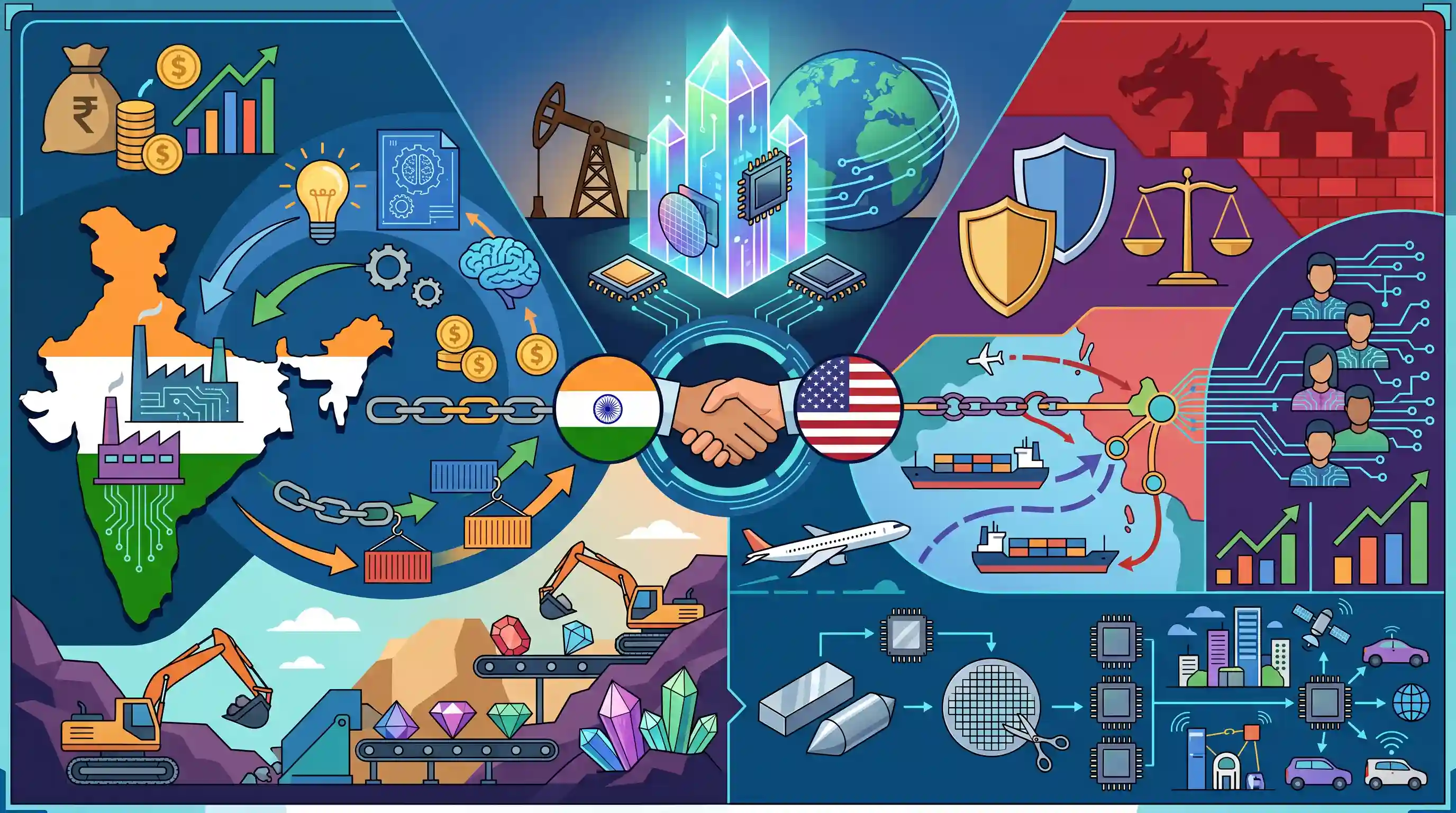
The article discusses India's strategic entry into 'Pax Silica,' a new world order where global geopolitical and economic power is dictated by control over semiconductors and tech supply chains rather than oil. Despite being a latecomer to semiconductor manufacturing, India's inclusion in US-led critical technology and mineral alliances is mutually beneficial. For New Delhi, these groupings provide indispensable access to capital, advanced tech, and secure supply chains, directly supporting the India Semiconductor Mission. Concurrently, the US and its allies view India as a crucial strategic counterweight and an essential node to reduce global reliance on China's supply chains, leveraging India's vast market and chip-design talent.
Key Points
- 'Pax Silica' denotes a new geopolitical era where strategic power is driven by control over silicon chips, semiconductors, and technology supply chains rather than fossil fuels.
- The United States is leading critical technology alliances to de-risk global supply chains and counter China's dominance in the tech and mineral sectors.
- Despite a delayed start in semiconductor manufacturing, India's entry into these US-led groupings is crucial for gaining access to advanced technology, capital, and integration into global value chains.
- For the West, India represents a vital strategic and economic alternative ('China Plus One' strategy), offering a massive market and a robust talent pool in chip design.
- The partnership significantly bolsters India's domestic ambitions, particularly the India Semiconductor Mission and related PLI schemes aimed at achieving tech self-reliance.
Important Terms
initiative on Critical and Emerging Technology (iCET)

A high-level bilateral framework between India and the US to expand strategic technology partnership and defense industrial cooperation in areas like AI, space, and semiconductors.
UPSC context
Relevant for GS Paper 2 (International Relations) and Paper 3 (S&T); tests Indo-US strategic and technological convergence.
India Semiconductor Mission (ISM)
A specialized business division within the Digital India Corporation (MeitY) tasked with building a sustainable semiconductor and display ecosystem through financial incentives and strategic partnerships.
UPSC context
Crucial for GS Paper 3 (Economy/S&T); tests industrial policy, self-reliance, and high-tech manufacturing strategies.
Minerals Security Partnership (MSP)
A US-led multinational collaboration of 14 countries and the EU aimed at securing sustainable global supply chains for critical minerals like lithium and cobalt.
UPSC context
Important for GS Paper 2 (IR) and Paper 3 (Resources/Energy); tests global resource diplomacy and energy security.
Production Linked Incentive (PLI) scheme
A government initiative providing financial incentives to companies based on incremental sales from products manufactured in India to boost domestic production and exports.
UPSC context
Core topic for GS Paper 3 (Economy); tests strategies for manufacturing growth and 'Atmanirbhar Bharat'.
CHIPS and Science Act
A 2022 US federal law providing approximately $52 billion in subsidies to revitalize domestic semiconductor manufacturing and research to reduce dependence on foreign supply chains.
UPSC context
Relevant for GS Paper 2 and 3; tests understanding of global tech policies influencing India's industrial landscape.
Prelims Trap
India is a founding member of the US-led Minerals Security Partnership (MSP).
India joined the MSP in June 2023; it is not a founding member. UPSC frequently tests India’s exact membership timeline in newer alliances.
Static Concepts Connected
What is the Minerals Security Partnership (MSP) and its strategic focus?
- Core Objective: Catalyze public and private investment for secure, sustainable critical mineral supply chains globally.
- Target Minerals: Focuses on minerals vital for clean energy and technology, such as lithium, cobalt, nickel, and rare earths.
- China De-risking: Aims to break China's processing monopoly by creating alternative, allied-nation supply networks (China Plus One).
How is the India Semiconductor Mission (ISM) structured to build a domestic ecosystem?
- Nodal Agency: Operates as an independent business division within Digital India Corporation (MeitY) to appraise PLI proposals.
- Financial Outlay: Administers the ₹76,000 crore PLI scheme, offering flat 50% project cost support across all technology nodes.
- Ecosystem Approach: Focuses beyond fabrication, providing incentives for ATMP, OSAT, and a specific Design Linked Incentive (DLI) scheme.
Cross-Topic Patterns
Quad tech + bilateral iCET synergy
The Quad's Critical and Emerging Technology working group directly complements the bilateral iCET framework, shifting focus from traditional maritime security to establishing resilient, non-Chinese tech supply chains.
EV transition + MSP mineral dependency
India’s FAME scheme and renewable energy targets remain highly vulnerable without secured access to lithium and cobalt via geopolitical alliances like the Minerals Security Partnership.

Expect a 2026 prelims question blending MSP membership status, iCET's strategic domains, and the nodal agency of the Semiconductor Mission.
Linked PYQs · 4
Linked PYQs · 4
- 2024MainsGS2
‘The West is fostering India as an alternative to reduce dependence on China's supply chain and as a strategic ally to counter China's political and economic dominance.’ Explain this statement with examples.
- 2025MainsGS3
India aims to become a semiconductor manufacturing hub. What are the challenges faced by the semiconductor industry in India? Mention the salient features of the India Semiconductor Mission.
- 2021MainsGS2
“The USA is facing an existential threat in the form of a China, that is much more challenging than the erstwhile Soviet Union.” Explain.
- 2012PrelimsGS1
Recently, there has been a concern over the short supply of a group of elements called 'rare earth metals'. Why? 1. China, which is the largest producer of these elements, has imposed some restrictions on their export. 2. Other than China, Australia, Canada and Chile, these elements are not found in any country. 3. Rare earth metals are essential for the manufacture of various kinds of electronic items and there is a growing demand for these elements. Which of the statements given above is/are correct?
