Semiconductor Supply Chains and Technology Alliances
Source:Indian Express ↗
Why It Matters
Semiconductors are at the heart of modern national security and economic growth. The concept of 'Pax Silica' directly links domestic industrial policies (GS3) with international relations and strategic tech alliances (GS2). UPSC frequently asks about the India Semiconductor Mission and the weaponization of technology supply chains.
Summary
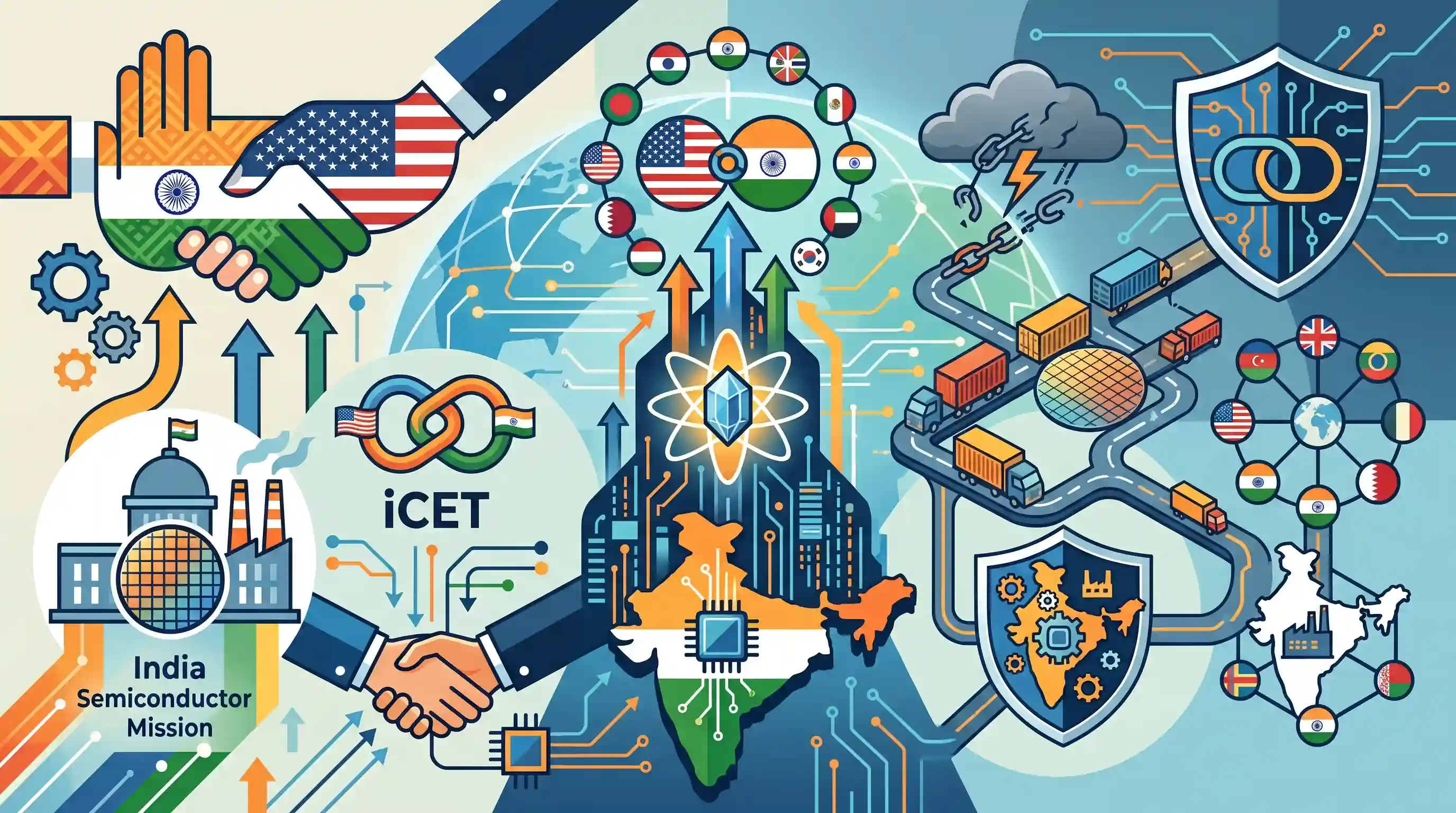
India's evolving role in the global semiconductor supply chain is being heralded as its entry into 'Pax Silica'—a tech-centric geopolitical order driven by silicon chips. The US has welcomed this development, noting that India's growing capabilities in semiconductor manufacturing strengthen the coalition of democratic nations striving to secure critical technology supply chains. Propelled by the India Semiconductor Mission and bilateral agreements like iCET, India's tech rise serves the dual purpose of domestic self-reliance and geopolitical strategic alignment to de-risk global electronics manufacturing.
Key Points
- 'Pax Silica' refers to the emerging global geopolitical order driven by dominance in semiconductor manufacturing and supply chains.
- The US has welcomed India's entry into the semiconductor space, viewing it as a move that strengthens the tech coalition of democratic nations.
- India's push into semiconductor fabrication and assembly is driven by domestic industrial policies like the India Semiconductor Mission and PLI schemes.
- Collaborative frameworks like the US-India iCET are critical in diversifying global supply chains and reducing dependence on China for critical tech infrastructure.
Important Terms
iCET (Initiative on Critical and Emerging Technology)

A 2023 India-US framework to foster collaboration, co-development, and technology sharing in sectors like AI, semiconductors, space, and defense, aimed at reducing export barriers.
UPSC context
GS Paper II: Bilateral Relations. Tests understanding of tech-led diplomacy and strategic deep-tech partnerships.
India Semiconductor Mission (ISM)
An autonomous nodal agency under the Ministry of Electronics and IT, launched with ₹76,000 crore to build a sustainable semiconductor and display ecosystem in India.
UPSC context
GS Paper III: Science & Technology. Tests knowledge of missions for technological self-reliance and global supply chain integration.
Production Linked Incentive (PLI) Scheme
A government scheme providing fiscal incentives (up to 50% for semiconductors) on incremental sales from domestic manufacturing to attract global investors and boost local production.
UPSC context
GS Paper III: Indian Economy/Industrial Policy. Tests awareness of manufacturing incentives and the Atmanirbhar Bharat initiative.
Quad (Quadrilateral Security Dialogue)
A strategic grouping of India, US, Japan, and Australia that collaborates on regional security and resilient supply chains through the 'Semiconductor Supply Chain Initiative.'
UPSC context
GS Paper II: International Relations/Groupings. Tests understanding of Indo-Pacific strategy and collective tech-security frameworks.
Prelims Trap
"iCET is a legally binding multilateral framework signed by Quad nations to regulate AI and semiconductors."
iCET is a bilateral initiative between India and the US, not a multilateral Quad treaty. It focuses on technology co-development, not regulatory enforcement.
Static Concepts Connected
What are the core components of the India Semiconductor Mission (ISM)?
- Nodal Agency: It operates as an independent, autonomous business division within the Digital India Corporation under the Ministry of Electronics and IT (MeitY).
- Comprehensive Scope: It supports the entire value chain, including silicon semiconductor fabs, display fabs, and ATMP/OSAT (Assembly, Testing, Marking, and Packaging) facilities.
- Financial Outlay: It offers pari-passu financial support, providing up to 50% of the total project cost to approved applicants for setting up critical fabs.
How do supply chain strategies like Friendshoring, Reshoring, and Nearshoring differ?
- Friendshoring: Relocating critical supply networks to geopolitical allies (e.g., US deepening tech ties with India) to reduce exposure to geopolitical rivals like China.
- Reshoring: Transferring manufacturing operations fully back to the home country to ensure complete domestic control over strategic industries and jobs.
- Nearshoring: Shifting production to neighboring or geographically closer nations to mitigate logistical bottlenecks, avoid supply shocks, and reduce transit costs.
Cross-Topic Patterns
Semiconductors + Critical Minerals Mapping
Securing silicon chips directly relies on upstream critical minerals (e.g., gallium, germanium) dominated by China, linking India's semiconductor PLI schemes to the Quad's broader critical mineral mapping initiatives.
iCET + Defence Indigenisation (INDUS-X)
iCET's framework underpins dialogues like INDUS-X, connecting civilian semiconductor supply-chain resilience directly to joint defense innovation, jet engine technology, and space co-production.

Expect a multi-statement question in 2026 linking iCET (bilateral) with Quad initiatives (multilateral) and semiconductor PLI criteria.
Linked PYQs · 2
Linked PYQs · 2
- 2025MainsGS3
India aims to become a semiconductor manufacturing hub. What are the challenges faced by the semiconductor industry in India? Mention the salient features of the India Semiconductor Mission.
- 2025MainsGS3
Discuss the rationale of the Production Linked Incentive (PLI) scheme. What are its achievements? In what way can the functioning and outcomes of the scheme be improved?
