Geopolitical Shifts and Supply Chain De-risking Strategies
Source:The Hindu ↗
Why It Matters
Understanding the shift from globalization to geo-economics is crucial for UPSC aspirants. It explains the rationale behind India's contemporary foreign policy, its push for alternative supply chains (like 'China Plus One'), the strategic importance of recent FTAs, and how national security concerns are reshaping global trade and tech policies.
Summary
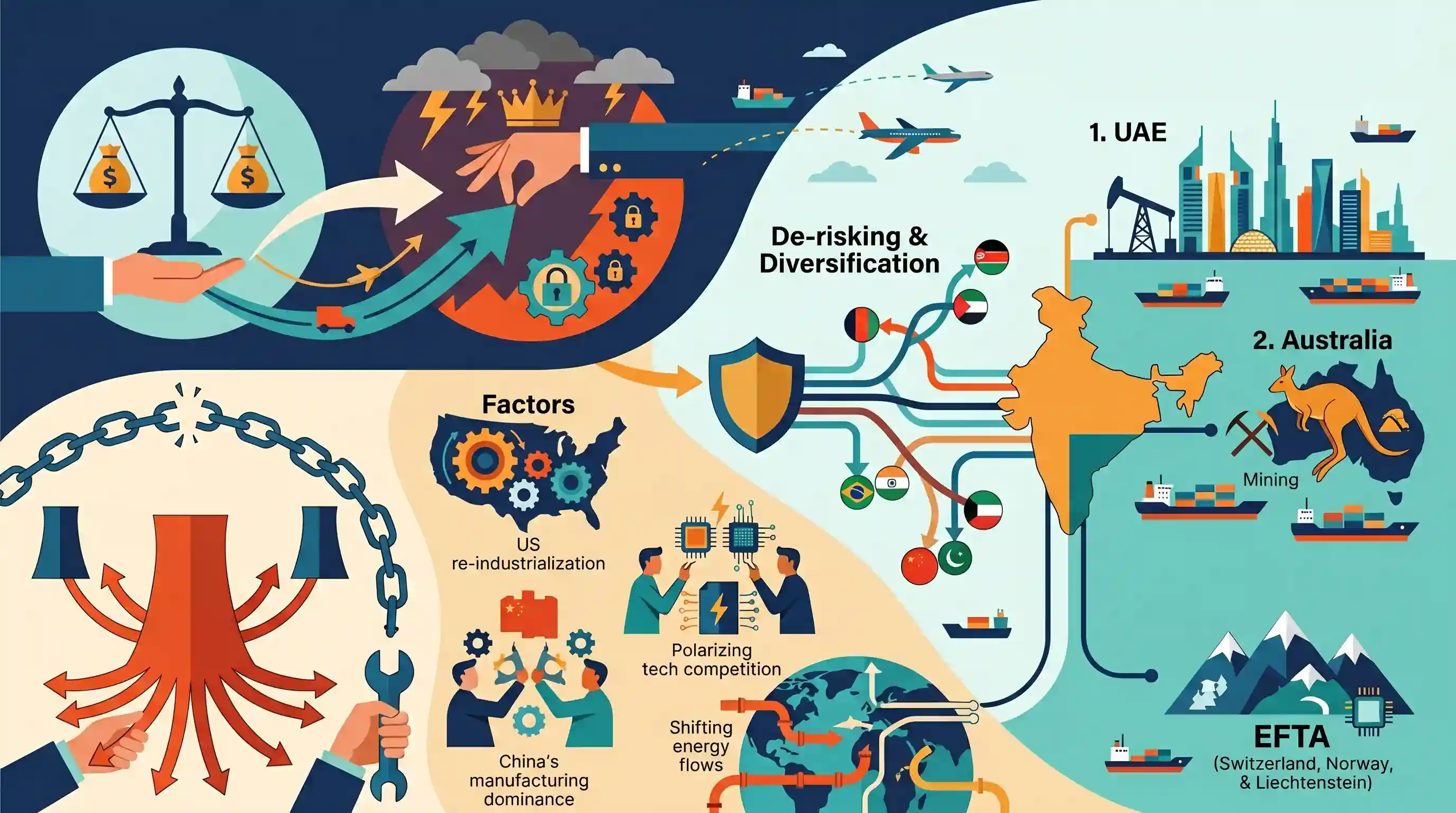
External Affairs Minister S. Jaishankar highlighted a fundamental shift in international relations, asserting that geopolitics and security are increasingly dictating choices over pure economics. Speaking at the Global Economic Cooperation summit, he pointed to the vulnerabilities exposed by concentrated supply chains and their subsequent weaponization. Jaishankar argued that 'de-risking' and supply chain diversification are now essential strategic imperatives. He cited factors like U.S. re-industrialization, China's manufacturing dominance, polarizing tech competition, and shifting energy flows. In response, India is intensifying global partnerships through recent Free Trade Agreements (FTAs) with the UAE, Australia, and EFTA to navigate this transitional, multipolar era.
Key Points
- External Affairs Minister S. Jaishankar emphasized that political and security considerations are increasingly overriding pure economic choices in global relations.
- He highlighted the necessity of 'de-risking' and 'diversifying' across multiple dimensions to mitigate vulnerabilities caused by over-reliance on concentrated supply chains.
- The global economic landscape is shifting due to US re-industrialization, China's export-driven manufacturing dominance, and the weaponization of economic interdependencies.
- Strategic technology competition is driving geopolitical polarization, while global energy trade flows are undergoing substantial redefinition.
- India is actively navigating this transition by accelerating global engagement, securing FTAs with partners like the UAE, Australia, and EFTA, and promoting a multipolar world order.
Important Terms
Free Trade Agreements (FTAs)

Formal treaties between countries to reduce or eliminate tariffs and non-tariff barriers on goods and services, while regulating investment and intellectual property.
UPSC context
GS Paper II/III (International Relations/Economy): Evaluates India's shift toward bilateral trade pacts (UAE, Australia, EFTA) to boost exports and investment.
EFTA (European Free Trade Association)
An intergovernmental organization comprising Iceland, Liechtenstein, Norway, and Switzerland, operating parallel to the EU to promote free trade and economic integration.
UPSC context
GS Paper II/III: Recent India-EFTA TEPA is significant for its landmark $100 billion investment commitment and technology transfer.
De-risking
A strategic policy of reducing economic over-dependence on a single nation (typically China) to mitigate supply chain vulnerabilities without completely severing trade ties.
UPSC context
GS Paper II: Tests understanding of modern diplomatic strategies compared to 'decoupling' in the context of global value chains.
Geo-economics
The use of economic instruments—such as trade policy, investments, and sanctions—to achieve geopolitical goals and enhance a nation's strategic influence.
UPSC context
GS Paper II: A core framework for analyzing how economic power is weaponized or leveraged in contemporary international relations.
Supply Chain Resilience
A strategy to diversify supply sources across multiple nations to ensure economic activity remains uninterrupted during natural disasters, pandemics, or geopolitical conflicts.
UPSC context
GS Paper III (Economy/Security): Relevant for the Supply Chain Resilience Initiative (SCRI) and reducing 'concentration risk' in critical sectors.
Multipolarity
A global order characterized by multiple centers of power, where no single nation or bloc dominates, requiring nations to navigate complex, overlapping partnerships.
UPSC context
GS Paper II: Fundamental to Indian foreign policy (Strategic Autonomy) and the functioning of groups like BRICS, SCO, and Quad.
Prelims Trap
"India recently signed the Trade and Economic Partnership Agreement (TEPA) with the European Union to secure a $100 billion FDI commitment."
TEPA was signed with EFTA (Switzerland, Norway, Iceland, Liechtenstein), not the EU. EFTA is a distinct intergovernmental organization. Confusing EFTA with the EU is a classic UPSC trap.
Static Concepts Connected
What are the core objectives of the Supply Chain Resilience Initiative (SCRI)?
- Strategic Origin: A trilateral grouping launched by India, Japan, and Australia in 2021 to counter global supply chain disruptions.
- Primary Objective: To reduce over-dependence on Chinese manufacturing by enhancing FDI and building redundant, resilient supply networks in the Indo-Pacific.
- Implementation Mechanisms: Focuses on sharing best practices, holding mutual investment promotion events, and exploring buyer-seller matching platforms across member nations.
How does a CEPA differ from a traditional Free Trade Agreement (FTA)?
- Scope of Coverage: Unlike standard FTAs which predominantly focus on goods, CEPAs are comprehensive, encompassing services, investments, trade facilitation, and IPR.
- Tariff Reduction: CEPAs generally involve broader and deeper tariff elimination or reduction on a significantly wider range of items.
- Regulatory Cooperation: They often include mutual recognition agreements and binding customs cooperation to eliminate non-tariff barriers and streamline geopolitically sensitive trade.
Cross-Topic Patterns
Critical Minerals & Geo-economic De-risking
Security-driven trade links to India's quest for critical minerals via KABIL in Australia and Argentina, actively bypassing Chinese processing monopolies to secure green-tech supply chains.
Binding FDI targets in Trade Pacts
The EFTA TEPA introduces a paradigm shift by legally tying trade access to a binding $100 billion FDI commitment, setting a new precedent for ongoing EU and UK negotiations.

EFTA's FDI mandate + SCRI + 'de-risking' terminology will likely form a multi-statement geo-economics Prelims question in 2026.
Linked PYQs · 3
Linked PYQs · 3
- 2024MainsGS2
‘The West is fostering India as an alternative to reduce dependence on China's supply chain and as a strategic ally to counter China's political and economic dominance.’ Explain this statement with examples.
- 2025MainsGS2
"With the waning of globalization, post-Cold War world is becoming a site of sovereign nationalism.” Elucidate.
- 2025MainsGS2
"Energy security constitutes the dominant kingpin of India's foreign policy, and is linked with India's overarching influence in Middle Eastern countries.” How would you integrate energy security with India's foreign policy trajectories in the coming years?
