Revocation of Bangladesh Transshipment Facility and Security
Source:Indian Express ↗
Why It Matters
The suspension of the transshipment facility marks a significant setback in India-Bangladesh connectivity and trade relations. For UPSC aspirants, it is a crucial case study on how changes in regime (the Yunus interim government) affect bilateral ties (Neighbourhood First Policy) and how trade routes can become vulnerabilities for internal security and economic stability (influx of Chinese goods into the Northeast).
Summary
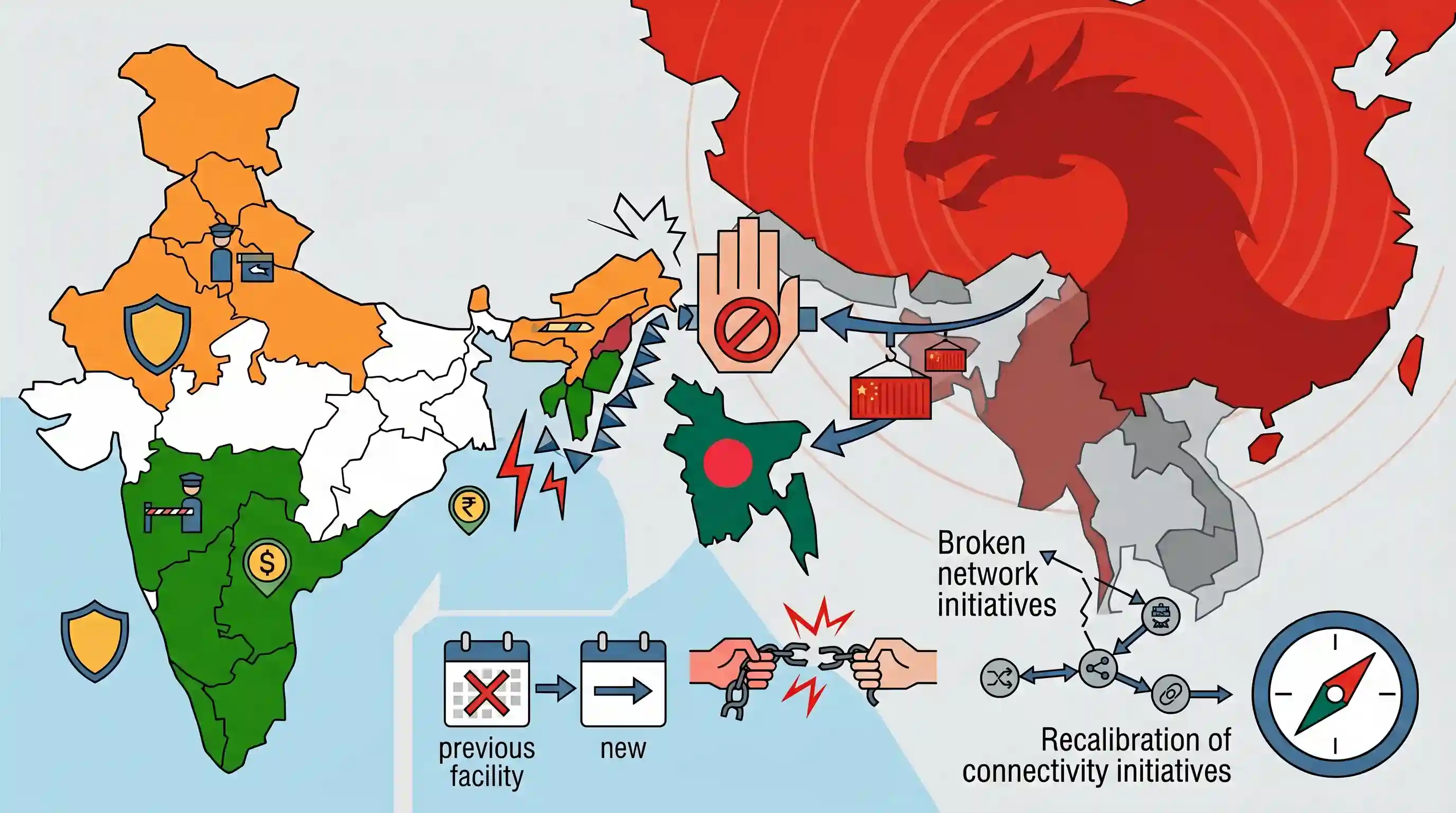
India has decided to end the transshipment facility previously granted to Bangladesh amid concerns that it was being misused to funnel Chinese goods into India's Northeastern states. The strategic move reflects growing friction in bilateral ties since the Muhammad Yunus-led interim government took power in Dhaka. By revoking the transit privileges, India is prioritizing its economic security and border integrity, signaling a cautious recalibration of its 'Neighbourhood First' connectivity initiatives in light of China's expanding regional influence.
Key Points
- India has revoked the transshipment facility granted to Bangladesh, halting the movement of certain goods through Indian territory.
- The decision was driven by concerns that the facility was being exploited to flood India's Northeast with cheap Chinese goods, bypassing standard trade regulations.
- The move reflects a distinct cooling of bilateral ties under the Muhammad Yunus-led interim government in Dhaka, following the ouster of Sheikh Hasina.
- India is prioritizing internal economic security and border management over regional connectivity in response to perceived geopolitical shifts and China's growing footprint in the neighbourhood.
Important Terms
Neighbourhood First Policy

India’s primary diplomatic framework prioritizing relations with its immediate South Asian neighbors. It focuses on enhancing physical, digital, and people-to-people connectivity while providing non-reciprocal assistance to ensure regional stability.
UPSC context
GS Paper II: India and its neighborhood-relations; tests understanding of regional diplomacy and the '5S' guiding principles.
Transshipment Facility
A logistics arrangement where goods are transported to an intermediate destination before being sent to their final destination. In bilateral trade, it allows one country to use another’s infrastructure for third-country exports.
UPSC context
GS Paper III: Infrastructure and Economy; tests knowledge of trade facilitation agreements and logistics-based security challenges.
Act East Policy
An upgraded diplomatic initiative focusing on the Indo-Pacific and Southeast Asia. It positions India's Northeast as a strategic gateway for economic, cultural, and security cooperation with ASEAN nations.
UPSC context
GS Paper II: Regional groupings and agreements; tests the link between domestic development and foreign policy goals.
Interim Government (Bangladesh)
The provisional administration led by Chief Adviser Muhammad Yunus, established after the ouster of Sheikh Hasina. Its diplomatic pivot toward China has recalibrated India-Bangladesh strategic and economic ties.
UPSC context
GS Paper II: Effect of policies/politics of developing countries on India's interests; tests real-time bilateral crisis management.
Siliguri Corridor (Chicken's Neck)
A narrow 22-kilometer strip of land in West Bengal connecting mainland India to its eight Northeastern states. It is a critical strategic choke point vulnerable to regional geopolitical shifts.
UPSC context
GS Paper III: Internal Security; tests awareness of geographical bottlenecks and border area management.
Economic Security
The protection of a nation’s sovereignty through the safeguarding of its trade routes, domestic markets, and critical infrastructure from external threats, unfair competition, or unauthorized foreign influence.
UPSC context
GS Paper III: Challenges to internal security; tests understanding of non-traditional security threats like trade-based infiltration.
Prelims Trap
Under SAFTA, any goods shipped from Bangladesh automatically qualify for zero-customs duty entry into India.
False. SAFTA enforces strict 'Rules of Origin' (RoO). Goods must undergo substantial local value addition in the partner country to secure tariff benefits, explicitly to prevent third countries from dumping goods.
Static Concepts Connected
What are 'Rules of Origin' (RoO) in International Trade?
- Core Definition: The specific criteria utilized to determine the national source or economic nationality of a product in international trade.
- Primary Purpose: Prevents 'trade deflection' where non-FTA countries route their exports through an FTA partner nation simply to exploit zero-tariff or preferential benefits.
- Value Addition Norms: Usually requires a 'substantial transformation' of the good or a minimum percentage of domestic value addition within the partner nation before export.
What are the key connectivity routes to India's North East?
- Siliguri Corridor: The 'Chicken's Neck', a narrow 22-km strip in West Bengal, serving as the primary mainland overland route to the North East, presenting a major strategic vulnerability.
- Kaladan Project: An alternative multi-modal transit initiative connecting Kolkata port to Sittwe port in Myanmar, and onwards via river and road to Mizoram.
- IBP Routes: Inland Water Transit and Trade Protocol routes that historically utilized Bangladesh's river networks to move cargo between West Bengal and states like Assam and Tripura.
Cross-Topic Patterns
Connectivity vs Internal Security
Transnational connectivity under Act East frequently clashes with internal security realities, as porous borders intended for trade inadvertently facilitate smuggling, drug trafficking, and insurgent logistics.
Rules of Origin & Chinese Dumping
China routinely bypasses direct Indian tariffs by routing subsidized goods through neighboring countries with preferential trade access to India, prompting New Delhi to enforce strict Rules of Origin.

Expect a 2026 Mains question evaluating the trade-off between 'Neighbourhood First' connectivity projects and Northeast border security.
Linked PYQs · 5
Linked PYQs · 5
- 2024MainsGS2
‘The West is fostering India as an alternative to reduce dependence on China's supply chain and as a strategic ally to counter China's political and economic dominance.’ Explain this statement with examples.
- 2022MainsGS2
Do you think that BIMSTEC is a parallel organisation like the SAARC ? What are the similarities and dissimilarities between the two ? How are Indian foreign policy objectives realized by forming this new organisation?
- 2024MainsGS3
India has a long and troubled border with China and Pakistan fraught with contentious issues. Examine the conflicting issues and security challenges along the border. Also give out the development being undertaken in these areas under the Border Area Development Programme (BADP) and Border Infrastructure and Management (BIM) Scheme.
- 2019MainsGS3
Cross-border movement of insurgents is only one of the several security challenges facing the policing of the border in North-East India. Examine the various challenges currently emanating across the India-Myanmar border. Also, discuss the steps to counter the challenges.
- 2014MainsGS3
How does illegal transborder migration pose a threat to India's security? Discuss the strategies to curb this, bringing out the factors which give impetus to such migration.
