India Updated Nationally Determined Contributions and Climate Targets
Source:Indian Express ↗
Why It Matters
Nationally Determined Contributions (NDCs) are central to the global climate governance architecture under the Paris Agreement. India's evolving targets have direct implications for its energy policy, economic transition, and international diplomatic positioning, making it a highly probable topic for both Prelims (factual targets) and Mains (evaluating climate commitments and energy transition).
Summary
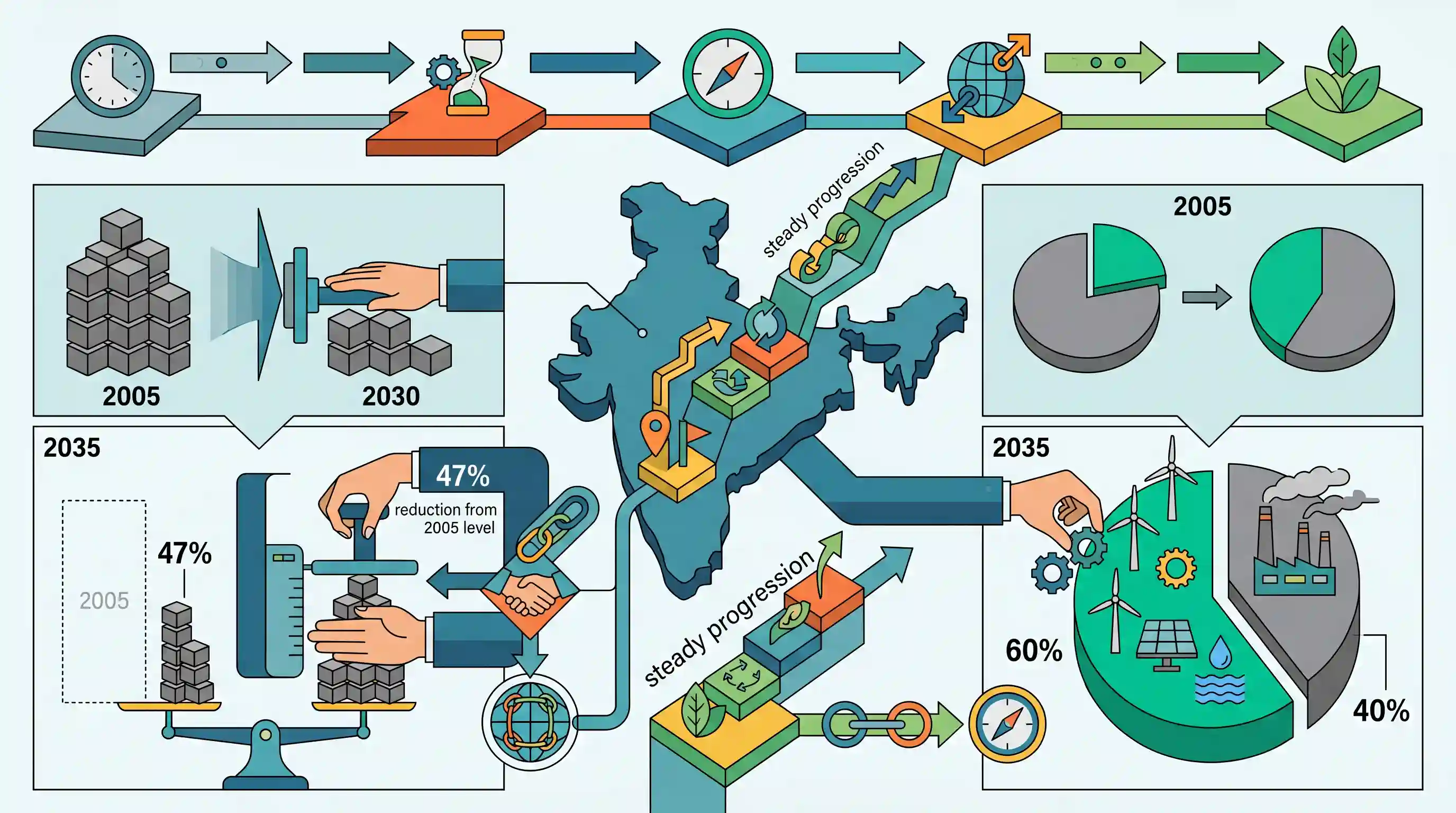
India has announced updated Nationally Determined Contributions (NDCs) for 2035 under the Paris Agreement. The new climate targets include reducing the emission intensity of its GDP by 47% from 2005 levels and achieving 60% of its cumulative electric power installed capacity from non-fossil fuel sources. These targets build upon the previously set 2030 goals, demonstrating a steady progression in India's commitment to combatting climate change and transitioning toward clean energy, aligning with its ultimate objective of reaching net-zero emissions by 2070.
Key Points
- India has updated its Nationally Determined Contributions (NDCs), setting a target to reduce the emission intensity of its GDP by 47% by 2035 compared to 2005 levels.
- A new target has been established to achieve 60% of cumulative electric power installed capacity from non-fossil fuel-based energy resources by 2035.
- These 2035 goals represent a progression from India's 2030 targets, which aimed for a 45% emission intensity reduction and 50% non-fossil electricity capacity.
- The updated targets act as intermediate milestones in India's long-term strategy to achieve net-zero carbon emissions by 2070.
Important Terms
Nationally Determined Contributions (NDCs)

Climate action plans submitted by countries under the Paris Agreement outlining national emission reduction and adaptation targets, updated every five years with increasing ambition.
UPSC context
GS III (Environment). Essential for understanding India’s global climate commitments and domestic policy alignment.
Paris Agreement
A legally binding international treaty on climate change adopted in 2015 to limit global warming to well below 2°C (preferably 1.5°C) above pre-industrial levels.
UPSC context
GS II (IR) and GS III (Environment). Represents the primary global legal framework for climate action.
UNFCCC
The 1992 parent treaty aimed at stabilizing greenhouse gas concentrations; it establishes the framework for annual COPs and the principle of 'Common but Differentiated Responsibilities'.
UPSC context
GS III (Environment). Foundational to international environmental law and multilateral climate negotiations.
Emission Intensity
The volume of greenhouse gas emissions produced per unit of GDP, indicating the carbon efficiency of a country's economic growth.
UPSC context
GS III (Economy/Environment). Vital for tracking India's progress in decoupling economic growth from environmental degradation.
Net-Zero Emissions
A state where total greenhouse gas emissions released into the atmosphere are balanced by the amount removed, achieving a net-neutral impact on the climate.
UPSC context
GS III (Environment). Relates to India's long-term 2070 target for climate stabilization.
Prelims Trap
"India aims to reduce absolute emissions by 47% and achieve 60% power generation from renewables by 2035."
India's NDCs target 'emission intensity of GDP', not absolute emissions. Furthermore, the 60% non-fossil target applies strictly to 'installed capacity', not actual electricity generation.
Static Concepts Connected
What are the core mechanisms of the Paris Agreement driving NDC updates?
- Ratchet Mechanism: Requires countries to submit updated NDCs every 5 years with progressively higher ambitions, preventing backsliding.
- Global Stocktake: A five-yearly periodic review of the world's collective progress toward achieving the Paris Agreement's long-term climate goals.
- CBDR-RC: Acknowledges different national capabilities, economic realities, and historical responsibilities in addressing global climate change.
How does Installed Capacity differ from Power Generation in the energy sector?
- Installed Capacity: The maximum theoretical electrical output a power plant can produce under ideal, continuous conditions.
- Power Generation: The actual volume of electricity produced over time, which depends heavily on the Plant Load Factor (PLF).
- The Renewables Gap: Solar and wind have much lower PLFs than coal; thus, 60% non-fossil capacity yields significantly less than 60% of total generated electricity.
Cross-Topic Patterns
Energy Transition vs Critical Minerals
Reaching 60% non-fossil capacity requires massive solar PV and battery storage rollout, shifting India's import dependency from Middle Eastern oil to Chinese critical minerals and rare earths.
NDCs and Carbon Border Tariffs
Despite ambitious domestic NDC targets, India's high-carbon export industries (steel, cement) face rising friction with developed nations due to unilateral trade tools like the EU's Carbon Border Adjustment Mechanism (CBAM).

Expect a 2026 question swapping 'installed capacity' for 'generation' or confusing 'absolute emissions' with 'emission intensity'.
Linked PYQs · 3
Linked PYQs · 3
- 2025MainsGS3
Write a review on India's climate commitments under the Paris Agreement (2015) and mention how these have been further strengthened in COP26 (2021). In this direction, how has the first Nationally Determined Contribution intended by India been updated in 2022?
- 2022MainsGS3
Do you think India will meet 50 percent of its energy needs from renewable energy by 2030 ? Justify your answer. How will the shift of subsidies from fossil fuels to renewables help achieve the above objective ? Explain.
- 2025PrelimsGS1
Consider the following statements : Statement I: Article 6 of the Paris Agreement on climate change is frequently discussed in global discussions on sustainable development and climate change. Statement II: Article 6 of the Paris Agreement on climate change sets out the principles of carbon markets. Statement III : Article 6 of the Paris Agreement on climate change intends to promote inter-country non-market strategies to reach their climate targets. Which one of the following is correct in respect of the above statements?
