Habitat fragmentation and human-elephant conflict in central India
Source:Indian Express ↗
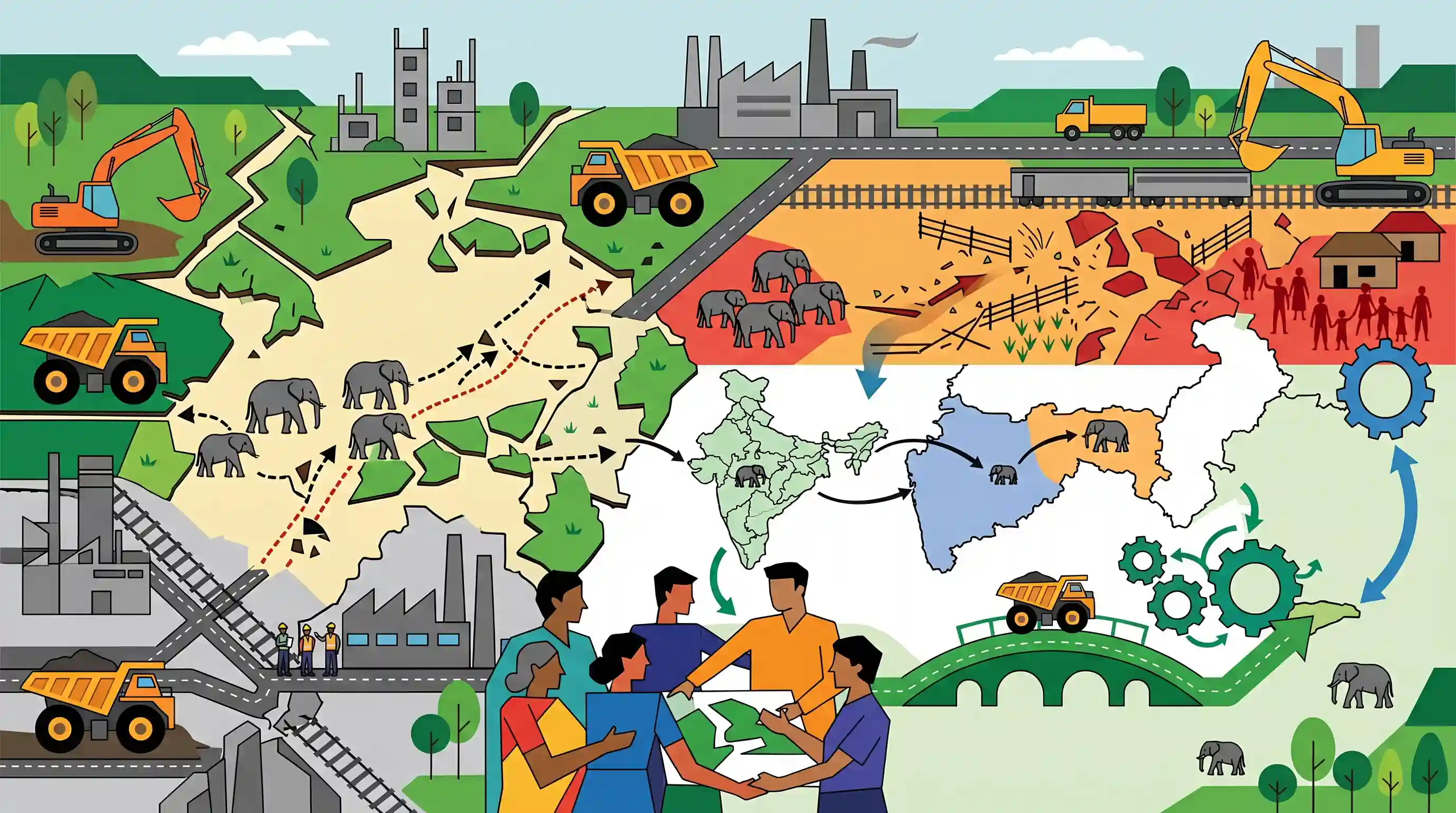
Why It Matters
Human-animal conflict is a prominent theme in UPSC Environment sections. The phenomenon of 'stateless' herds highlights critical governance gaps in wildlife management across state boundaries and the real-world consequences of habitat fragmentation.
Summary
An escalating human-elephant conflict in Central India has created a severe crisis, where merely 8% of the country's elephant population is responsible for 50% of all conflict-related human fatalities. Driven by severe habitat fragmentation, mining, and infrastructural expansion, "stateless" elephant herds are forced to migrate continuously across the borders of Odisha, Chhattisgarh, Jharkhand, and Madhya Pradesh. This constant movement outside Protected Areas brings them into frequent, fatal contact with local populations. The crisis underscores the urgent need for robust inter-state conservation strategies, the protection of historical elephant corridors, and coordinated management policies rather than fragmented state-level interventions.
Key Points
- Despite hosting only 8% of India's elephant population, the Central Indian region accounts for approximately half of all human fatalities caused by elephant encounters.
- The crisis is primarily driven by severe habitat fragmentation resulting from mining, linear infrastructure development, and agricultural expansion, which forces elephants out of shrinking dense forests.
- 'Stateless herds' continuously migrate across the borders of Odisha, Chhattisgarh, Jharkhand, and Madhya Pradesh, complicating jurisdiction and rendering isolated, state-level conservation efforts ineffective.
- Mitigating the conflict requires robust inter-state coordination, restoration of traditional elephant corridors, and community-led early warning systems.
Important Terms
Wildlife (Protection) Act, 1972

India's primary legal framework for protecting plant and animal species. It establishes protected areas, regulates hunting, and categorizes species into schedules based on the level of protection required.
UPSC context
Crucial for GS Paper 3 (Environment). Tests knowledge of legal conservation frameworks and species protection status (Schedules).
Project Elephant
A centrally sponsored scheme launched in 1992 to protect elephants, their habitats, and corridors. It addresses human-elephant conflict and ensures the welfare of both wild and captive elephants.
UPSC context
Relevant for GS Paper 3 (Biodiversity). Tests understanding of species-specific conservation strategies and inter-state coordination.
Elephant Corridors
Narrow strips of land that act as conduits, connecting larger forest habitats. They allow elephants to migrate safely, maintaining genetic diversity and reducing contact with human settlements.
UPSC context
High importance for Prelims and Mains (GS 3). Focuses on habitat connectivity and conflict mitigation strategies.
Habitat Fragmentation
The process where large, continuous habitats are broken into smaller, isolated patches due to infrastructure, mining, or agriculture, disrupting migration and increasing human-wildlife encounters.
UPSC context
Key concept for GS Paper 3 (Environment). Tests analytical ability regarding developmental impacts on biodiversity.
Human-Wildlife Conflict (HWC)
Negative interactions between people and wildlife that result in property damage, loss of life, or retaliatory killing of animals, often driven by shrinking natural habitats.
UPSC context
Frequent Mains topic (GS 3). Requires knowledge of mitigation techniques like early warning systems and compensation policies.
Keystone Species
A species that has a disproportionately large effect on its natural environment relative to its abundance, such as elephants, which create forest paths and waterholes for other animals.
UPSC context
Fundamental ecological concept for Prelims. Tests understanding of ecosystem roles and interdependence.
National Heritage Animal
A formal status granted to the Asian Elephant by India in 2010 to strengthen its conservation and highlight its cultural and ecological importance to the nation.
UPSC context
Fact-based detail for Prelims. Highlights India's specific conservation priorities and symbolic species protection.
Prelims Trap
Central India accounts for most elephant-related fatalities because it hosts the highest elephant population.
It is a paradox: Central India accounts for ~50% of human fatalities despite hosting less than 8% of India's wild elephants. South India has the highest population.
Static Concepts Connected
What is the conservation status and ecology of the Asian Elephant?
- Legal Status: Listed under Schedule I of the Wildlife (Protection) Act, 1972, IUCN Red List as Endangered, and CITES Appendix I.
- Social Structure: Herds are matriarchal, led by the oldest and largest female.
- Gestation Period: They have the longest known gestation period among all mammals, lasting up to 22 months.
How is the conservation of elephants structurally managed in India?
- Project Elephant: Launched in 1992 as a Centrally Sponsored Scheme to provide financial and technical support to states.
- Administrative Merger: In 2023-24, Project Elephant was merged with Project Tiger to form an integrated program under the National Tiger Conservation Authority (NTCA).
- Identified Corridors: The 'Elephant Corridors of India 2023' report identifies 150 corridors, with West Bengal hosting the highest number of any state.
Cross-Topic Patterns
Mining expansion vs. Elephant Corridors
The expansion of coal and iron ore mining in the Chota Nagpur plateau (Singhbhum, Keonjhar) directly links resource extraction policies with forced 'stateless' elephant migration and habitat fragmentation.
Federalism challenges in wildlife jurisdiction
'Stateless herds' crossing Odisha, Chhattisgarh, Jharkhand, and MP borders highlight the limitations of state-specific forest administration, demanding regional, inter-state cooperative federalism for wildlife management.

Expect a paired-statement question in 2026 contrasting elephant population distribution (South) against conflict hotspots (Central).
Linked PYQs · 3
Linked PYQs · 3
- 2020PrelimsGS1
With reference to Indian elephants, consider the following statements: 1. The leader of an elephant group is a female. 2. The maximum gestation period can be 22 months. 3. An elephant can normally go on calving till the age of 40 years only. 4. Among the States in India, the highest elephant population is in Kerala. Which of the statements given above is/are correct?
- 2022PrelimsGS1
With reference to Indian laws about wildlife protection, consider the following statements : 1. Wild animals are the sole property of the government. 2. When a wild animal is declared protected, such animal is entitled for equal protection whether it is found in protected areas or outside. 3. Apprehension of a protected wild animal becoming a danger to human life is sufficient ground for its capture or killing. Which of the statements given above is/are correct?
- 2024MainsGS3
What role do environmental NGOs and activists play in influencing Environmental Impact Assessment (EIA) outcomes for major projects in India? Cite four examples with all important details.
