India UK FTA negotiations and premium automobile duty cuts
Source:Indian Express ↗
Why It Matters
This issue perfectly illustrates the trade-offs in FTAs (Free Trade Agreements). UPSC aspirants must understand how tariff barriers are used surgically to protect domestic industries (like mass-market autos) while offering concessions in non-competing sectors (like premium autos) to secure broader diplomatic and economic pacts.
Summary
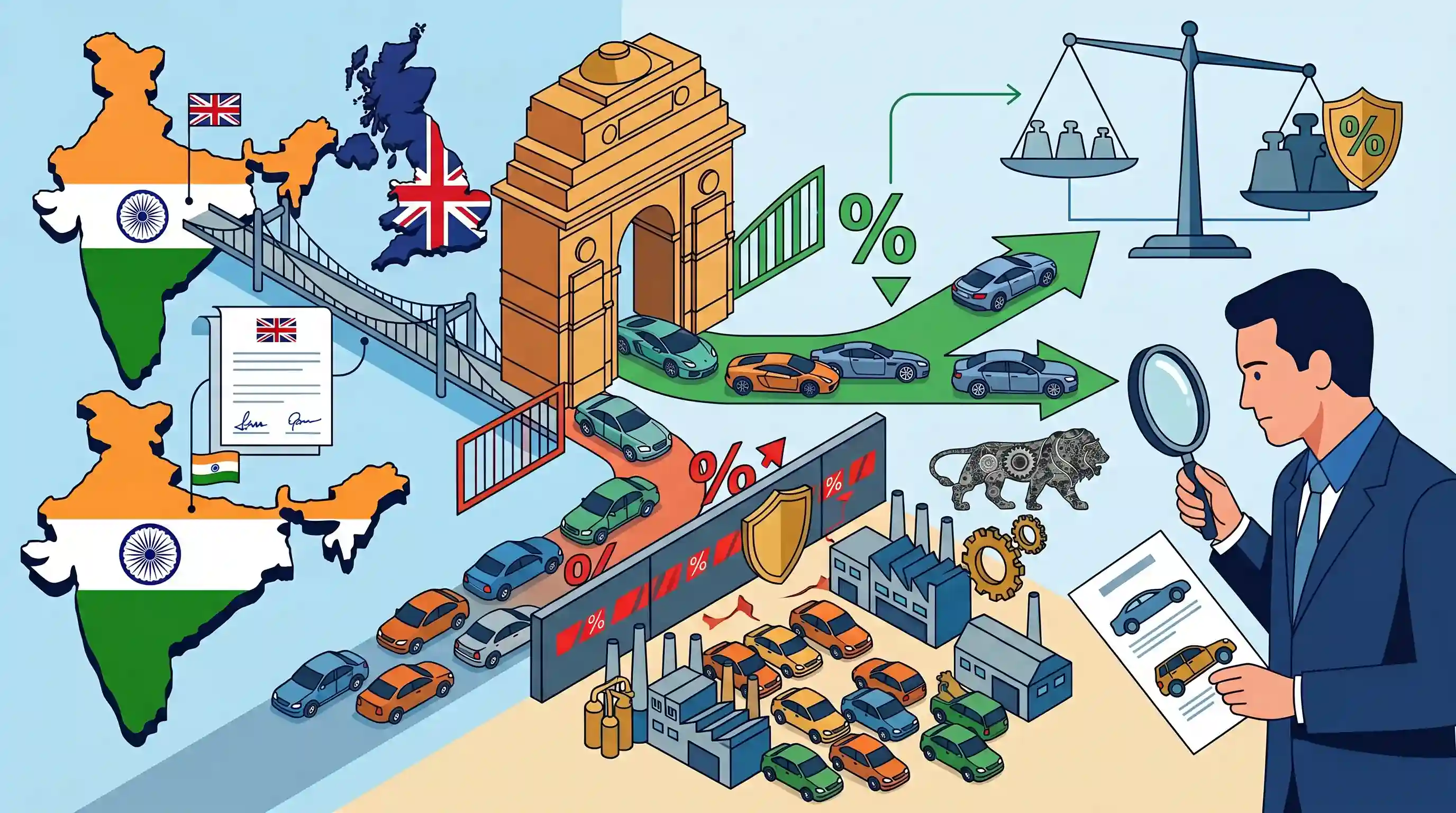
During ongoing India-UK Free Trade Agreement (FTA) negotiations, a UK official noted that India's proposed import duty cuts on automobiles are primarily restricted to the "premium" vehicle segment. This targeted tariff reduction strategy reflects India's intent to protect its domestic mass-market automakers—key to its 'Make in India' goals—while offering limited market access to British luxury manufacturers. The move highlights the broader challenge of balancing domestic protectionism with bilateral trade liberalization.
Key Points
- Automobile import tariffs are a major sticking point in the ongoing India-UK Free Trade Agreement (FTA) negotiations.
- India's proposed duty concessions on automobiles will predominantly apply to the 'premium' or luxury segment rather than mass-market vehicles.
- This targeted tariff reduction aims to protect domestic Indian mass-market automakers while providing market access to British luxury car manufacturers.
- The strategy underscores India's balancing act between negotiating bilateral trade pacts and pursuing its domestic 'Make in India' manufacturing agenda.
Important Terms
India-UK Free Trade Agreement (FTA)

A bilateral pact aiming to double trade by 2030 through tariff reductions on 99% of Indian exports and lower duties on British cars, whisky, and machinery.
UPSC context
GS Paper 2: Bilateral agreements; GS Paper 3: Effects of liberalization on Indian economy and industrial growth.
Make in India
Launched in 2014, this flagship initiative encourages domestic manufacturing and design to transform India into a global manufacturing hub while protecting local industries via calibrated tariffs.
UPSC context
GS Paper 3: Industrial policy and its impact on manufacturing; investment models and self-reliance (Atmanirbhar Bharat).
Jaguar Land Rover (JLR)
A British luxury automaker owned by India's Tata Motors. It serves as a focal point in India-UK trade talks regarding premium vehicle tariffs and local assembly.
UPSC context
GS Paper 3: Significant Indian investments abroad and corporate diplomacy in bilateral trade relations.
Completely Built Units (CBU)
Vehicles or goods imported in a fully assembled state. In India, CBUs often face the highest import duties (60–100%+) to encourage local assembly.
UPSC context
GS Paper 3: Trade policy; specifically the use of tariff structures to promote domestic value addition.
Tariff Rate Quota (TRQ)
A trade policy tool that allows a lower tariff rate for a specific volume of imports, with higher duties applied once the limit is exceeded.
UPSC context
GS Paper 3: International trade mechanisms and WTO-compliant market access strategies.
Economic Protectionism
Government policies that restrict international trade to help domestic industries, often through tariffs, quotas, or subsidies to prevent foreign competition.
UPSC context
GS Paper 3: Challenges of globalization vs. domestic growth; trade wars and their impact on emerging economies.
Prelims Trap
"Under FTAs, India eliminates Basic Customs Duty on all segments of imported passenger vehicles."
India heavily utilizes Tariff Rate Quotas (TRQs) and segmented cuts (e.g., only on luxury cars) in FTAs to protect domestic mass-market manufacturers.
Static Concepts Connected
What is CAROTAR 2020 and why is it crucial for FTAs?
- Rules of Origin: Prevents third countries (e.g., China) from dumping goods by routing them through an FTA partner nation to bypass tariffs.
- Value Addition: Importers must furnish proof of minimum domestic value addition (typically 35%) occurring within the exporting FTA partner country.
- Strict Compliance: Shifts the burden of proof to the Indian importer, empowering customs to deny preferential FTA tariffs if origin data is insufficient.
What are Tariff Rate Quotas (TRQs) in international trade?
- Two-Tier Tariffs: Allows a specific, predetermined quantity of a product to be imported at a lower or zero tariff rate.
- Excess Penalties: Any imports that exceed the defined quota volume automatically face a significantly higher, standard protective tariff rate.
- Balancing Tool: Acts as a strategic compromise to grant FTA partners limited market access without overwhelming domestic producers.
Cross-Topic Patterns
Auto PLI + FTA Protectionism
India's refusal to cut mass-market auto tariffs directly shields the ₹25,938 crore Auto PLI scheme, ensuring domestic capacity building isn't undercut by cheap imports.
New EV Import Policy vs FTA Limits
Recent policies allow concessional tariffs for global EV makers if they invest locally (Make in India), creating a dual-track tariff regime alongside traditional FTA negotiations.

A combined Prelims question linking Rules of Origin (CAROTAR 2020), Tariff Rate Quotas (TRQs), and FTA exceptions is highly probable.
Linked PYQs · 3
Linked PYQs · 3
- 2025MainsGS3
What are the challenges before the Indian economy when the world is moving away from free trade and multilateralism to protectionism and bilateralism? How can these challenges be met?
- 2023MainsGS3
Faster economic growth requires increased share of the manufacturing sector in GDP, particularly of MSMEs. Comment on the present policies of the Government in this regard.
- 2018PrelimsGS1
Consider the following countries: 1. Australia 2. Canada 3. China 4. India 5. Japan 6. USA Which of the above are among the 'free-trade partners' of ASEAN?
