Doping Crisis and Integrity Challenges in Indian Sports
Source:Indian Express ↗
Why It Matters
Sports governance and regulatory bodies have gained prominence in UPSC following recent legislative efforts like the Anti-Doping Bill and India's growing ambitions in global sports. Understanding the institutional and ethical failures in anti-doping mechanisms is crucial for analyzing governance deficits, social issues related to youth development, and institutional accountability.
Summary
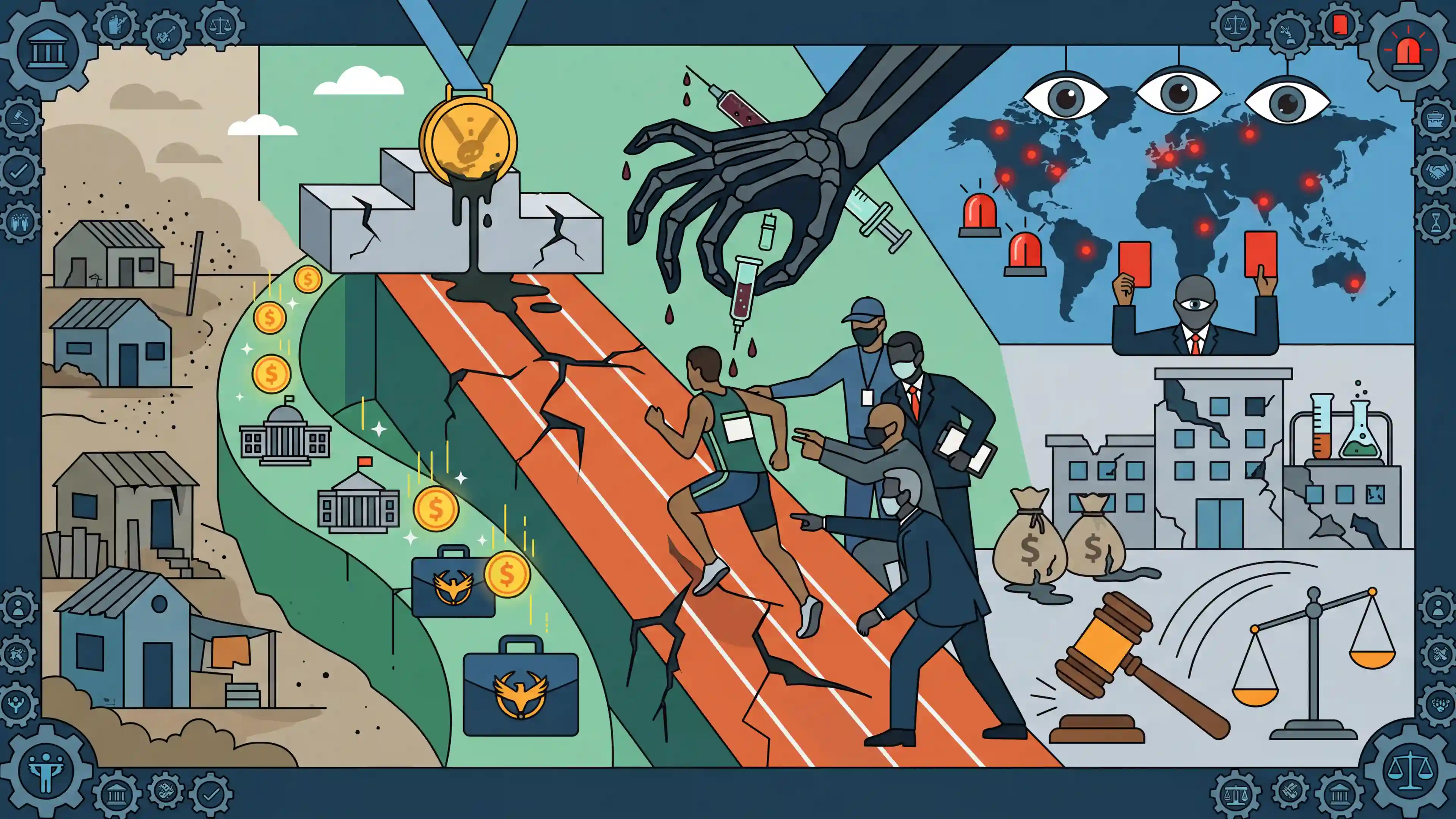
The article examines the severe doping epidemic undermining the integrity of Indian sports. Driven by a "medal-at-all-costs" culture, athletes and complicit coaches resort to performance-enhancing drugs, often viewing sporting success as a critical pathway out of poverty via government jobs. Global bodies like WADA and AIU have flagged India's high rate of doping violations. Meanwhile, domestic anti-doping mechanisms suffer from reduced funding, past laboratory suspensions, and a lack of stringent legal deterrence, as the 2022 Anti-Doping Bill failed to criminalise doping. This situation presents a complex challenge intertwining sports governance, ethics, and socio-economic pressures.
Key Points
- India has emerged as a major producer and consumer of performance-enhancing drugs, topping the global list of dope cheats between 2023 and 2025.
- The World Anti-Doping Agency (WADA) and Athletics Integrity Unit (AIU) have severely criticized India's sporting integrity and testing mechanisms.
- Despite the passage of the Anti-Doping Bill in 2022, the government failed to criminalise doping, limiting deterrence.
- Institutional mechanisms remain weak, highlighted by a budget reduction for NADA and the NDTL, the latter having been previously suspended by WADA.
- A socio-economic driver for the doping epidemic is the reliance on sports for government jobs to escape poverty, coupled with complicit coaches prioritizing results over ethics.
Important Terms
World Anti-Doping Agency (WADA)

Global authority established in 1999 to harmonize anti-doping policies across nations. It maintains the 'Prohibited List' and monitors compliance with the World Anti-Doping Code to ensure fair competition.
UPSC context
GS Paper II (International Organizations); focuses on global standards and India's obligations under international sports treaties.
National Anti-Doping Agency (NADA)
India's statutory body responsible for implementing anti-doping rules domestically. It manages test results, conducts awareness programs, and aligns Indian sports with the World Anti-Doping Code.
UPSC context
GS Paper II (Statutory Bodies) and Paper IV (Ethics); tests understanding of domestic integrity mechanisms and enforcement of standards.
Athletics Integrity Unit (AIU)
Independent organization established by World Athletics to combat doping and corruption. It monitors national federations and recently designated India as a high-risk 'Category A' nation due to high violation rates.
UPSC context
GS Paper II and Prelims; examines international oversight and the impact of doping on India’s global sporting reputation.
National Anti-Doping Act, 2022
Law providing statutory backing to NADA and establishing a National Board for Anti-Doping. It strengthens investigative powers and aligns Indian sports governance with international UNESCO conventions.
UPSC context
GS Paper II (Government Policies/Governance); tests knowledge of legal frameworks for ensuring ethics and integrity in Indian sports.
National Dope-Testing Laboratory (NDTL)
India's WADA-accredited facility for analyzing athlete samples to detect banned substances. It ensures scientific integrity and compliance with global anti-doping standards in sports testing.
UPSC context
GS Paper II (Regulatory Bodies) and Paper III (S&T); tests technical infrastructure capacity in sports governance.
Khelo India
Flagship government scheme aimed at grassroots sports development and talent identification. It provides financial assistance (₹5 lakh annually for 8 years) to talented youth to foster a robust sports culture.
UPSC context
GS Paper II (Human Resource Development/Policies); evaluates strategies for grassroots empowerment and identifying future sporting talent.
Prelims Trap
The National Anti-Doping Act, 2022 criminalises doping in sports and prescribes imprisonment for guilty athletes.
The 2022 Act confers statutory status on NADA and focuses on sporting sanctions, but it deliberately avoids making doping a criminal offence.
Static Concepts Connected
What are the core provisions of the National Anti-Doping Act, 2022?
- Statutory Status: Confers statutory recognition upon the National Anti-Doping Agency (NADA) and the National Dope Testing Laboratory (NDTL).
- UNESCO Compliance: Enacted to fulfill India's commitments under the UNESCO International Convention Against Doping in Sport.
- Disciplinary Mechanisms: Establishes a National Anti-Doping Disciplinary Panel to adjudicate anti-doping rule violations and impose sporting sanctions.
What is the global regulatory framework for anti-doping?
- WADA: The World Anti-Doping Agency drafts and monitors the World Anti-Doping Code, coordinating global anti-doping policies.
- UNESCO Convention: The 2005 UNESCO Convention provides the legal framework for governments to align domestic policies with the WADA Code.
- Sport-Specific Units: Independent bodies like the Athletics Integrity Unit (AIU) manage doping and ethical issues for specific international sports federations.
Cross-Topic Patterns
Ethics: Ends vs Means in Sports
The 'medal-at-all-costs' culture serves as a classic GS4 case study where ethical means (fair play) are abandoned for desirable ends (fame, financial security).
Perverse Incentives of Job Quotas
While sports quotas in government jobs aim to support athletes, tying employment strictly to medal outcomes inadvertently fuels socio-economic desperation and systemic doping.

Expect a GS2/GS4 question linking sports governance deficits and the 'medal-at-all-costs' culture to ethical failures in India.
Linked PYQs · 4
Linked PYQs · 4
- 2015MainsGS4
Today we find that in spite of various measures like prescribing codes of conduct, setting up vigilance cells/commissions, RTI, active media and strengthening of legal mechanisms, corrupt practices are not coming under control. Evaluate the effectiveness of these measures with justifications.
- 2023PrelimsGS1
Consider the following pairs with regard to sports awards: 1. Major Dhyan Chand Khel Ratna Award : For the most spectacular and outstanding performance by a sportsperson over period of last four years 2. Arjuna Award : For the lifetime achievement by a sportsperson 3. Dronacharya Award : To honour eminent coaches who have successfully trained sportspersons or teams 4. Rashtriya Khel Protsahan Puraskar : To recognize the contribution made by sportspersons even after their retirement How many of the above pairs are correctly matched?
- 2023PrelimsGS1
Consider the following statements in respect of the 44th Chess Olympiad, 2022: 1. It was the first time that Chess Olympiad was held in India. 2. The official mascot was named 'Thambi'. 3. The trophy for the winning team in the open section is the Vera Menchik Cup. 4. The trophy for the winning team in the women's section is the Hamilton-Russell Cup. How many of the above statements are correct?
- 2023MainsGS2
The crucial aspect of development process has been the inadequate attention paid to Human Resource Development in India. Suggest measures that can address this inadequacy.
