Constitutional Framework of Linguistic Pluralism in India
Source:Indian Express ↗
Why It Matters
Linguistic diversity is a core tenet of Indian society and a recurring theme in UPSC exams, spanning Post-Independence history (linguistic reorganisation), Indian Society (unity in diversity), and Polity (Eighth Schedule and Official Language debates).
Summary
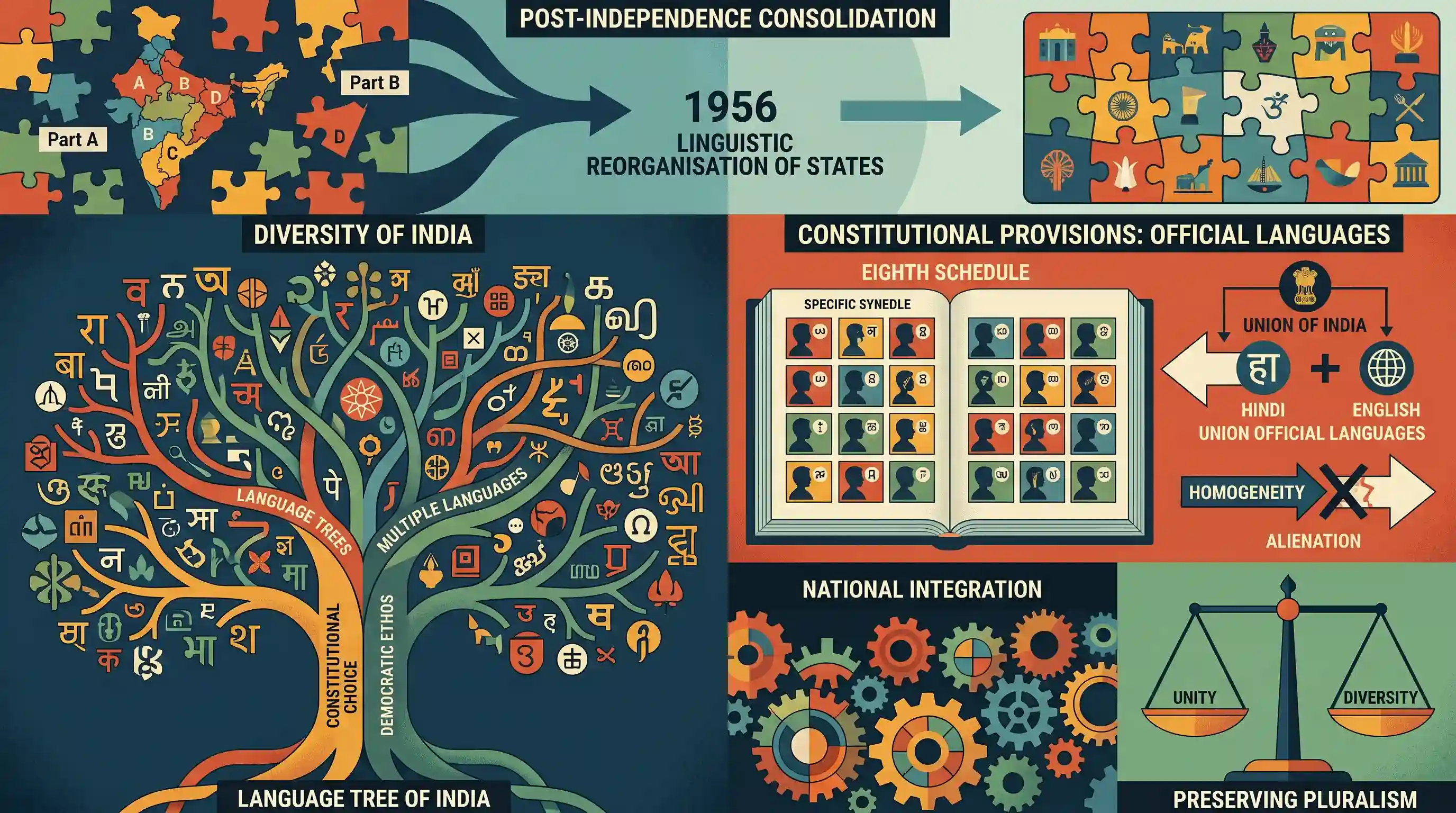
The article underscores the importance of India's linguistic diversity, arguing that the country's constitutional choice to embrace multiple languages rather than imposing a single national language is foundational to its unity. It emphasizes that attempts to enforce linguistic homogeneity contradict the democratic ethos and historical compromises that have kept the nation together, such as the linguistic reorganisation of states and the inclusion of multiple languages in the Eighth Schedule. Preserving this linguistic pluralism is essential to prevent alienation and maintain national integration.
Key Points
- India's constitutional framers deliberately chose linguistic diversity by accommodating multiple regional languages rather than imposing a single national language.
- The Eighth Schedule and the linguistic reorganisation of states serve as institutional mechanisms that have historically preserved national unity by respecting regional identities.
- Attempts at linguistic imposition or homogeneity threaten the delicate balance of India's pluralistic society and run counter to its democratic ethos.
- Maintaining linguistic harmony requires adherence to inclusive frameworks like the three-language formula, ensuring that language acts as a bridge rather than a barrier.
Important Terms
Eighth Schedule of the Constitution

A constitutional list (Articles 344(1) and 351) recognizing 22 languages. It ensures their representation in official commissions and promotes their development, serving as a key safeguard for India’s linguistic diversity.
UPSC context
GS Paper II (Polity/Society); tests knowledge of constitutional safeguards for linguistic diversity and their role in national integration.
States Reorganisation Act, 1956
A 1956 landmark law that restructured India’s internal boundaries along linguistic lines. It abolished colonial-era state classifications, creating 14 states and 6 union territories to improve administrative efficiency and cultural unity.
UPSC context
GS Paper I (Post-Independence Consolidation); evaluates understanding of how linguistic states helped stabilize Indian federalism.
Official Languages Act, 1963
Legislation enacted to allow the continued use of English alongside Hindi for official Union purposes after 1965. It acts as a federal compromise to address the concerns of non-Hindi-speaking states.
UPSC context
GS Paper II (Polity/Governance); relevant for understanding federal tensions, language policy, and administrative inclusivity.
Constituent Assembly
The sovereign body (1946–1950) responsible for drafting India’s Constitution. It navigated intense debates on language and identity, choosing a pluralistic framework to maintain national unity across diverse communities.
UPSC context
GS Paper I & II; focuses on the historical evolution of the Constitution and the philosophical foundations of Indian democracy.
Prelims Trap
"Hindi is the officially designated National Language of India under Article 343."
The Indian Constitution deliberately avoids defining a 'National Language'. Article 343 designates Hindi and English strictly as the 'Official Languages' of the Union.
Static Concepts Connected
How did the Eighth Schedule expand from 14 to 22 languages?
- 21st Amendment (1967): Added Sindhi to the Eighth Schedule.
- 71st Amendment (1992): Added Konkani, Manipuri, and Nepali.
- 92nd Amendment (2003): Added Bodo, Dogri, Maithili, and Santhali.
What constitutional protections exist for linguistic minorities in India?
- Article 29: Grants any section of citizens the fundamental right to conserve their distinct language, script, or culture.
- Article 350A: Directs states to provide facilities for primary education in the mother tongue for children of linguistic minority groups.
- Article 350B: Mandates the appointment of a Special Officer for Linguistic Minorities to investigate safeguards; inserted by the 7th Amendment (1956).
Cross-Topic Patterns
NEP 2020 + Three-Language Formula
The Kothari Commission's 1968 three-language formula directly connects to NEP 2020's mandate for mother-tongue foundational learning and flexible multilingualism, bridging historical Polity with modern Governance.
Linguistic Reorganization + Asymmetric Federalism
The States Reorganisation Act (1956) based on the Fazal Ali Commission is a classic Mains GS1 theme demonstrating how linguistic federalism strengthened, rather than compromised, Indian unity.

Expect a Prelims 'matching pairs' question linking Eighth Schedule languages to their specific Constitutional Amendments (21st, 71st, 92nd).
Linked PYQs · 3
Linked PYQs · 3
- 2016MainsGS1
Has the formation of linguistic States strengthened the cause of Indian Unity?
- 2024PrelimsGS1
The Constitution (71st Amendment) Act, 1992 amends the Eighth Schedule to the Constitution to include which of the following languages? 1. Konkani 2. Manipuri 3. Nepali 4. Maithili Select the correct answer using the code given below:
- 2008PrelimsGS1
Under which one of the following Constitution Amendment Acts, four languages were added to the languages under the Eighth Schedule of the Constitution of India, thereby raising their number to 22?
