First Direct Container Freight Train From India To Nepal
Source:Indian Express ↗
આ શા માટે મહત્વનું છે
Seamless cross-border connectivity is essential for integrating South Asia's economy. Providing efficient transit corridors for landlocked neighbors like Nepal is a strategic imperative under India's 'Neighborhood First' policy, strengthening bilateral trust and reducing Nepal's dependence on alternative regional actors.
સારાંશ
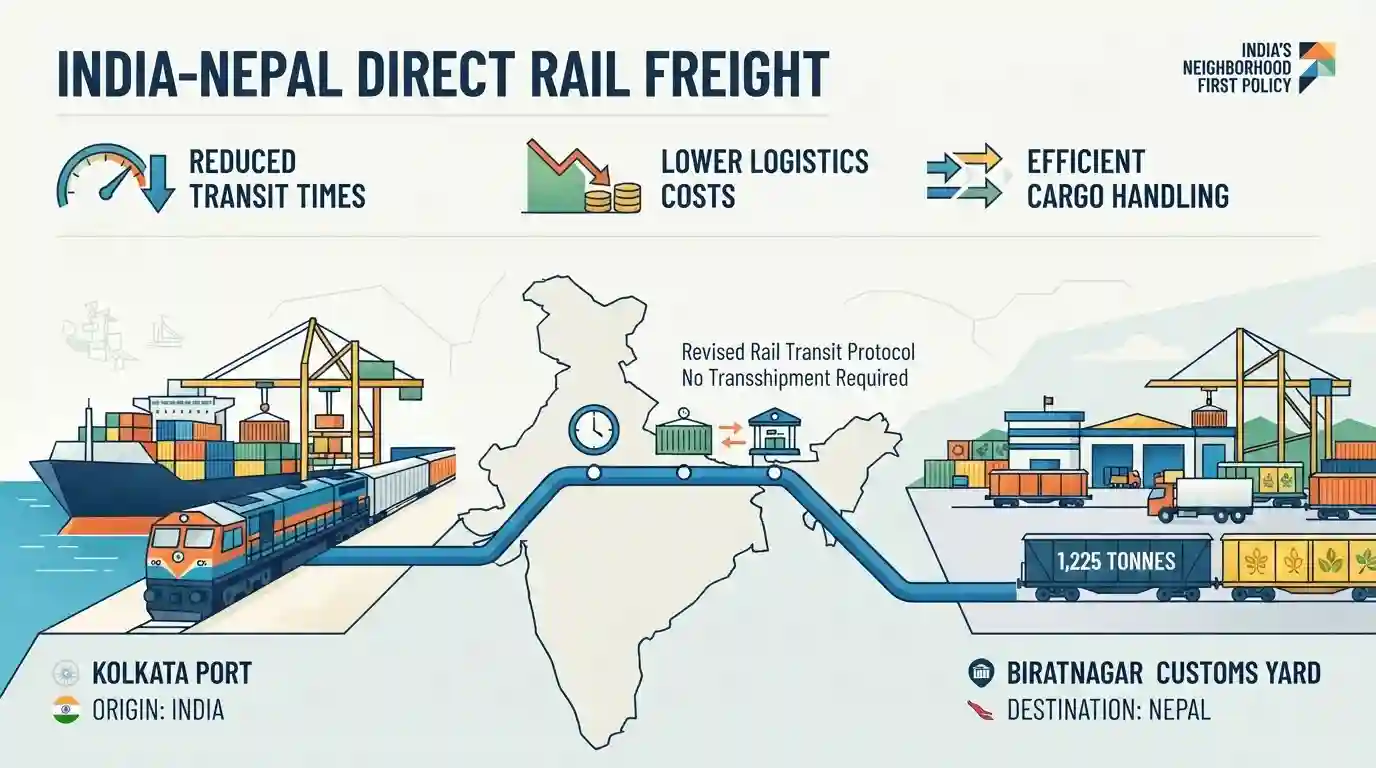
India has successfully launched its first direct commercial container freight train to Nepal, transporting 1,225 tonnes of canola from the Kolkata port to the Biratnagar customs yard. The train utilized the newly constructed broad-gauge railway line between Jogbani in Bihar and Biratnagar in Nepal. This direct freight service was made possible by the revised India-Nepal Rail Transit Protocol, which eliminates the traditional requirement for transshipment at the border. Consequently, the initiative promises to significantly cut down transit times, lower logistics costs, and streamline cargo handling for Nepal-bound trade. This development serves as a practical demonstration of India's 'Neighborhood First' policy, aimed at enhancing cross-border infrastructure and deepening economic ties with neighboring countries.
મુખ્ય મુદ્દા
- India launched its first direct commercial container freight train to Nepal, carrying 1,225 tonnes of canola from Kolkata port.
- The train travelled to the Biratnagar customs yard in Nepal via the newly completed broad-gauge railway line connecting Jogbani (Bihar) and Biratnagar.
- The operation is facilitated by the revised India-Nepal Rail Transit Protocol, which allows seamless cross-border freight movement without the need for transshipment.
- This direct link drastically reduces transit times, lowers logistics costs, and minimizes cargo handling, thereby boosting bilateral trade efficiency.
- The project highlights India's ongoing commitment to its 'Neighborhood First' policy by strengthening physical connectivity and economic integration with its landlocked neighbor.
મહત્વપૂર્ણ શબ્દો
India-Nepal Rail Transit Protocol

A bilateral transit agreement amended to permit seamless, direct rail movement of containerized and bulk cargo between Indian ports and Nepal, eliminating the time-consuming transshipment requirement at the border.
UPSC context
GS Paper II (India and neighborhood relations); tests bilateral trade facilitation, transit treaties, and economic diplomacy.
Neighborhood First Policy
India's core diplomatic doctrine prioritizing political, economic, and physical connectivity with immediate South Asian neighbors to ensure regional stability, prosperity, and counter external geopolitical influences.
UPSC context
GS Paper II (India and its neighborhood- relations); tests strategic foreign policy doctrines and regional geopolitical integration.
Jogbani-Biratnagar Rail Link
An 18.6-km broad-gauge cross-border railway line built with Indian grant assistance, connecting Bihar in India to Biratnagar in Nepal, facilitating direct containerized bilateral trade.
UPSC context
GS Paper III (Infrastructure: Railways); tests cross-border infrastructure connectivity and logistics efficiency under bilateral trade programs.
Syama Prasad Mookerjee Port
India's oldest operational riverine port located on the Hooghly River in Kolkata, West Bengal, serving as a critical maritime gateway for landlocked neighbors like Nepal and Bhutan.
UPSC context
GS Paper III (Infrastructure: Ports); tests major riverine ports, geographical locations, and regional transit corridors.
પ્રિલિમ્સ ટ્રેપ
All third-country container cargo transit to Nepal requires mandatory physical transshipment and customs clearance at the Indian border customs yard.
The revised Rail Transit Protocol specifically eliminates the border transshipment requirement, permitting direct, sealed container movement from Indian ports to Nepalese customs yards.
સંલગ્ન સ્થિર ખ્યાલો
What are the rights of landlocked states under UNCLOS Article 125?
- Right of Access: Landlocked states have the right of access to and from the sea to enjoy freedom of the high seas.
- Transit Terms: Terms and modalities of transit must be agreed between landlocked and transit states via bilateral agreements.
- Tax Exemption: Traffic in transit is exempt from customs duties, taxes, or other transit charges, except specific service fees.
આંતર-વિષય પેટર્ન
Multi-modal transit and National Waterway-1
Linking Nepal's dry ports to India's National Waterway-1 (Ganga) via Kalughat or Sahibganj terminals creates a cheaper, eco-friendly alternative to rail-only corridors.
Countering China's Trans-Himalayan network
Efficient Indian rail transit directly competes with China's difficult Trans-Himalayan connectivity projects, offering Nepal cheaper and physically easier access to global markets.

Cross-border rail protocols and dry port linkages will likely be tested to evaluate India's non-reciprocal 'Neighborhood First' policy.
સંલગ્ન PYQ · 3
સંલગ્ન PYQ · 3
- 2026PrelimsGS1
Which of the following connectivity projects is/are a part of cooperation between India and the ASEAN member countries ? 1. Kaladan Multi-Modal Transit Transport Project 2. IMT Trilateral Highway 3. Agartala-Akhaura Rail Line Select the answer using the code given below :
- 2021MainsGS3
“Investment in infrastructure is essential for more rapid and inclusive economic growth.” Discuss in the light of India's experience.
- 2012MainsGS2
Discuss the contentious issues that have caused the prolonged constitutional logjam in Nepal.
