Kumbhalgarh Wildlife Sanctuary Declared Eco Sensitive Zone
Source:theclimatewatch ↗
Why It Matters
Important for RPSC RAS aspirants tracking environmental conservation policies, geographical landmarks, and protected wildlife zones in Rajasthan.
Summary
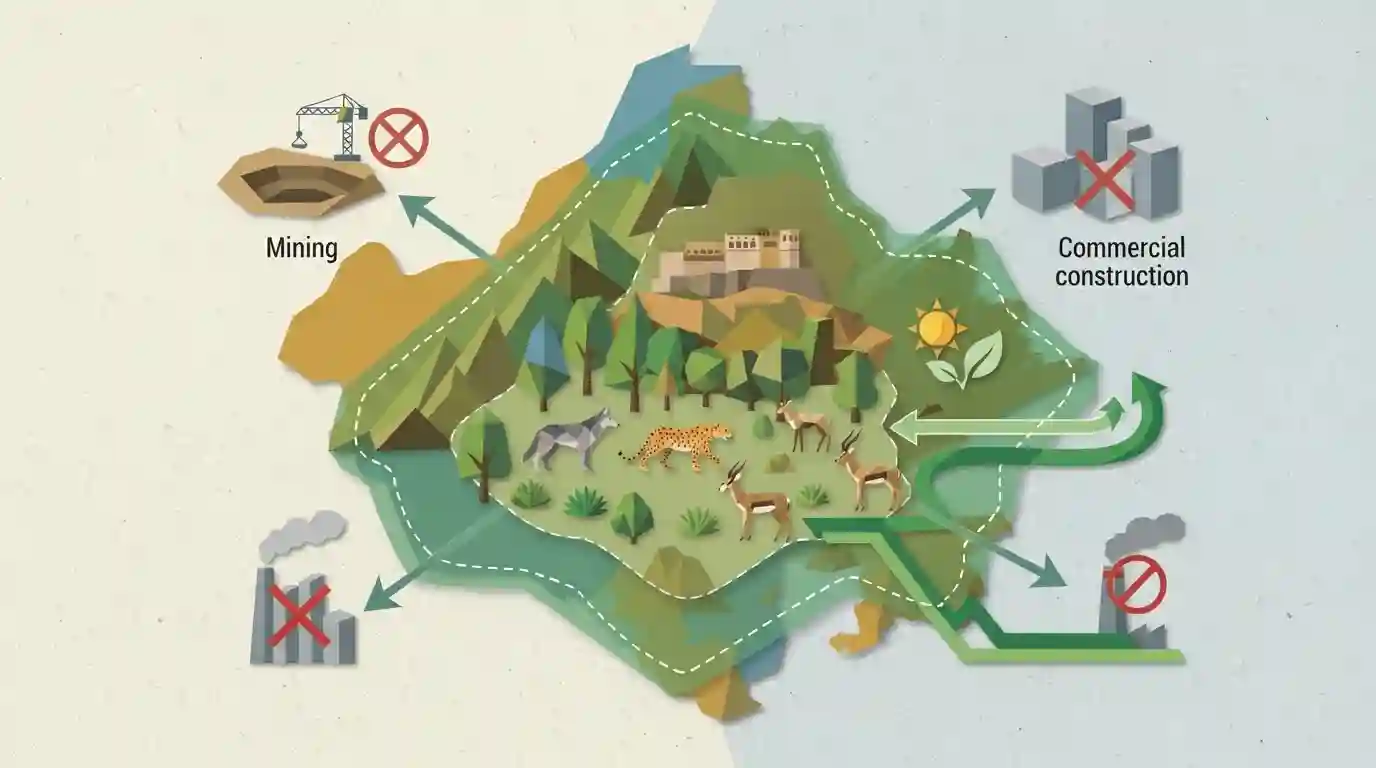
India has officially declared an Eco-Sensitive Zone (ESZ) around the Kumbhalgarh Wildlife Sanctuary in Rajasthan under the Environment (Protection) Act, 1986. The move aims to curb unchecked commercial exploitation, regulate mining and industrial activities, and safeguard the rich biodiversity and regional wildlife corridors of the Aravalli hills.
Key Points
- The government has declared an Eco-Sensitive Zone (ESZ) around the Kumbhalgarh Wildlife Sanctuary in Rajasthan to regulate commercial activities and protect its fragile ecosystem.
- Kumbhalgarh Wildlife Sanctuary spans the Aravalli range across districts like Rajsamand, Udaipur, and Pali, serving as a vital wildlife corridor and habitat for species such as the Indian wolf, leopard, and sloth bear.
- ESZ regulations restrict industrialization, mining, and major construction projects within a designated perimeter around protected areas to act as a shock absorber.
Important Terms
Eco-Sensitive Zone (ESZ) notifications under Environment Protection Act 1986

Buffer zones designated around protected areas under the Environment (Protection) Act, 1986, to act as a shock absorber by regulating activities like mining and commercial construction.
UPSC context
Important for RPSC Paper III (Environment, Biodiversity and Conservation), testing statutory conservation tools and wildlife protection frameworks.
Ministry of Environment, Forest and Climate Change
The apex central government body in India responsible for planning, promoting, and overseeing environmental and forestry policy implementation, including the notification of ESZs.
UPSC context
Relevant for RPSC Polity and Governance / Environment, testing administrative jurisdiction over national conservation policies.
Rajasthan Forest Department
The state-level department responsible for forest management, wildlife protection, and implementing state and central conservation initiatives across Rajasthan.
UPSC context
Crucial for RPSC Rajasthan Geography and Administration papers, testing state-level environment governance and sanctuary management.
Prelims Trap
ESZs around wildlife sanctuaries are statutory creations of the Wildlife Protection Act, 1972.
Aspirants often assume ESZs are created directly under the Wildlife Protection Act 1972, but they are notified under the Environment (Protection) Act, 1986.
Static Concepts Connected
What are Eco-Sensitive Zones (ESZs) and under which statutory framework are they notified in India?
- Statutory Root: Statutory basis: Notified by the Ministry of Environment, Forest and Climate Change (MoEFCC) under Section 3 of the Environment (Protection) Act, 1986.
- Shock Absorber: Buffer function: Act as a shock absorber for protected areas by regulating commercial activities, mining, and large constructions.
- Area Extent: Extent: Generally extend up to 10 kilometers around protected areas, though can vary based on specific ecological sensitivities.
Cross-Topic Patterns
EPA 1986 & Aravalli Ecological Governance
Kumbhalgarh's ESZ notification connects environmental jurisprudence under the EPA 1986 with Rajasthan geography, specifically Aravalli mineral regulation and wildlife corridors.

Expect a matching-list question linking Rajasthan wildlife sanctuaries (Kumbhalgarh, Todgarh Raoli, Mount Abu) with their districts or ESZ provisions.
Linked PYQs · 3
Linked PYQs · 3
- 2023RPSC_PRELIMSGS1
Which of the following pairings is incorrect? Wildlife Sanctuary – District
- 2025RPSC_PRELIMSGS1
Choose the incorrect statement with respect to the Rajasthan Forestry and Biodiversity Project (Phase-2).
- 2023RPSC_PRELIMSGS1
The National Tiger Conservation Authority has conferred the status of the fifth tiger sanctuary in Rajasthan, to which of the following sanctuaries?
