Kumbhalgarh Wildlife Sanctuary Eco Sensitive Zone And Biodiversity
Source:esgbroadcast ↗
Why It Matters
Crucial for RPSC RAS aspirants tracking environmental updates, protected areas, and wildlife management policies within Rajasthan.
Summary
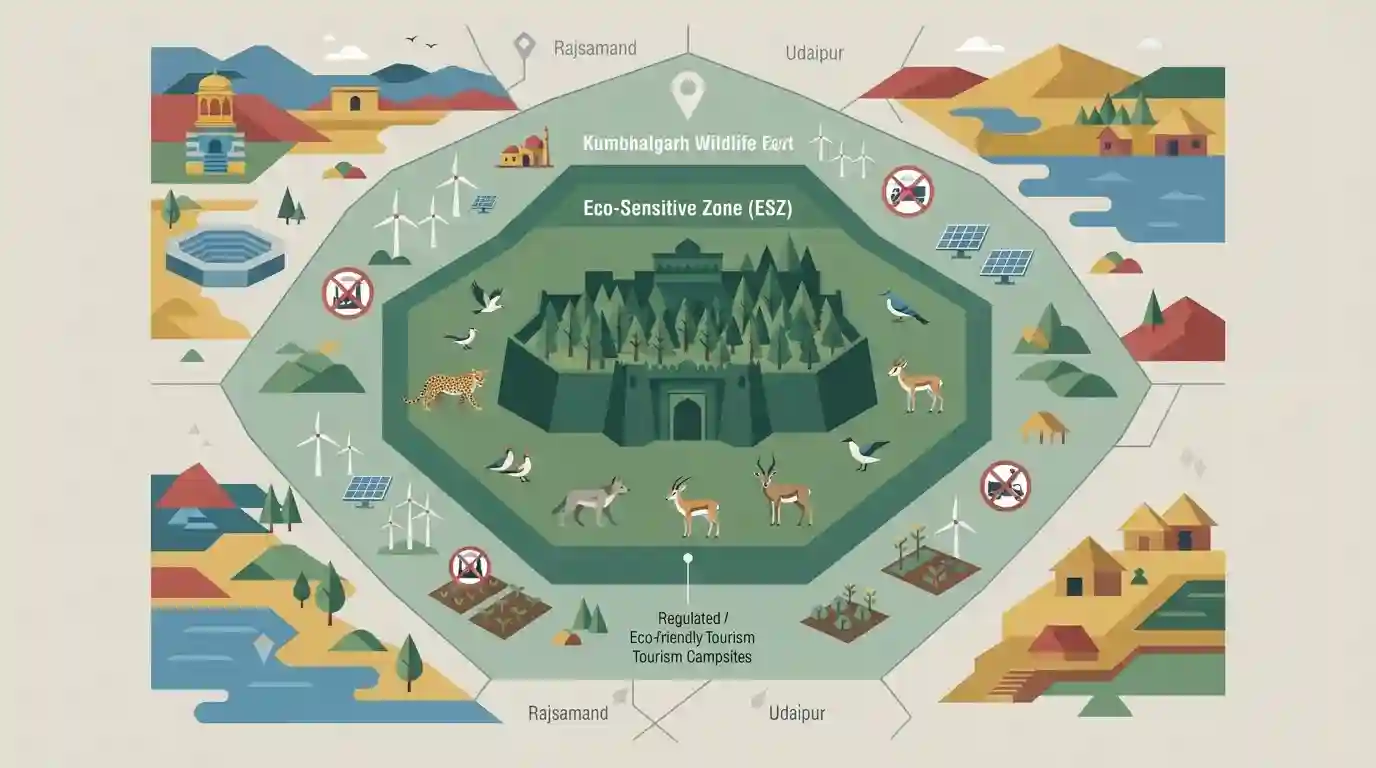
The central government has declared an Eco-Sensitive Zone (ESZ) around the Kumbhalgarh Wildlife Sanctuary in Rajasthan to fortify biodiversity protection, regulate commercial and industrial activities, and promote sustainable development in the surrounding regions spanning Rajsamand, Udaipur, and Pali districts.
Key Points
- India declared an Eco-Sensitive Zone (ESZ) around the Kumbhalgarh Wildlife Sanctuary in Rajasthan to protect its rich biodiversity and support sustainable development.
- The sanctuary spans parts of Rajsamand, Udaipur, and Pali districts, serving as an essential wildlife corridor and habitat for leopards, wolves, and numerous bird species.
- The ESZ regulations aim to restrict commercial mining, polluting industries, and large-scale construction activities in the immediate vicinity of the sanctuary to mitigate human-wildlife conflict and safeguard ecological balance.
Important Terms
Eco-Sensitive Zone (ESZ) guidelines

Buffer zones declared by the MoEFCC around protected national parks and wildlife sanctuaries under the Environment (Protection) Act, 1986, to regulate commercial activities and protect sensitive ecosystems.
UPSC context
Important for RPSC Paper III (Environment & Biodiversity / Rajasthan Geography) covering protected area management and regulatory frameworks.
Ministry of Environment, Forest and Climate Change (MoEFCC)
The apex central government body in India responsible for formulating and administering environmental policies, wildlife protection laws, and notifications like ESZs.
UPSC context
Relevant for RPSC General Studies (Indian Polity & Environment), testing governance structures and central environmental legislation.
Rajasthan State Biodiversity Authority
A statutory board established under the Biological Diversity Act, 2002, tasked with conservation of state biodiversity, documentation of biological resources, and advising state governments.
UPSC context
Crucial for RPSC Rajasthan Geography and Governance, testing state-level institutions implementing biodiversity conservation and environmental sustainability.
Static Concepts Connected
What is the legal framework and objective of Eco-Sensitive Zones (ESZs) in India?
- Statutory Origin: Declared by the Ministry of Environment, Forest and Climate Change (MoEFCC) under the Environment (Protection) Act, 1986.
- Core Objective: To act as a shock absorber around Protected Areas (National Parks and Wildlife Sanctuaries) by regulating developmental activities.
- Regulated Activities: Prohibits commercial mining, sawmills, polluting industries, and major hydroelectric projects while permitting regulated agriculture and eco-tourism.
Cross-Topic Patterns
Aravalli Mining vs. Ecological Conservation Conflicts
ESZ demarcations in the Aravalli range frequently clash with mining leases, testing the balance between state revenue from marble/stone quarrying and central conservation mandates under the Environment Protection Act.

Expect an assertion-reason question on ESZ notification powers (Central Govt under EPA 1986 vs State Govt) and Aravalli geography.
Linked PYQs · 3
Linked PYQs · 3
- 2023RPSC_PRELIMSGS1
Which of the following pairings is incorrect? Wildlife Sanctuary – District
- 2024RPSC_PRELIMSGS1
Select the most correct statement regarding the Rajasthan State Biological Park (Phase-II): A. It covers 9 districts and is an initiative of the Rajasthan State Biodiversity Authority (RSBA). B. Achada, Merta and Machala Biological Park have been included in phase-II. C. In phase-II, Bio-Diversity Council, Water Conservation has also been incorporated in its list.
- 2025RPSC_PRELIMSGS1
Choose the incorrect statement with respect to the Rajasthan Forestry and Biodiversity Project (Phase-2).
