Cybersecurity Skills Gap And AI Talent Shortage In India
Source:Indian Express ↗
Why It Matters
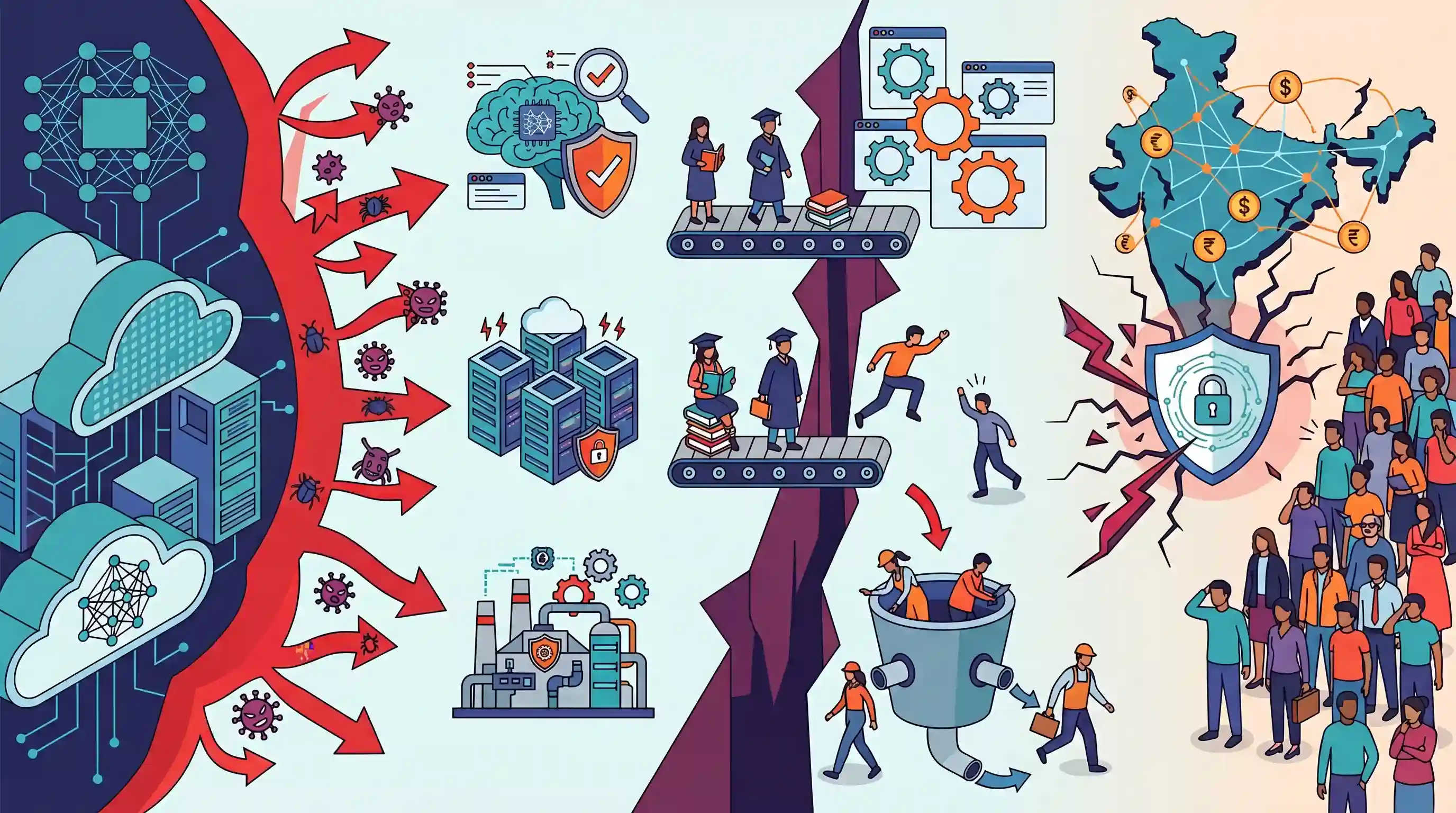
The article exposes a critical vulnerability in India's digital infrastructure—the acute shortage of specialized cybersecurity professionals. It directly connects the rapid adoption of emerging technologies (like AI and Generative AI) to new internal security threats, while also illustrating the paradox of high unemployment existing alongside a severe talent crunch (employability crisis vs. demographic dividend).
Summary
India is facing a severe cybersecurity skills gap, driven by the rapid integration of Artificial Intelligence (AI) and cloud technologies, which are expanding the cyber attack surface. According to the 'Indian Cyber Security Skilling Landscape Report 2025–26' by DSCI and the SANS Institute, a vast majority of enterprises struggle to find candidates with practical, hands-on skills in AI security, cloud-native platforms, and operational technology (OT/ICS). This mismatch between academic training and industry requirements, compounded by high attrition rates, poses a significant challenge to India's internal security and the digital economy, undermining the potential of its demographic dividend.
Key Points
- A joint report by DSCI and SANS Institute titled "Indian Cyber Security Skilling Landscape Report 2025–26" reveals a critical cybersecurity talent shortage in India.
- Around 73% of enterprises report difficulty finding qualified talent, primarily due to candidates lacking hands-on practical skills and cross-domain expertise.
- The rapid adoption of Artificial Intelligence (AI) and Generative AI expands the cyber attack surface, significantly driving up the demand for specialized security architects and AI security professionals.
- There is a pronounced deficit of specialists capable of securing complex ecosystems like cloud-native platforms, API architectures, and Operational Technology/Industrial Control Systems (OT/ICS).
- High attrition rates, fueled by intense competition for specialized talent and inadequate internal upskilling programs, further exacerbate India's cybersecurity vulnerabilities.
Important Terms
Data Security Council of India (DSCI)

A premier, not-for-profit industry body in India established by NASSCOM. It focuses on data protection, cybersecurity standards, and capacity building for a secure digital ecosystem.
UPSC context
GS-3: Internal Security/IT. Crucial for understanding public-private partnerships in securing India's digital economy.
National Cyber Security Policy
The 2013 framework aimed at protecting India's critical information infrastructure, establishing 24x7 threat monitoring, and developing a workforce of 500,000 cybersecurity professionals through public-private collaboration.
UPSC context
GS-3: Internal Security. Foundational policy for mains questions on India's digital defense and institutional preparedness.
Operational Technology (OT)
Specialized hardware and software that monitors or controls physical devices and industrial processes, such as power grids and water systems, often integrated with Industrial Control Systems (ICS).
UPSC context
GS-3: Internal Security. Relevant for discussing threats to Critical Information Infrastructure (CII) and IT-OT convergence.
Demographic Dividend
The economic growth potential resulting from a shift in a population's age structure, specifically when the working-age population is larger than the non-working-age population.
UPSC context
GS-3: Economy/Employment. Essential for explaining the risks posed by skill-mismatches in the high-tech workforce.
SANS Institute
The world's largest cooperative research and education organization for cybersecurity. It provides high-level training and professional certifications (GIAC) globally to government and commercial sectors.
UPSC context
GS-3: Internal Security. Significant as an international collaborator helping map India's cybersecurity skilling landscape.
Prelims Trap
The Data Security Council of India (DSCI) is a statutory body under the Ministry of Electronics and IT.
DSCI is a not-for-profit industry body on data protection in India set up by NASSCOM. It is NOT a statutory government body.
Static Concepts Connected
What constitutes Critical Information Infrastructure (CII) and who protects it?
- Legal Definition: Computer resources whose destruction or incapacitation would have a debilitating impact on national security, economy, or public health (Section 70, IT Act).
- Nodal Agency: The National Critical Information Infrastructure Protection Centre (NCIIPC), created under the National Technical Research Organisation (NTRO).
- OT/ICS Integration: Sectors like power, transport, and banking rely heavily on Operational Technology (OT) and Industrial Control Systems (ICS), making them prime CII targets.
What is the Demographic Dividend and how does a skills gap affect it?
- Definition: The economic growth potential resulting from shifts in a population’s age structure, specifically when the working-age population is larger than the non-working-age share.
- Employability Crisis: A mismatch between academic output and industry needs (like AI/cybersecurity) leads to "educated unemployment," turning a demographic asset into a socio-economic liability.
Cross-Topic Patterns
OT vulnerabilities in Power Grids
The skills gap in securing Operational Technology directly threatens India's power sector, linking GS-3 cyber threats with energy security vulnerabilities (e.g., Chinese RedEcho attacks on grid infrastructure).
IndiaAI Mission and Skill Mismatch
The lack of specialized AI security architects creates a bottleneck for the IndiaAI Mission, merging technology policy with the urgent need for higher education and vocational reform.

Expect a GS-3 Mains question linking India's AI/cyber skills deficit with threats to Critical Information Infrastructure and OT/ICS.
Linked PYQs · 4
Linked PYQs · 4
- 2017MainsGS3
Discuss the potential threats of Cyber attack and the security framework to prevent it.
- 2015MainsGS3
Considering the threats cyberspace poses for the country, India needs a "Digital Armed Force" to prevent crimes. Critically evaluate the National Cyber Security Policy, 2013 outlining the challenges perceived in its effective implementation.
- 2020MainsGS3
Discuss different types of cyber crimes and measures required to be taken to fight the menace.
- 2014MainsGS3
While we flaunt India's demographic dividend, we ignore the dropping rates of employability. What are we missing while doing so? Where will the jobs that India desperately needs come from? Explain.
