India Crude Oil Sourcing Pivot and Russia Sanctions Impact
Source:The Hindu ↗
Why It Matters
This article demonstrates how geopolitical regulations, tariffs, and acts like the Russia Sanctions Act directly influence India's energy basket, import diversification strategies, and foreign policy balancing in West Asia and beyond.
Summary
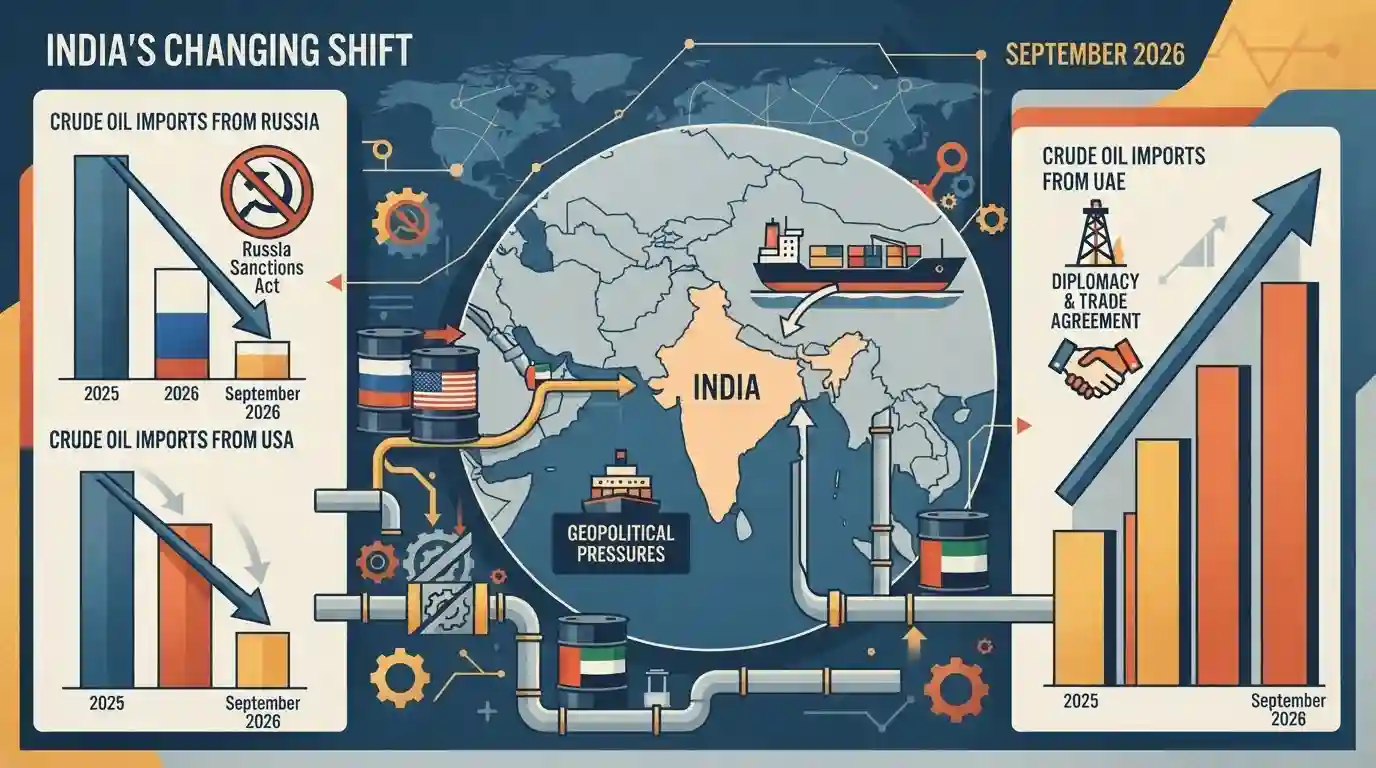
In September 2026, India adjusted its crude oil import strategy by sharply reducing reliance on supplies from the U.S. and Russia, aligning with new geopolitical pressures and the 'Russia Sanctions Act'. Concurrently, India expanded its energy sourcing from the UAE, showcasing a flexible approach to maintaining energy security amidst global trade barriers and sanctions.
Key Points
- India significantly cut its crude oil imports from the United States and Russia in September 2026.
- The shift coincided with tightening Western measures, including the introduction of the 'Russia Sanctions Act'.
- India pivoted heavily toward the United Arab Emirates (UAE) as an alternative supplier, increasing imports to navigate shifting tariffs and international sanctions.
- Highlights India's strategic energy diplomacy and agile response to changing global trade restrictions and geopolitical pressures.
Important Terms
Russia Sanctions Act

A U.S. legislative measure designed to restrict international energy trade with Russia by authorizing steep tariffs on major importers of Russian oil and gas.
UPSC context
Important for GS Paper II (International Relations) and GS Paper III (Economy/Energy Security), testing impacts of secondary sanctions on India's foreign policy.
UAE
A key West Asian strategic partner and major crude oil supplier to India, serving as an alternative energy source amidst global sanctions and supply shifts.
UPSC context
Relevant for GS Paper II (Bilateral Relations, West Asia Policy) and GS Paper III (Energy Security and Diversification).
Prelims Trap
India completely severed its crude oil imports from Russia and the U.S. following the Russia Sanctions Act.
Aspirants might assume India completely halted Russian oil imports due to sanctions, whereas India only reduced reliance while actively balancing other traditional suppliers like the UAE.
Static Concepts Connected
What are the key determinants and institutional mechanisms governing India's energy security and strategic petroleum reserves?
- Strategic Reserves: Strategic Reserves: India maintains strategic crude oil reserves through ISPRL at three underground locations (Visakhapatnam, Mangaluru, and Padur) to buffer supply shocks.
- Import Basket: Diversification: India imports crude from over 35 countries, systematically avoiding single-source dependency to insulate the domestic economy from geopolitical volatility.
- Institutional Role: Policy Framework: Guided by the Ministry of Petroleum and Natural Gas, balancing domestic affordability with international diplomatic commitments.
Cross-Topic Patterns
CEPA and Energy Security Diplomacy
India's shift to the UAE amidst Western sanctions illustrates how bilateral trade pacts like CEPA insulate strategic sectors from multilateral trade disruptions.
Secondary Sanctions vs. Strategic Autonomy
Navigating secondary sanctions under acts like the Russia Sanctions Act tests India's doctrine of strategic autonomy in contemporary geopolitics.

India's crude oil basket diversification under secondary sanctions is prime for a statement-based prelims question on energy security.
Linked PYQs · 3
Linked PYQs · 3
- 2025MainsGS3
What are the challenges before the Indian economy when the world is moving away from free trade and multilateralism to protectionism and bilateralism? How can these challenges be met?
- 2025MainsGS2
"Energy security constitutes the dominant kingpin of India's foreign policy, and is linked with India's overarching influence in Middle Eastern countries.” How would you integrate energy security with India's foreign policy trajectories in the coming years?
- 2017MainsGS2
The question of India's Energy Security constitutes the most important part of India's economic progress. Analyze India's energy policy cooperation with West Asian countries.
