Solar Power Curtailment And Grid Transmission Bottlenecks
Source:Indian Express ↗
Why It Matters
Highlights the practical infrastructure and regulatory challenges (like transmission bottlenecks and grid stability) underlying India's ambitious climate commitments, essential for analyzing energy transition and power sector reforms in Mains GS-3.
Summary
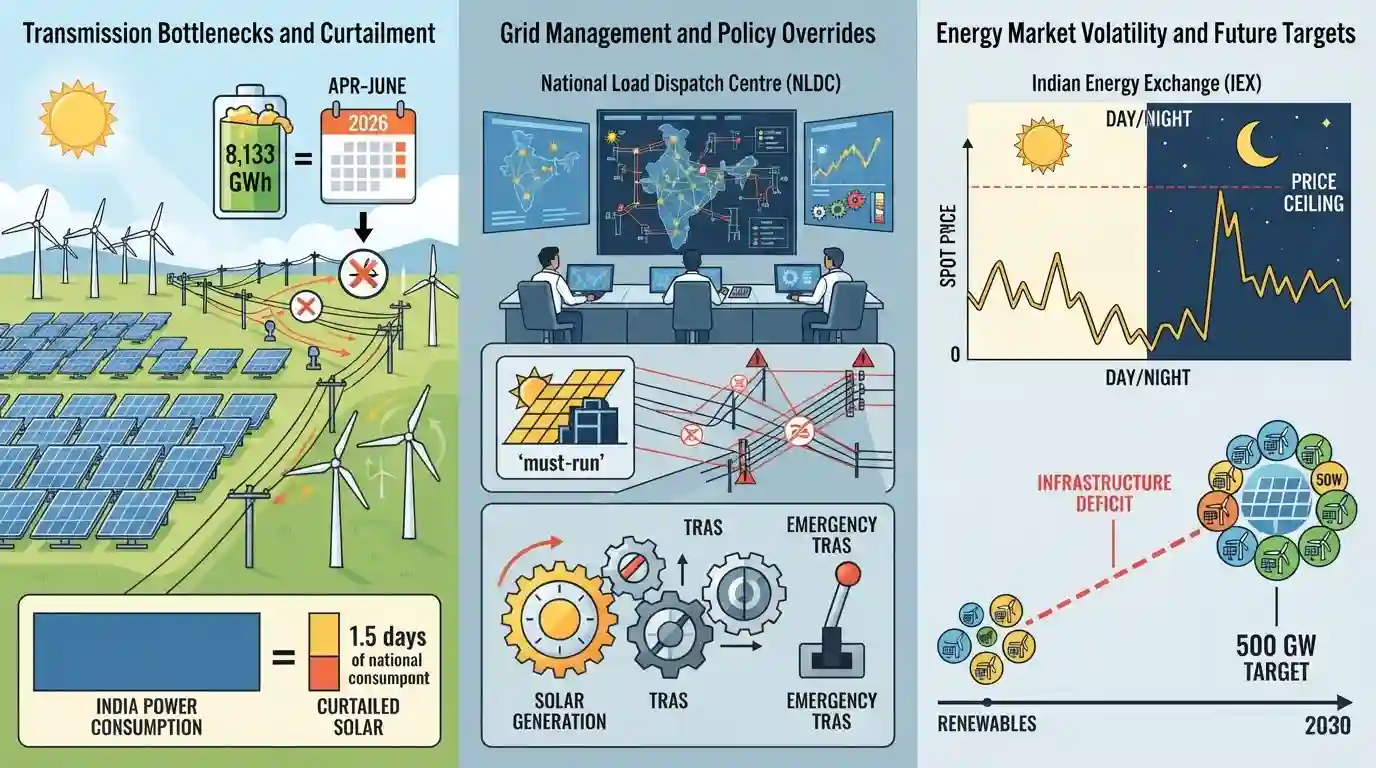
Between April and June 2026, India was forced to curtail 8,133 GWh of solar power—equivalent to 1.5 days of the entire country's power consumption—due to severe transmission bottlenecks and grid security constraints. The core issue lies in the rapid expansion of solar and wind generation significantly outpacing the development of the Inter-state Transmission System (ISTS). Consequently, the National Load Dispatch Centre (NLDC) increasingly relies on the Emergency TRAS (Tertiary Reserve Ancillary Services) mechanism to scale down generation, overriding solar power's traditional 'must-run' status. This daytime oversupply causes severe price volatility on the Indian Energy Exchange (IEX), with prices plunging near zero during the day and hitting regulatory ceilings at night. This infrastructure deficit poses a substantial hurdle to India's target of achieving 500 GW of renewable energy capacity by 2030.
Key Points
- Grid operators curtailed 8,133 GWh of solar electricity between April and June 2026 due to the inability of the grid to absorb excess daytime generation.
- The massive curtailment reveals a severe mismatch between rapid renewable energy deployment and the slower expansion of the Inter-state Transmission System (ISTS).
- To prevent system collapse, the National Load Dispatch Centre (NLDC) invokes Emergency TRAS to back down generation, despite solar power legally having a 'must-run' status.
- The daytime solar glut causes spot prices on the Indian Energy Exchange (IEX) Real-Time Market to crash to near zero, while peak nighttime demand pushes prices to the Rs 10 per unit regulatory ceiling.
- India aims to reach 500 GW of renewable energy capacity by 2030 (currently at 288 GW), but ongoing transmission bottlenecks threaten the financial viability of these ambitious targets.
Important Terms
Must-Run Status

A regulatory designation in India ensuring that electricity from renewable sources is evacuated without curtailment, except during critical grid safety or stability emergencies.
UPSC context
GS Paper III (Infrastructure: Energy). Tests understanding of regulatory frameworks supporting India's clean energy transition.
Emergency TRAS (Tertiary Reserve Ancillary Services)
An emergency grid-balancing mechanism triggered by the National Load Dispatch Centre to direct generating stations to temporarily reduce or increase output to maintain grid stability.
UPSC context
GS Paper III (Infrastructure: Energy). Tests understanding of grid stability and ancillary services in renewable integration.
National Load Dispatch Centre (NLDC)
The apex body in India responsible for optimum scheduling and dispatch of electricity across regional grids, ensuring the secure and integrated operation of the national grid.
UPSC context
GS Paper III (Infrastructure: Energy). Evaluates knowledge of institutional architecture governing national power grid stability.
Grid India (Grid Controller of India Limited)
A central public sector enterprise under the Ministry of Power (formerly POSOCO) responsible for ensuring the integrated and secure round-the-clock operation of the Indian Power System.
UPSC context
GS Paper III (Infrastructure: Energy). Evaluates understanding of public sector bodies managing the national electricity grid.
Indian Energy Exchange (IEX)
India's premier nationwide, automated power trading platform that provides an electronic marketplace for the physical delivery of electricity and price discovery.
UPSC context
GS Paper III (Energy Sector & Markets). Tests knowledge of trading platforms and pricing mechanisms in electricity distribution.
Ministry of New and Renewable Energy (MNRE)
The nodal ministry of the Government of India responsible for the research, development, and deployment of new and renewable energy sources like solar and wind.
UPSC context
GS Paper III (Renewable Energy). Tests knowledge of policies and ministries driving India's sustainable development targets.
Prelims Trap
Renewable energy projects with 'must-run' status cannot be legally subjected to curtailment or backed down by load dispatch centres.
While the IEGC mandates 'must-run' priority, grid operators can legally curtail generation during technical emergencies or grid security threats using TRAS-Down mechanisms.
Static Concepts Connected
What is India's 'Must-Run Status' and how is the grid balanced?
- Statutory Protection: IEGC grants statutory Must-Run status to solar/wind, prioritizing their evacuation over fossil fuels to promote clean energy.
- Security Exception: Operators can legally curtail 'must-run' plants during grid instability or system safety emergencies.
- TRAS Mechanism: Tertiary Reserve Ancillary Services help load dispatchers scale generation up or down to maintain grid frequency.
What are the primary energy storage mechanisms for grid balancing?
- Pumped Hydro (PSH): Pumps water uphill using cheap daytime solar, releasing it through hydro-turbines during peak evening demand.
- Battery Storage (BESS): Stores surplus power electrochemically; offers ultra-fast response times but relies heavily on lithium-ion supply chains.
Cross-Topic Patterns
RE Transition vs DISCOM Stress
Extreme spot-market price volatility worsens the financial health of state distribution companies locked into rigid, legacy long-term power purchase agreements.
Grid Integration & Critical Minerals
Solving solar curtailment via Battery Energy Storage (BESS) links domestic grid stability directly to international critical mineral supply chains and foreign policy alliances.

Ancillary services (TRAS) and 'must-run' exemptions under IEGC are highly likely to feature in upcoming Prelims infrastructure questions.
Linked PYQs · 4
Linked PYQs · 4
- 2022MainsGS3
Do you think India will meet 50 percent of its energy needs from renewable energy by 2030 ? Justify your answer. How will the shift of subsidies from fossil fuels to renewables help achieve the above objective ? Explain.
- 2020MainsGS3
Describe the benefits of deriving electric energy from sunlight in contrast to the conventional energy generation. What are the initiatives offered by our Government for this purpose?
- 2024PrelimsGS1
Recently, the term "pumped-storage hydropower" is actually and appropriately discussed in the context of which one of the following?
- 2024PrelimsGS1
Consider the following: 1. Battery storage 2. Biomass generators 3. Fuel cells 4. Rooftop solar photovoltaic units How many of the above are considered "Distributed Energy Resources"?
