Credit Card Delinquencies and Unsecured Retail Credit Risks
Source:Indian Express ↗
Why It Matters
The growth of unsecured retail credit and its rising delinquencies represent a key vulnerability in India's financial system. This trend explains the Reserve Bank of India's recent regulatory actions, such as increasing risk weights on consumer loans, and illustrates the trade-off between expanding credit access (financial inclusion) and managing default risks (financial stability).
Summary
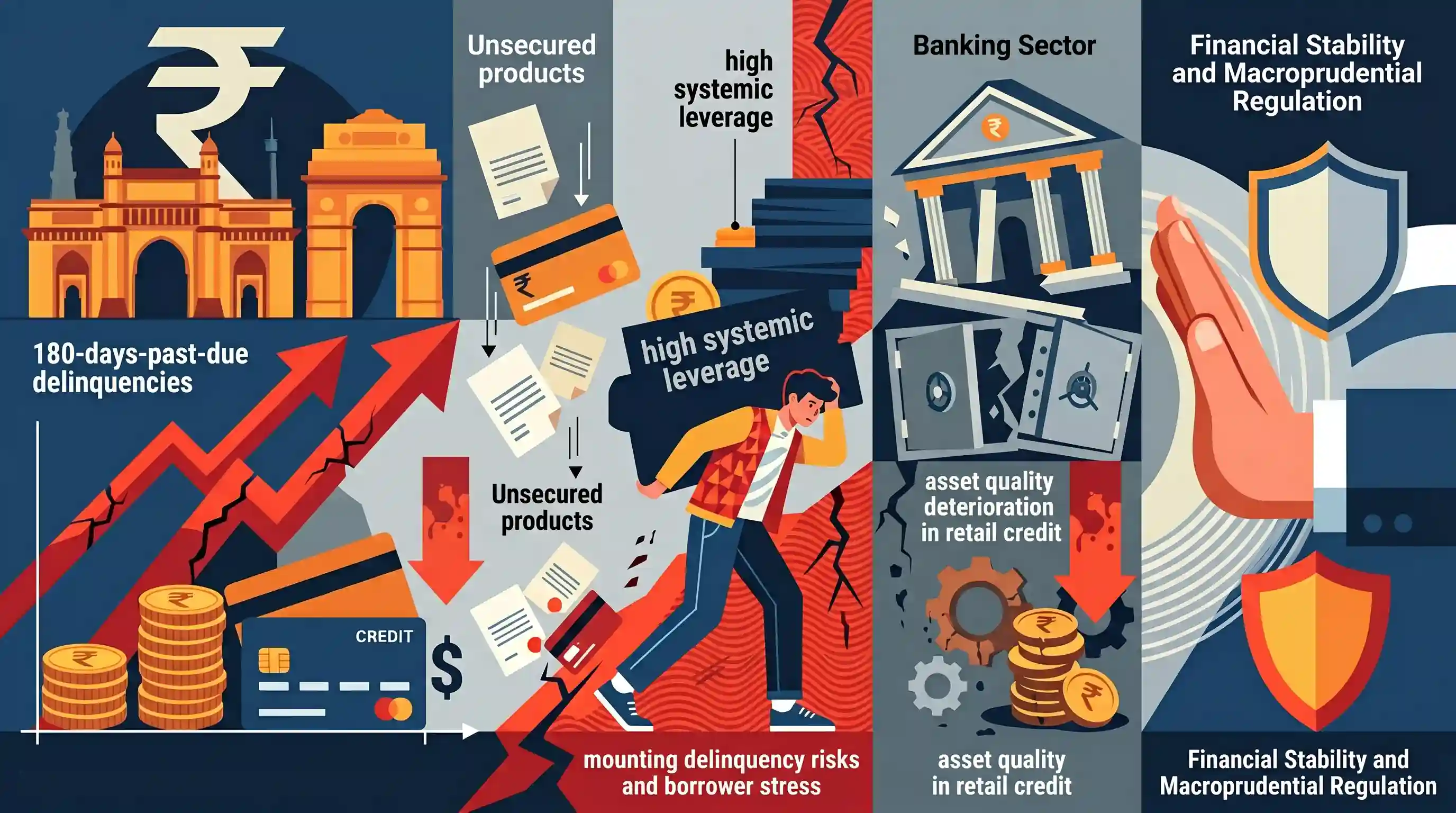
A TransUnion CIBIL white paper highlights mounting delinquency risks and borrower stress in India's Rs 3.1 lakh crore credit card market. Since 2022, 180-days-past-due delinquencies have risen to 8.1% (up from 5.8%), driven by a shift toward multiple unsecured products (such as small-ticket personal loans) and high systemic leverage, particularly among younger Gen Z borrowers and high-exposure users. This signals potential asset quality deterioration in retail credit, necessitating tight macroprudential supervision.
Key Points
- India’s decade-long credit card boom is experiencing rising borrower stress and deteriorating asset quality, with outstanding balances growing eight-fold over the decade to reach Rs 3.1 lakh crore.
- Delinquencies in the 180 days-past-due (dpd) category have risen from 5.8% to 8.1% between 2022 and March 2026, signaling rising credit defaults.
- A structural shift in unsecured lending has occurred, with credit cards' share in total unsecured products dropping from 56% in 2016 to 38% in 2026, due to the massive growth of alternative unsecured credit like small-ticket personal loans (< Rs 50,000).
- Consumers are increasingly holding multiple cards and credit lines; the percentage of cardholders with three or more cards rose from 12% to 22%, and those with other consumption-led credit doubled from 16% to 32%.
- Younger borrowers (Gen Z) and 'high-exposure' cardholders are highly vulnerable, building leverage faster and entering the credit market with multiple pre-existing loans compared to older generations.
Important Terms
Reserve Bank of India

India's central bank and regulatory authority established in 1935. It controls monetary policy, regulates scheduled commercial banks and financial institutions, manages foreign exchange reserves, and maintains price and financial stability.
UPSC context
GS Paper III (Economy). Tests understanding of banking regulation, monetary policy, and overall financial sector stability in India.
TransUnion CIBIL
India's first and leading Credit Information Company (credit bureau) licensed by the RBI. It collects credit histories of individuals and entities to generate credit scores, helping lenders evaluate borrowing risks.
UPSC context
GS Paper III (Economy). Relates to credit information infrastructure, banking health, and the management of bad loans.
Unsecured Loans
Debt or credit facilities, such as credit cards and personal loans, that do not require physical collateral. Approval relies entirely on the borrower's creditworthiness and repayment history.
UPSC context
GS Paper III (Economy). Essential for analyzing retail loan growth, consumer behavior, credit risks, and systemic banking stability.
Macroprudential Regulation
Financial policies designed to minimize systemic risks and safeguard the stability of the entire financial system, rather than focusing solely on the health of individual institutions.
UPSC context
GS Paper III (Economy). Tests knowledge of system-wide regulatory tools (e.g., risk weights) used to prevent systemic financial crises.
Non-Performing Assets (NPAs)
Loans or advances where principal or interest payments remain overdue for 90 days or more. It is a critical metric for assessing the asset quality and health of the banking sector.
UPSC context
GS Paper III (Economy). Evaluates understanding of bad loans, banking sector reforms, and mechanisms for debt recovery in India.
Prelims Trap
Credit institutions are legally mandated to maintain membership with only one RBI-authorized Credit Information Company (CIC) of their choice.
While CICRA 2005 initially allowed singular membership, the RBI mandated in 2014 that all credit institutions (banks and NBFCs) must be members of all four licensed CICs.
Static Concepts Connected
How do risk weights act as macroprudential tools under RBI regulations?
- Capital-to-Risk Linkage: Risk weights represent the riskiness of bank assets, determining how much capital must be set aside for every rupee loaned.
- Counter-cyclical control: RBI raises risk weights on specific sectors (like unsecured loans) to make lending expensive, thereby arresting runaway credit growth.
- Impact on CRAR: Higher risk weights increase the denominator of the Capital-to-Risk-Weighted Assets Ratio, forcing banks to conserve capital.
What is the regulatory framework governing Credit Information Companies (CICs) in India?
- Statutory basis: Governed by the Credit Information Companies (Regulation) Act, 2005, and strictly licensed and regulated by the RBI.
- Mandatory membership: All systemic lenders (banks, NBFCs) are legally mandated to report borrower credit data to all four RBI-licensed CICs.
- Commercial nature: CICs are independent corporate entities, not government departments, though they perform a critical public-utility function.
Cross-Topic Patterns
Retail credit + Declining household savings
Surging unsecured micro-consumption loans correlate with a historic dip in net household financial savings, impacting long-term domestic capital formation.
Fintech UPI + Systemic risk
Instant digital loans facilitated by India's robust public infrastructure accelerate systemic leverage, shifting financial risks from corporate balances to household balances.

RBI's macroprudential tools (risk weights) and CIC reporting mandates likely to be tested via conceptual banking questions in 2026.
Linked PYQs · 3
Linked PYQs · 3
- 2019PrelimsGS1
Which of the following is not included in the assets of a commercial bank in India?
- 2026PrelimsGS1
Which one of the following correctly represents the three key sub-indices of the Financial Inclusion Index (FI-Index) of the Reserve Bank of India (RBI) ?
- 2023MainsGS3
What is the status of digitalization in the Indian economy? Examine the problems faced in this regard and suggest improvements.
