India economy resilient against external shocks via domestic demand
Source:The Hindu ↗
Why It Matters
The article provides critical insights into India's economic resilience and its strategic pivot in international trade. The shift from globalization towards supply chain resilience, strategic autonomy, and regional FTAs (like TEPA) directly impacts topics in GS Paper 3 (Indian Economy) and GS Paper 2 (International Relations/Bilateral Agreements).
Summary
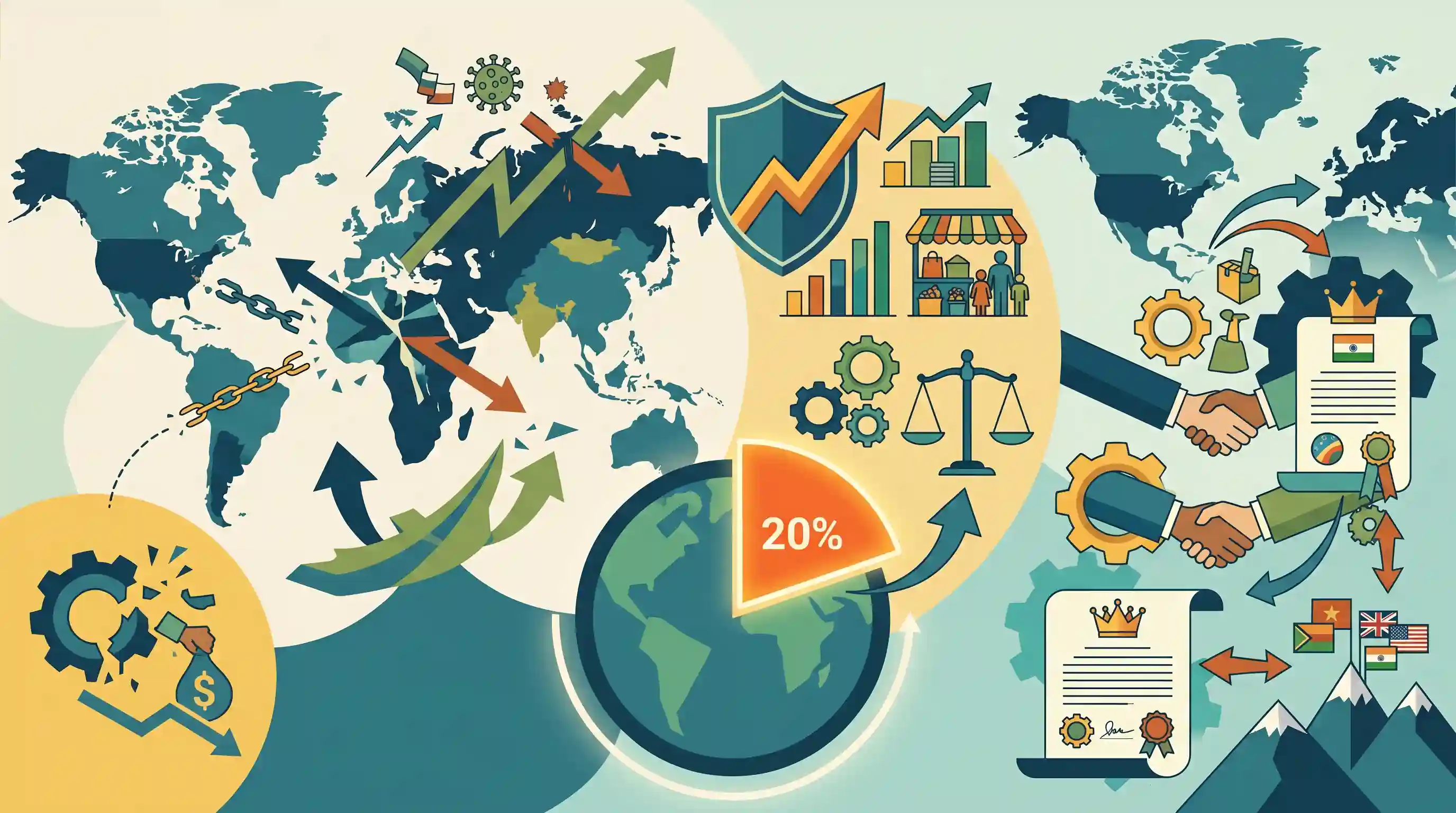
In a recent address, Principal Secretary to the Prime Minister Shaktikanta Das underscored India's economic resilience, stating the country is poised to contribute roughly 20% to global GDP growth. This stability is largely attributed to strong domestic demand and prudent macroeconomic policies that have insulated the economy from external shocks. Das highlighted a paradigm shift in the global economic order—accelerated by the pandemic and geopolitical conflicts—where established globalization rules are giving way to strategic autonomy, self-reliance, and a focus on supply chain resilience over cost efficiency. Adapting to this fragmented environment, India is actively negotiating Free Trade Agreements (FTAs) with major economies like the US and the EU to secure fair and balanced trade partnerships, building on recent successes like the TEPA with the EFTA nations.
Key Points
- India is projected to contribute about one-fifth of global GDP growth, driven by robust domestic demand and prudent macroeconomic policies.
- The global economy is witnessing significant fragmentation, moving away from unhindered globalization toward self-reliance, strategic autonomy, and regional trade alliances due to recent crises like the COVID-19 pandemic and geopolitical conflicts.
- Nations are increasingly prioritizing supply chain resilience over mere cost competitiveness in global trade.
- India is recalibrating its trade engagements, prioritizing fair and balanced outcomes in ongoing Free Trade Agreement (FTA) negotiations with the US, EU, Peru, Oman, and New Zealand.
- India recently signed a comprehensive Trade and Economic Partnership Agreement (TEPA) with the European Free Trade Association (EFTA) block in March 2024.
Important Terms
Free Trade Agreements (FTAs)

Treaties between two or more countries to reduce or eliminate trade barriers like tariffs and quotas on most goods and services, facilitating easier cross-border commerce.
UPSC context
GS Paper III: Economy. Tests knowledge of external sector reforms, trade liberalization, and India’s global trade positioning.
Trade and Economic Partnership Agreement (TEPA)
A comprehensive free trade agreement signed in March 2024 between India and the four EFTA nations, featuring a unique $100 billion investment commitment to India.
UPSC context
GS Paper III: Economy. Represents a new generation of FTAs focusing on investment, services, and sustainable development.
European Free Trade Association (EFTA)
An intergovernmental organization consisting of Iceland, Liechtenstein, Norway, and Switzerland, promoting free trade and economic integration outside the European Union.
UPSC context
GS Paper II: International Relations. Important for understanding non-EU European partnerships and India’s diversified trade diplomacy.
Aatmanirbhar Bharat
The 'Self-Reliant India' initiative launched in 2020 to boost domestic manufacturing, reduce import dependency, and strengthen supply chain resilience without pursuing isolationism.
UPSC context
GS Paper III: Indian Economy. Central to discussions on industrial policy, PLI schemes, and economic sovereignty.
Preferential Trade Agreements (PTAs)
A trade pact where partners reduce tariffs on a specific 'positive list' of products, serving as a less ambitious precursor to a full FTA.
UPSC context
GS Paper III: Economy. Distinguishing between levels of trade integration is a frequent Prelims and Mains theme.
Reserve Bank of India (RBI)
India's central bank and regulatory body responsible for monetary policy, maintaining price stability, and managing the country's foreign exchange reserves.
UPSC context
GS Paper III: Economy. Essential for understanding monetary policy, inflation targeting, and macroeconomic stability.
Strategic Autonomy
A nation's capacity to pursue its own national interests and foreign policy independently, especially in a fragmented or polarized global economic order.
UPSC context
GS Paper II: International Relations. Key concept for India’s balancing act between major powers and global blocs.
Prelims Trap
"India recently signed the TEPA with EFTA, a specialized economic bloc comprising key member states of the European Union."
EFTA (Iceland, Liechtenstein, Norway, Switzerland) operates parallel to the EU. They participate in the European Single Market but are NOT members of the European Union.
Static Concepts Connected
What are the different levels of bilateral trade integration?
- PTA: Offers preferential tariff treatment only to a specific 'positive list' of traded goods.
- FTA: Eliminates tariffs on a broad 'negative list' of goods, but doesn't strictly cover services or investments.
- CEPA / CECA: Comprehensive agreements (like CEPA or CECA) covering trade in goods, services, investments, IPR, and government procurement.
How does strong domestic demand insulate India from external shocks?
- Consumption-driven growth: A high share of Private Final Consumption Expenditure (PFCE) makes economic growth less dependent on volatile global export markets.
- Capital Formation: Strong domestic Gross Fixed Capital Formation (GFCF), often led by government infrastructure spending, sustains economic momentum during global recessions.
- Market size elasticity: India's vast population offers sufficient internal scale for domestic manufacturing, making it viable even when global supply chains fragment.
Cross-Topic Patterns
Supply chain resilience & PLI
The global shift from mere 'cost competitiveness' to 'supply chain resilience' forms the core macroeconomic rationale for India's Atmanirbhar Bharat push and Production Linked Incentive (PLI) schemes.
FDI commitments in modern Trade Pacts
The TEPA with EFTA represents a shift in India's FTA strategy, moving beyond just tariff reduction to securing binding foreign direct investment (FDI) commitments for domestic job creation.

Expect a 2026 question testing EFTA vs EU membership alongside TEPA's unique $100B FDI commitment, contrasting it with traditional FTAs.
Linked PYQs · 5
Linked PYQs · 5
- 2018MainsGS3
How would the recent phenomena of protectionism and currency manipulations in world trade affect macroeconomic stability of India?
- 2019MainsGS3
Do you agree with the view that steady GDP growth and low inflation have left the Indian economy in good shape? Give reasons in support of your arguments.
- 2023MainsGS3
Faster economic growth requires increased share of the manufacturing sector in GDP, particularly of MSMEs. Comment on the present policies of the Government in this regard.
- 2020MainsGS2
Quadrilateral Security Dialogue (Quad)' is transforming itself into a trade bloc from a military alliance, in present times - Discuss.
- 2011MainsGS2
Compared to the South Asian Free Trade Area (SAFTA), the Bay of Bengal Initiative for Multisectoral Technical and Economic Cooperation Free Trade Area (BIMSTEC FTA) seems to be more promising." Critically evaluate.
