India Stand on Global Climate Equity and Carbon Budget
Source:The Hindu ↗
Why It Matters
The article underlines India's strategic narrative in global climate diplomacy, spotlighting the ongoing friction between the Global North and South over historical emission responsibilities, equitable access to the carbon budget, and unfulfilled climate finance pledges. This forms a core area for UPSC questions on climate governance, international environmental treaties, and India's evolving green policies.
Summary
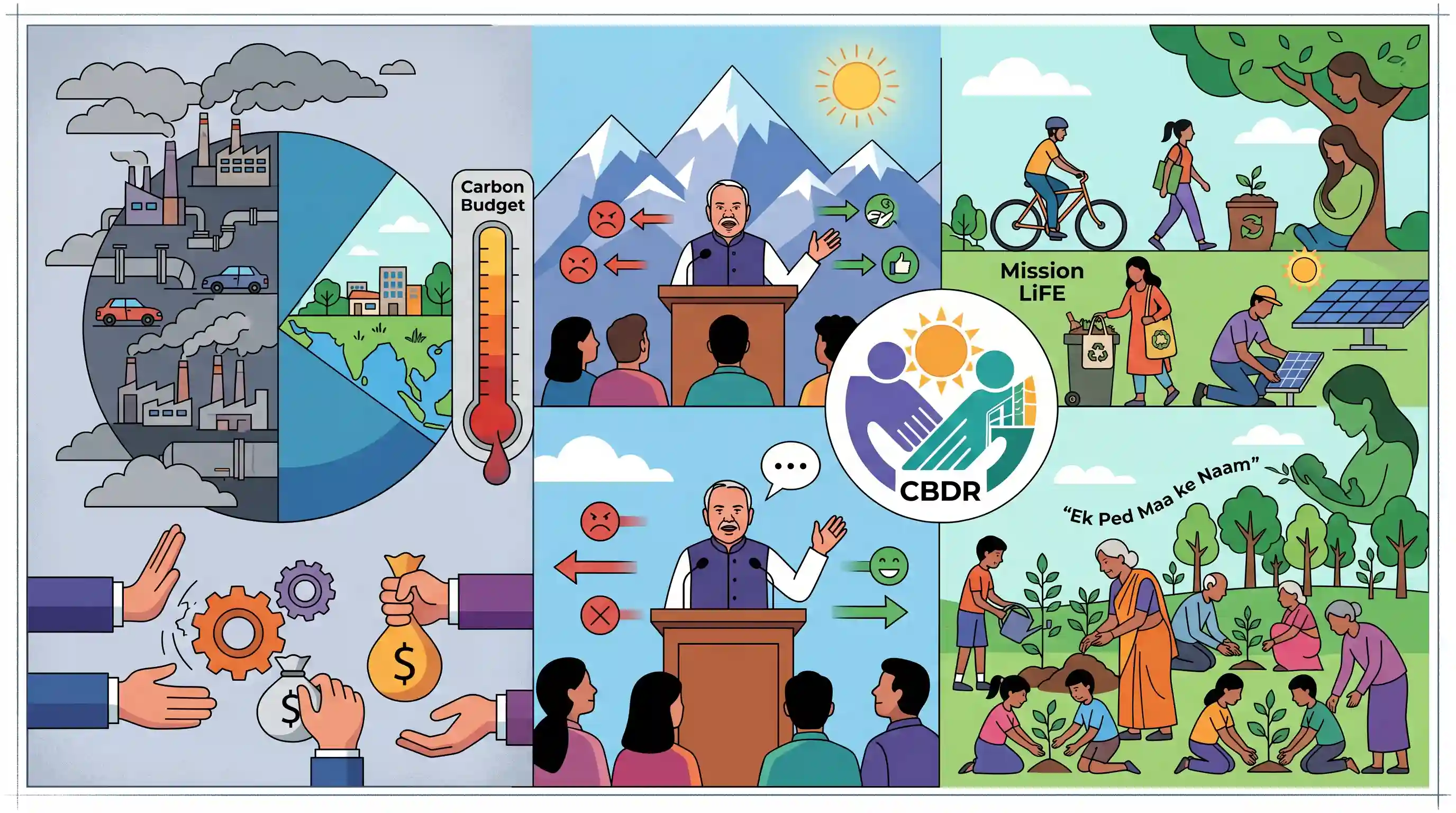
At the first edition of the 'Sagarmatha Sambaad' in Kathmandu, Union Environment Minister Bhupender Yadav stressed that India is undertaking urgent climate action despite South Asia's minimal historical contribution to global greenhouse gas emissions (only 4% until 2020). He criticized developed nations for exhausting the global carbon budget and neglecting their commitments toward climate finance and technology transfer. Highlighting India's proactive domestic measures such as Mission LiFE and the massive afforestation drive "Ek Ped Maa ke Naam", the Minister reiterated that global climate action frameworks must unequivocally adhere to the principles of equity and Common But Differentiated Responsibilities (CBDR).
Key Points
- India is actively contributing to global climate action despite historically low emissions, as emphasized by Union Environment Minister Bhupender Yadav at the 'Sagarmatha Sambaad' dialogue in Kathmandu.
- Developed nations have disproportionately consumed the global carbon budget while failing to meet obligations concerning climate finance, technology transfer, and capacity building.
- South Asia accounts for merely 4% of global cumulative CO2 emissions up to 2020, yet it remains highly vulnerable to climate impacts, particularly in ecologically fragile mountainous regions like the Himalayas.
- India is driving domestic climate action through community-led initiatives such as "Mission LiFE" (Lifestyle for Environment) and the "Ek Ped Maa ke Naam" campaign, which has resulted in planting 1.42 billion saplings.
- Global climate negotiations must remain firmly rooted in the foundational principles of equity and Common But Differentiated Responsibilities and Respective Capabilities (CBDR-RC).
Important Terms
Sagarmatha Sambaad

A biennial global dialogue forum initiated by Nepal in Kathmandu to discuss climate change, sustainable development, and mountain ecology, aiming to amplify the voices of mountain communities in international climate negotiations.
UPSC context
GS Paper II (International Relations) and GS Paper III (Environment); relevant for regional cooperation and mountain ecosystem resilience.
Common But Differentiated Responsibilities (CBDR)
A foundational UNFCCC principle recognizing that all states share responsibility for environmental protection, but their obligations differ based on historical emissions, economic development, and technical capacity.
UPSC context
GS Paper III (Environment); critical for understanding climate justice and India's stance in global climate negotiations.
Mission LiFE (Lifestyle for Environment)
An India-led global mass movement launched at COP26 to encourage individuals to adopt environmentally conscious lifestyles, shifting the focus from 'use-and-dispose' habits to a circular economy.
UPSC context
GS Paper III (Environment); relates to sustainable development goals (SDG 12 and 13) and individual climate action.
Ek Ped Maa ke Naam
A nationwide afforestation campaign launched by PM Modi on World Environment Day 2024, urging citizens to plant trees as a tribute to their mothers to enhance India's green cover.
UPSC context
GS Paper III (Environment); relevant for afforestation drives, biodiversity conservation, and environmental governance in India.
Global Carbon Budget
The maximum cumulative amount of net global CO2 emissions permitted to limit global warming to a specific temperature threshold, such as 1.5°C or 2°C above pre-industrial levels.
UPSC context
GS Paper III (Environment); vital for assessing climate equity and the scientific basis for national emission targets.
Climate Finance
The provision of financial resources—from public, private, or alternative sources—to assist developing countries in mitigation and adaptation actions to address climate change impacts.
UPSC context
GS Paper III (Environment/Economy); central to discussions on North-South equity and the implementation of the Paris Agreement.
Prelims Trap
"Sagarmatha Sambaad is a global dialogue platform initiated by India for Himalayan ecology."
It is a global dialogue platform initiated by Nepal, not India. Sagarmatha is the Nepali name for Mount Everest.
Static Concepts Connected
What is the principle of CBDR-RC under the UNFCCC?
- Origin: Formalized at the 1992 Earth Summit (Rio Declaration), acknowledging varying capabilities and historical contributions to global warming.
- Core Premise: While all nations must protect the environment, developed countries must bear a greater burden due to their historical industrial emissions.
- Obligations: It mandates developed nations to take the lead in mitigation efforts and provide mandatory climate finance to developing ones.
How does the 'Carbon Budget' impact climate negotiations?
- Definition: The maximum cumulative CO2 emissions permitted globally to limit warming to a specific threshold, such as 1.5°C above pre-industrial levels.
- Disproportionate Use: Developed nations have exhausted the vast majority of this budget during their prolonged industrialization phases.
- Negotiation Stance: Developing countries cite this historical exhaustion to demand remaining 'carbon space' for economic growth and equitable climate finance.
Cross-Topic Patterns
Himalayan Ecology & Regional Diplomacy
Forums like Sagarmatha Sambaad link GS-2 neighborhood diplomacy with GS-3 disaster management, specifically addressing transboundary risks like Glacial Lake Outburst Floods (GLOFs) in fragile mountain ecosystems.
Mission LiFE as Climate Soft Power
India is increasingly utilizing domestic behavioral campaigns (like Mission LiFE) on global platforms to shift its diplomatic image from a defensive climate negotiator to a proactive leader.

Expect a 2026 Prelims pair-matching question on regional environmental forums (e.g., Sagarmatha Sambaad) and their host nations.
Linked PYQs · 4
Linked PYQs · 4
- 2025MainsGS3
Write a review on India's climate commitments under the Paris Agreement (2015) and mention how these have been further strengthened in COP26 (2021). In this direction, how has the first Nationally Determined Contribution intended by India been updated in 2022?
- 2021MainsGS3
Describe the major outcomes of the 26th session of the Conference of the Parties (COP) to the United Nations Framework Convention on Climate Change (UNFCCC). What are the commitments made by India in this conference?
- 2022MainsGS3
Discuss global warming and mention its effects on the global climate. Explain the control measures to bring down the level of greenhouse gases which cause global warming, in the light of the Kyoto Protocol, 1997.
- 2022PrelimsGS1
"Climate Action Tracker" which monitors the emission reduction pledges of different countries is a :
