Prahaar Counterterrorism Framework and National Security Strategy
Source:Indian Express ↗
Why It Matters
Understanding the distinction between a statement of intent and a comprehensive National Security Strategy is crucial for GS3. It highlights the ongoing evolution and existing gaps in India's institutional framework for countering terrorism and managing internal security.
Summary
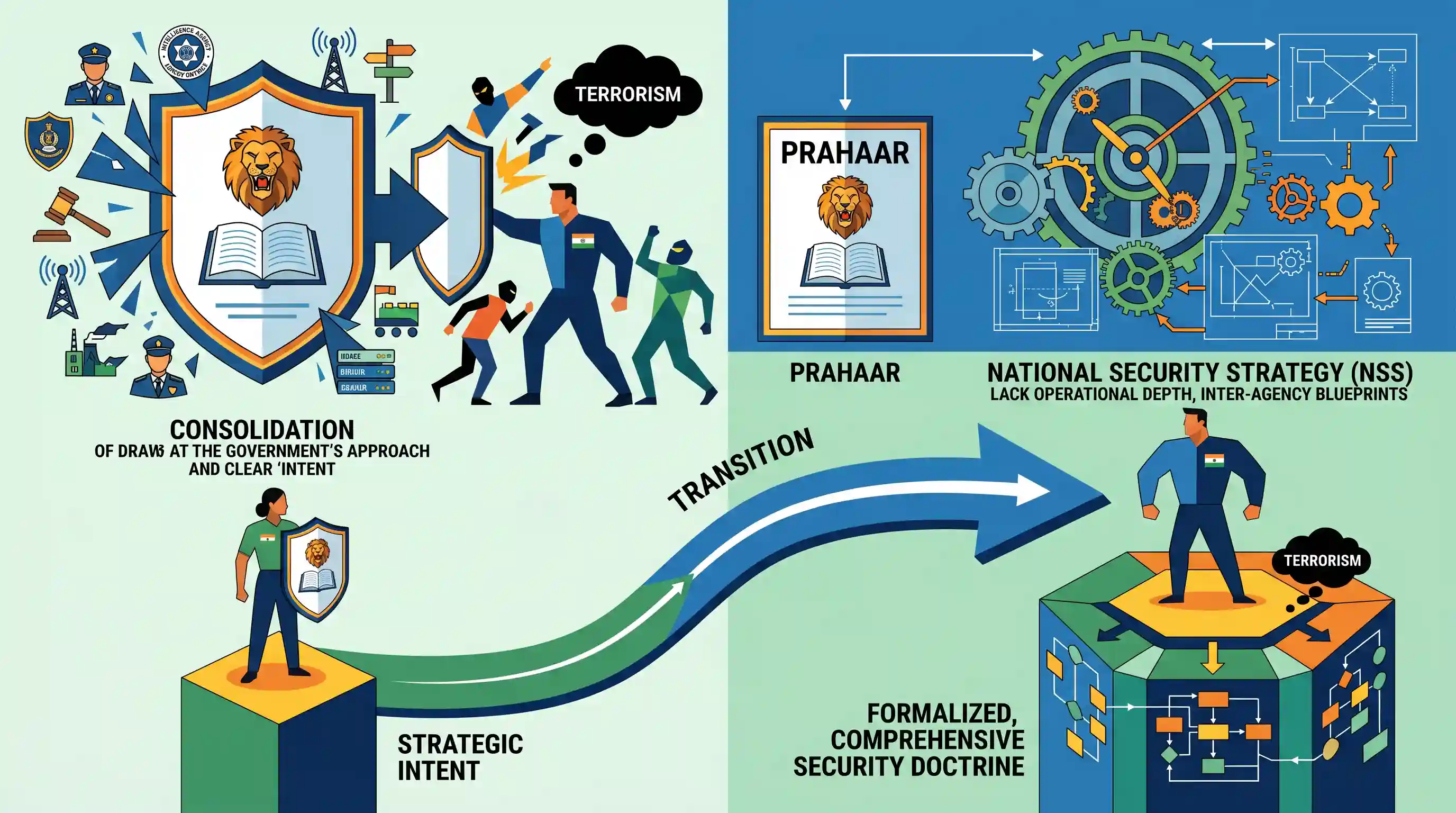
The article analyzes 'PRAHAAR', India's newly released counterterrorism document. While it successfully consolidates the government's approach to combating terrorism and demonstrates a clear intent, experts note that it lacks the operational depth and inter-agency blueprints characteristic of a full-fledged National Security Strategy (NSS). The document underscores the ongoing need for India to transition from statements of strategic intent to a formalized, comprehensive security doctrine.
Key Points
- India has introduced a new counterterrorism document titled 'PRAHAAR'.
- The document consolidates the nation's broad approach to tackling terrorism and articulates strong political intent.
- Experts argue that it stops short of being a full-fledged National Security Strategy, functioning more as a statement of objectives than an operational blueprint.
- The release of PRAHAAR revives ongoing debates regarding the necessity of a formalized, comprehensive National Security Strategy (NSS) for India's strategic architecture.
Important Terms
PRAHAAR

A 2026 Ministry of Home Affairs document (Policy for Response Against Hostile Activities and Radicalism) outlining India's first publicly articulated seven-pillar counter-terrorism strategy focusing on prevention, response, and resilience.
UPSC context
GS Paper III: Internal Security. Tests knowledge of new national doctrines and the evolution of India's counter-terrorism policy architecture.
National Security Strategy (NSS)
A comprehensive, written framework (currently in development for India) that defines a nation's security objectives, threats, and the integrated use of national power to address them.
UPSC context
GS Paper III: Security Challenges. High-priority topic regarding the need for a unified military-civilian security doctrine.
Multi-Agency Centre (MAC)
A nodal body under the Intelligence Bureau (IB) for real-time sharing of counter-terrorism intelligence among various Central and State security agencies in India.
UPSC context
GS Paper III: Various Security Forces and Agencies. Tests understanding of inter-agency coordination mechanisms in intelligence.
Zero-Tolerance Policy
India's firm doctrinal stance that rejects any justification for terrorism and mandates swift, proportionate responses against all forms of violent extremism without exception.
UPSC context
GS Paper III: Internal Security. Key phrase in India's diplomatic and domestic security posture.
Whole-of-Government Approach
A strategy integrating all government branches—defense, intelligence, law enforcement, and civil administration—to ensure a unified and synergistic response to complex national security threats.
UPSC context
GS Paper III: Security Architecture. Relates to administrative reforms and efficiency in managing internal security.
Unlawful Activities (Prevention) Act (UAPA)
India's primary anti-terror legislation used to prevent unlawful activities and deal with terrorist threats, providing the legal backbone for strategies like PRAHAAR.
UPSC context
GS Paper III: Challenges to Internal Security. Essential legal knowledge regarding security laws and fundamental rights.
Prelims Trap
"PRAHAAR is India’s first comprehensive National Security Strategy (NSS) formulated by the Armed Forces."
PRAHAAR is an MHA-led counter-terrorism document, not a full National Security Strategy. It specifically stops short of providing operational blueprints for the armed forces.
Static Concepts Connected
Why does India currently lack a formal National Security Strategy (NSS)?
- Strategic Ambiguity: Policymakers historically preferred ad-hoc flexibility over rigid written doctrines to maintain strategic autonomy in a volatile region.
- Institutional Silos: A historical lack of consensus and operational turf wars among military, intelligence, and civilian ministries hinder unified drafting.
- Political Directives: India currently relies on the Raksha Mantri's operational directives and cabinet resolutions rather than a formalized, comprehensive national doctrine.
What forms the core institutional architecture for counter-terrorism in India?
- NIA: The National Investigation Agency acts as the central counter-terrorism law enforcement agency for investigating and prosecuting offenses.
- MAC: The Multi-Agency Centre, functioning under the Intelligence Bureau, serves as the primary nodal hub for sharing intelligence.
- NATGRID: An integrated intelligence grid connecting core databases of security agencies to track terror suspects, travel, and financing.
Cross-Topic Patterns
Terror Financing & Emerging Tech
PRAHAAR’s focus on crypto and encrypted comms links directly to GS3 FATF guidelines and the challenges of tracking decentralized finance in terror networks.
Civil-Military Institutional Silos
The fact that PRAHAAR is MHA-led and excludes military operational blueprints highlights ongoing civil-military integration debates, echoing the Chief of Defence Staff (CDS) mandate.

Expect a GS3 Mains question contrasting MHA's PRAHAAR doctrine with the demand for a codified, multi-domain National Security Strategy.
Linked PYQs · 3
Linked PYQs · 3
- 2025MainsGS3
Terrorism is a global scourge. How has it manifested in India? Elaborate with contemporary examples. What are the counter measures adopted by the State? Explain.
- 2021MainsGS3
Analyse the complexity and intensity of terrorism, its causes, linkages and obnoxious nexus. Also suggest measures required to be taken to eradicate the menace of terrorism.
- 2021MainsGS3
Analyse the multidimensional challenges posed by external state and non-state actors, to the internal security of India. Also discuss measures required to be taken to combat these threats.
