Strategic intent and operational gaps in counterterrorism documents
Source:Indian Express ↗
Why It Matters
Understanding national counter-terrorism doctrines like PRAHAAR is critical for the UPSC Internal Security syllabus (GS-3). Analyzing the gaps between strategic intent and operational strategy helps aspirants evaluate India's internal security preparedness, institutional bottlenecks, and the structural reforms needed to effectively combat emerging threats.
Summary
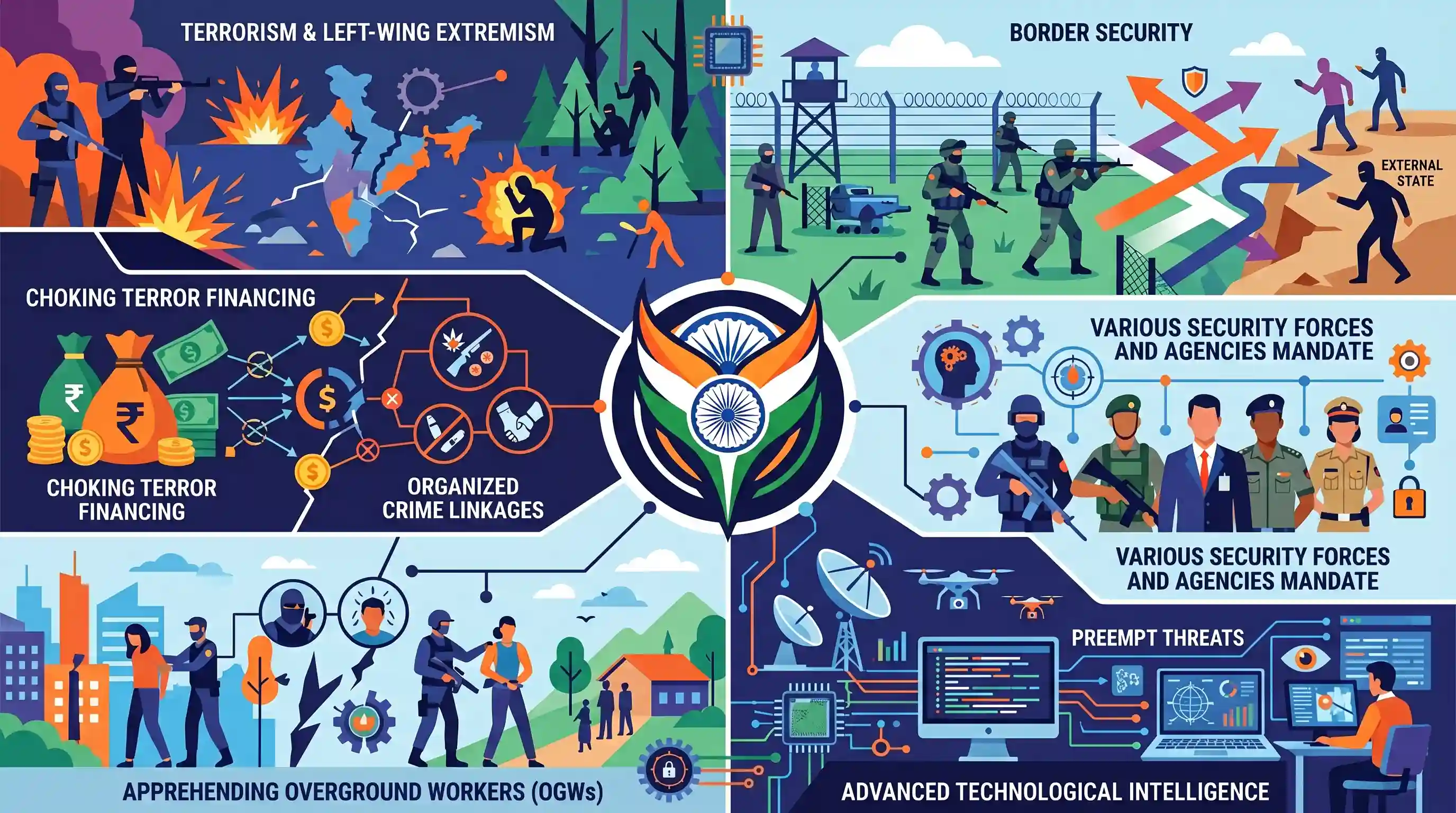
The article analyzes 'PRAHAAR', India's newly consolidated counterterrorism document, concluding that it functions primarily as a statement of intent rather than a comprehensive, actionable strategy. While it effectively signals the nation's zero-tolerance approach and proactive deterrence against terrorism, it falls short on operational specifics, institutional reforms, and defined command structures. Key areas requiring deeper strategic guidance include inter-agency coordination, intelligence sharing, modernizing state police forces, and tackling the multifaceted nexus of cyber-terrorism, terror financing, and organized crime.
Key Points
- The 'PRAHAAR' document outlines India's strategic intent and political will for a zero-tolerance approach to terrorism, emphasizing proactive deterrence and neutralization of threats.
- It is viewed as more of a statement of intent rather than a full-fledged strategy because it lacks detailed operational frameworks, specific resource allocation plans, and actionable standard operating procedures (SOPs).
- A comprehensive counterterrorism strategy requires addressing systemic institutional challenges, including seamless intelligence sharing among central and state agencies, and the operationalization of an overarching body like the National Counter Terrorism Centre (NCTC).
- Modern counterterrorism frameworks must be equipped to tackle evolving dimensions of the threat, including cyber-terrorism, terror financing, narco-terrorism, and complex linkages with transnational organized crime.
- Bridging the capacity gap between specialized central agencies and local state police forces—who act as the first responders—remains a critical requirement for a robust security apparatus.
Important Terms
PRAHAAR

India's first publicly articulated National Counter-Terrorism Policy and Strategy. It adopts a proactive 'zero-tolerance' doctrine focused on prevention, coordinated response, and dismantling terror ecosystems using a whole-of-government approach.
UPSC context
GS Paper III: Internal Security. Tests understanding of evolving national security doctrines and integrated institutional frameworks for counter-terrorism.
National Investigation Agency (NIA)
India's premier federal counter-terrorism agency established post-26/11. A statutory body under the NIA Act 2008, it possesses pan-India jurisdiction to investigate and prosecute terror-related offenses without state consent.
UPSC context
GS Paper III: Security Agencies. Tests knowledge of specialized federal investigative powers and the legal framework for internal security.
National Counter Terrorism Centre (NCTC)
A proposed federal anti-terror organization designed to unify intelligence and operations. It remains controversial due to concerns regarding state sovereignty and the federal balance of power in policing.
UPSC context
GS Paper II & III: Federalism and Internal Security. Tests critical analysis of institutional gaps vs. federal challenges in security coordination.
National Security Guard (NSG)
An elite federal contingency force established in 1984. Known as 'Black Cats,' it is specialized in high-risk counter-terrorism, hostage rescue, and counter-hijacking operations across land, sea, and air.
UPSC context
GS Paper III: Security Forces. Tests understanding of specialized mandates for rapid-response tactical units during exceptional security crises.
Prelims Trap
PRAHAAR is a statutory framework and the NCTC is India's operational apex body for counter-terrorism.
PRAHAAR is a strategic policy document, not a legislative Act. Furthermore, the NCTC remains stalled and non-operational since 26/11 due to states' federalism concerns.
Static Concepts Connected
Why has the National Counter Terrorism Centre (NCTC) remained non-operational?
- State Subject: 'Public Order' and 'Police' are State subjects under Schedule VII, making state governments wary of central overreach.
- Intelligence Overreach: States opposed giving the Intelligence Bureau (IB) sweeping arrest and seizure powers under the proposed NCTC framework.
- Federal Friction: States feared the deployment of central agencies without their consent would override local police jurisdiction.
What is the mandate and jurisdiction of the National Investigation Agency (NIA)?
- Creation: Constituted under the NIA Act 2008 post-26/11 to investigate specific Scheduled Offences like terrorism.
- Jurisdiction: Has concurrent jurisdiction to take up terror cases across states without requiring the state government's permission.
- 2019 Expansion: The 2019 amendment expanded its scope to cover cyber-terrorism, human trafficking, and offences committed outside India.
Cross-Topic Patterns
Counter-terrorism vs. Federalism
The non-operationalization of NCTC and friction over NIA's jurisdiction reflect the constant tension between national security imperatives and the 7th Schedule (Police as a State subject).
The Narco-Terror-Cyber Nexus
Modern terror financing increasingly relies on transnational organized crime and crypto, shifting the counter-terrorism focus from purely kinetic warfare to financial intelligence and FATF compliance.

GS-3 Mains will likely ask you to critically evaluate if 'PRAHAAR' resolves systemic federal bottlenecks in India's security architecture.
Linked PYQs · 4
Linked PYQs · 4
- 2021MainsGS3
Analyse the multidimensional challenges posed by external state and non-state actors, to the internal security of India. Also discuss measures required to be taken to combat these threats.
- 2021MainsGS3
Analyse the complexity and intensity of terrorism, its causes, linkages and obnoxious nexus. Also suggest measures required to be taken to eradicate the menace of terrorism.
- 2022MainsGS3
Discuss the types of organised crimes. Describe the linkages between terrorists and organised crime that exist at the national and transnational levels.
- 2024MainsGS3
Explain how narco-terrorism has emerged as a serious threat across the country. Suggest suitable measures to counter narco-terrorism.
