Prahaar strategy outlines India consolidated anti terror framework
Source:Indian Express ↗
Why It Matters
Counter-terrorism frameworks are a high-yield topic in GS3 (Internal Security). Understanding consolidated strategies like 'Prahaar' is crucial for writing comprehensive Mains answers on how the Indian State is evolving its institutional and tactical approach to dismantle terror ecosystems and tackle internal threats.
Summary
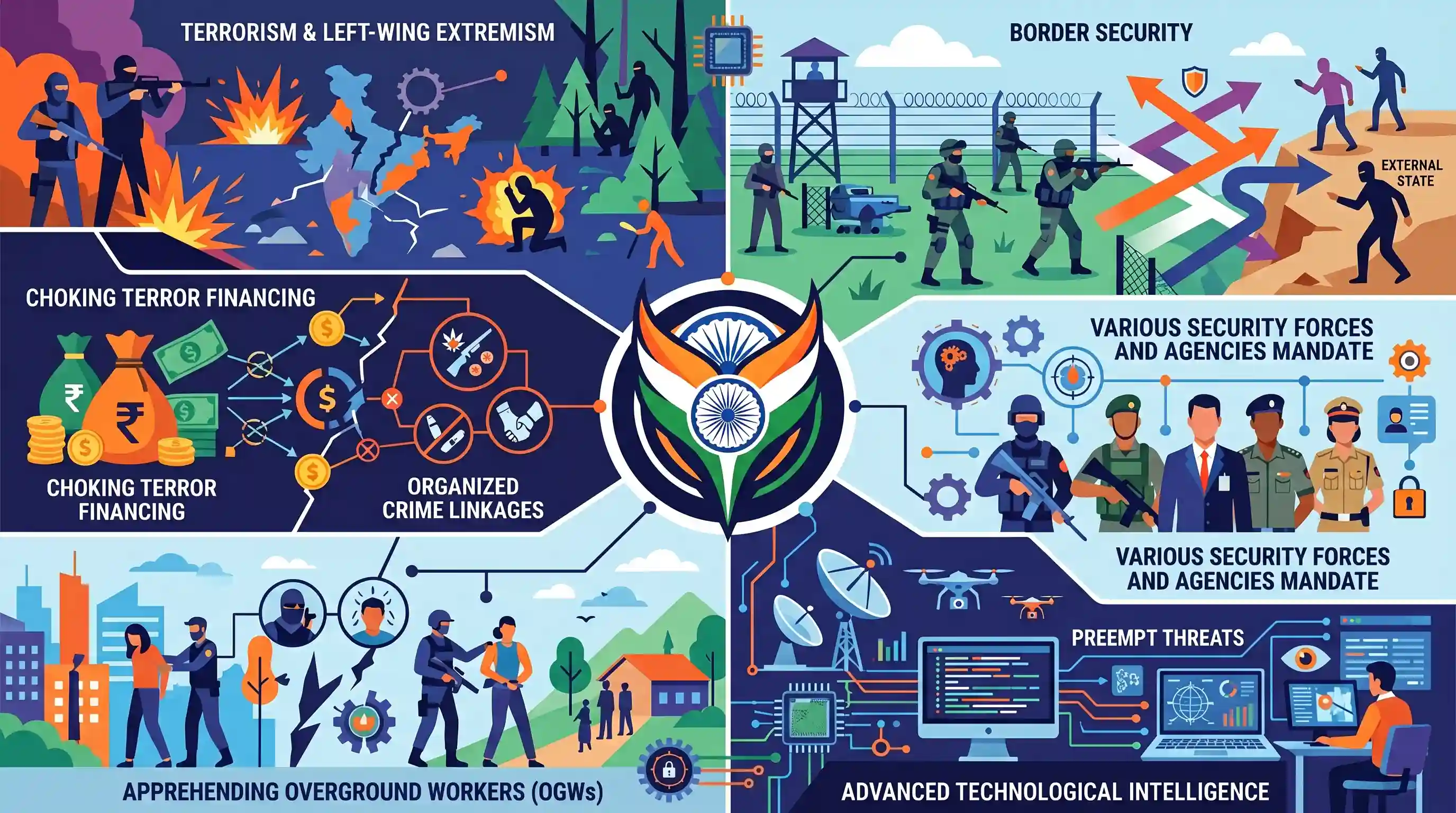
The article explains India's consolidated anti-terror strategy dubbed 'Prahaar', a comprehensive framework aimed at neutralizing terrorism and Left-Wing Extremism (LWE). Guided by a zero-tolerance policy, the strategy relies on seamless coordination among central and state law enforcement, particularly emphasizing the role of the National Investigation Agency (NIA) and intelligence bodies. 'Prahaar' targets the entire terror ecosystem, which includes choking terror financing networks, apprehending overground workers, and utilizing advanced technological intelligence to preempt threats. This unified approach marks a shift from reactive operations to a sustained, multi-layered offensive against internal security challenges.
Key Points
- 'Prahaar' represents India's consolidated multi-agency strategy to decisively counter internal security threats, encompassing both cross-border terrorism and Left-Wing Extremism.
- The strategy emphasizes a zero-tolerance approach, focusing not just on active militants but also dismantling the larger terror ecosystem, including financing and overground workers.
- Enhanced coordination between the National Investigation Agency (NIA), state police, and central intelligence bodies is a core pillar of this framework.
- Technological upgrades for intelligence gathering and grassroot capacity-building among local security forces are pivotal to preempting terror activities.
Important Terms
PRAHAAR Strategy

India's 2026 comprehensive National Counter-Terrorism Policy. It adopts a seven-pillar framework for proactive, intelligence-led prevention and coordinated response against terror ecosystems and radicalization.
UPSC context
GS Paper 3 (Internal Security); covers doctrine-level shifts in India's anti-terror framework and integrated security strategies.
National Investigation Agency (NIA)
A statutory federal agency established under the NIA Act, 2008. It investigates and prosecutes terror-related offences and organized crime across India without requiring state-level permission.
UPSC context
GS Paper 3 (Security Agencies); mandates federal bodies and their role in handling national-level security threats.
Unlawful Activities (Prevention) Act (UAPA)
India's primary anti-terror legislation enacted in 1967. It empowers the government to designate individuals and organizations as terrorists and provides stringent measures for investigating unlawful activities.
UPSC context
GS Paper 2 (Governance) & 3 (Security); legal tools against terrorism versus civil liberties and fundamental rights.
Central Armed Police Forces (CAPFs)
Seven central security forces (like CRPF, BSF, and NSG) under the Ministry of Home Affairs. They guard borders and assist states in internal security and counter-terror operations.
UPSC context
GS Paper 3 (Security Forces); tests mandate, challenges, and roles of various central forces in internal stability.
Ministry of Home Affairs (MHA)
The nodal Union ministry responsible for internal security and public order. It oversees federal agencies like NIA and CAPFs and formulates national security policies.
UPSC context
GS Paper 3 (Security); nodal authority for internal security management and federal-state coordination.
Intelligence Bureau (IB)
India's premier domestic internal intelligence agency. It coordinates real-time intelligence through the Multi-Agency Centre (MAC) to preempt internal security threats and terrorist activities.
UPSC context
GS Paper 3 (Security Agencies); role of intelligence agencies in preemptive security and coordination.
Prelims Trap
'Prahaar' is exclusively a kinetic military operation to eliminate active Left-Wing Extremists.
'Prahaar' is a comprehensive 7-pillar national doctrine covering non-kinetic aspects like de-radicalization, financial tracking, and cross-border terrorism, not just a tactical anti-naxal military operation.
Static Concepts Connected
How does the NIA's jurisdiction differ from State Police?
- Suo Motu power: The NIA can take up terror cases suo motu across India under the NIA Act, 2008, bypassing the need for state government consent.
- Scheduled Offences: It investigates specific crimes listed in its Schedule (e.g., UAPA, hijacking), while state police handle general public order, which is a State List subject.
- Extra-territorial reach: The NIA possesses extra-territorial jurisdiction to investigate scheduled offenses and terror attacks involving Indian citizens or interests abroad.
What are the defining provisions of the UAPA, 1967?
- Individual designation: The 2019 amendment allows the Central Government to designate individuals as terrorists, rather than restricting the designation solely to organizations.
- Stringent bail: It restricts ordinary bail provisions; if the court finds accusations prima facie true, bail is denied, effectively shifting the burden of proof.
- Asset seizure: The NIA Director General can independently approve the seizure and attachment of properties suspected to be linked to proceeds of terrorism.
Cross-Topic Patterns
Counter-terror meets emerging border tech
The Prahaar doctrine explicitly addresses UAV/drone smuggling and cyber-terrorism, merging traditional border management strategies with emerging technology and cyber security frameworks.
Terror financing and PMLA linkages
Dismantling the 'terror ecosystem' and choking financing networks links counter-terrorism directly with the Prevention of Money Laundering Act (PMLA), demanding NIA-ED coordination.

Expect a 2026 GS-3 Mains question contrasting kinetic anti-terror ops with Prahaar's 'whole-of-ecosystem' and de-radicalization approach.
Linked PYQs · 4
Linked PYQs · 4
- 2025MainsGS3
Terrorism is a global scourge. How has it manifested in India? Elaborate with contemporary examples. What are the counter measures adopted by the State? Explain.
- 2023MainsGS3
What are the internal security challenges being faced by India? Give out the role of Central Intelligence and Investigative Agencies tasked to counter such threats.
- 2020MainsGS3
What are the determinants of left-wing extremism in Eastern part of India? What strategy should Government of India, civil administration and security forces adopt to counter the threat in the affected areas?
- 2020MainsGS3
Analyze internal security threats and transborder crimes along Myanmar, Bangladesh and Pakistan borders including Line of Control (LoC). Also discuss the role played by various security forces in this regard.
