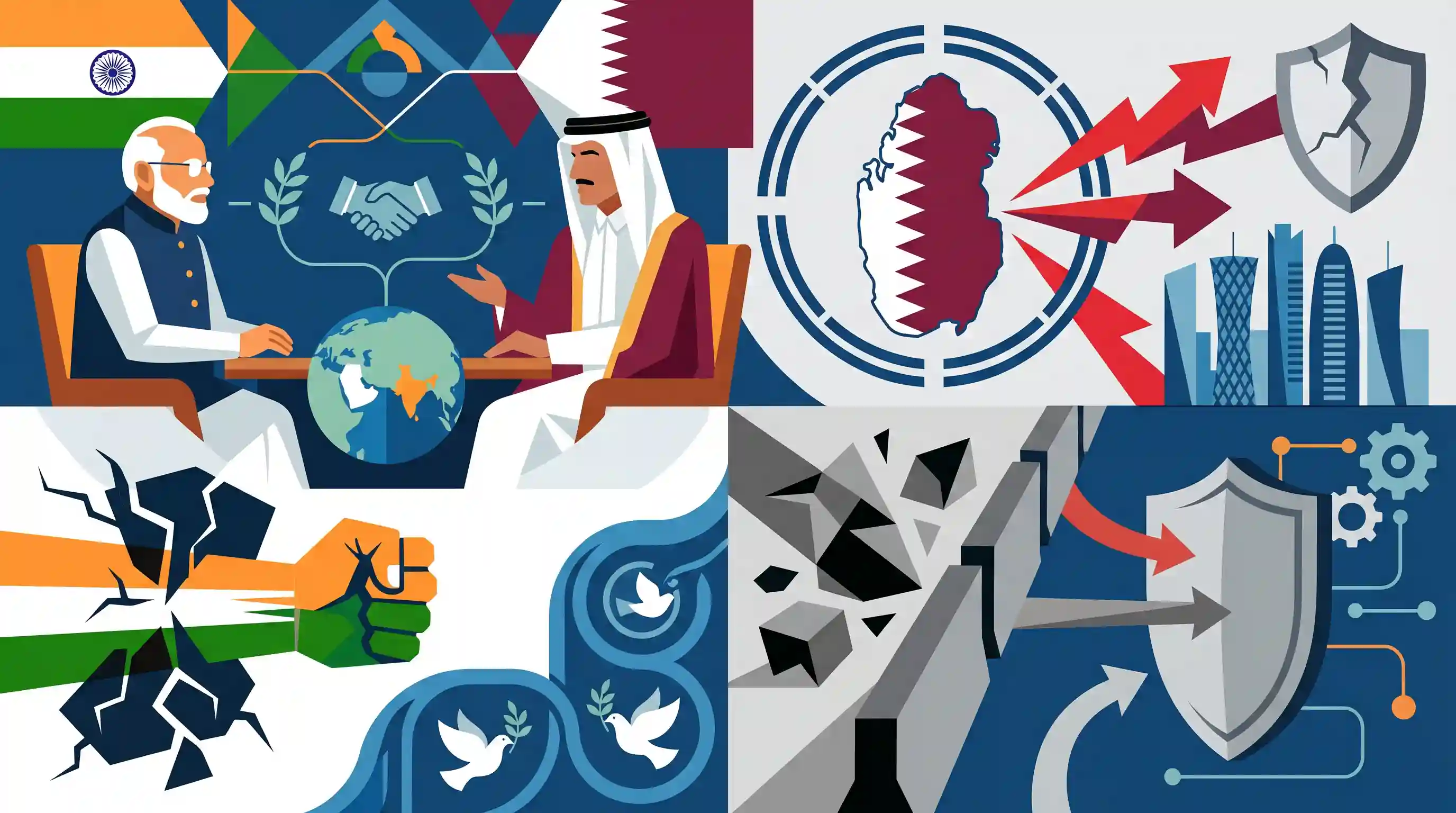
India Condemns Violation of Qatar Sovereignty in Doha
Source:The Hindu ↗
Why It Matters
The incident highlights India's delicate diplomatic balancing act in the Middle East. By condemning the violation of Qatar's sovereignty while maintaining its anti-terrorism posture regarding Hamas, India navigates complex regional geopolitics essential for its energy security, diaspora interests, and strategic partnerships with both Arab nations and Israel.
Summary
Prime Minister Narendra Modi has condemned Israel's recent strikes on Hamas leaders in Doha as a violation of Qatar's sovereignty. In a conversation with Qatar's Emir Sheikh Tamim Bin Hamad Al-Thani, Modi expressed deep concern over the attacks and urged that differences be resolved through dialogue and diplomacy to prevent regional escalation. While showing solidarity with the "brotherly State of Qatar," PM Modi also reaffirmed India's unwavering stance against all forms of terrorism and its commitment to peace and stability in the Middle East.
Key Points
- Prime Minister Narendra Modi condemned Israel's strikes targeting Hamas leaders in Doha, calling it a violation of Qatar's sovereignty.
- India expressed deep concern over the attacks and emphasized resolving issues through dialogue and diplomacy to avoid further escalation.
- PM Modi reiterated India's commitment to peace and stability in the Middle East while maintaining a firm stance against terrorism in all forms.
Important Terms
Hamas

A Palestinian Sunni-Islamic fundamentalist militant and political organization that has governed the Gaza Strip since 2007; it is designated as a terrorist group by several nations.
UPSC context
GS Paper II: International Relations. Relevant to West Asia conflict dynamics and India’s counter-terrorism diplomacy.
Sovereignty
The supreme and independent authority of a state to govern its territory and people without external interference, forming the legal basis for international relations.
UPSC context
GS Paper II: Polity and IR. Focuses on territorial integrity and the principle of non-interference under international law.
Strategic Autonomy
India’s foreign policy framework of maintaining independent decision-making and balancing relations with rival global powers to safeguard national interests without joining formal military alliances.
UPSC context
GS Paper II: India’s Foreign Policy. Tests India’s ability to navigate complex rivalries like Israel-Iran or Israel-Qatar.
West Asia
A strategically vital region for India (often called the Middle East) encompassing the Arab world, Iran, and Israel, critical for energy security and the Indian diaspora.
UPSC context
GS Paper II: Bilateral and Regional Groupings. Central to India’s 'Link West' policy and energy security.
Strategic Partnership
An elevated bilateral relationship where two nations commit to deep, long-term cooperation in sensitive sectors such as defense, energy, and intelligence.
UPSC context
GS Paper II: Bilateral Relations. Specifically relevant to India’s deepening ties with Qatar and other Gulf nations.
Dialogue and Diplomacy
The core pillar of Indian foreign policy advocating for the peaceful resolution of international disputes through negotiation rather than military force.
UPSC context
GS Paper II: International Relations. Represents India's principled stance on global conflicts, from Ukraine to the Middle East.
Prelims Trap
"India's condemnation of Israel marks the abandonment of its De-hyphenation policy in West Asia."
This is false. The simultaneous condemnation of a sovereignty violation and the reiteration of an anti-terror stance is the exact operationalization of De-hyphenation.
Static Concepts Connected
What characterizes India's 'De-hyphenation' policy in West Asia?
- Independent Ties: Dealing with conflicting nations (e.g., Israel and Arab states) independently based on mutual interests, avoiding zero-sum logic.
- Strategic Autonomy: Balancing defense and technological cooperation with Israel against energy security and diaspora interests with Arab nations.
How does international law define state sovereignty and non-intervention?
- UN Charter Article 2(4): Prohibits the threat or use of force against the territorial integrity or political independence of any state.
- Panchsheel Link: India's foundational foreign policy doctrine emphasizes mutual respect for territorial integrity and non-interference in internal affairs.
Cross-Topic Patterns
Qatar LNG and Energy Security
India's diplomatic solidarity is closely tied to its energy transition; Qatar supplies a massive share of India's LNG, essential for meeting its goal of a 15% gas-based economy by 2030.
Gulf Diaspora and Forex Reserves
The safety of over 800,000 Indians in Qatar is strategically vital, as Gulf remittances act as a major cushion for financing India's Current Account Deficit (CAD).
CCIT vs Extraterritorial Strikes
India's stance highlights the tension between pushing for a global legal framework against terror (CCIT) and opposing unilateral extraterritorial strikes that violate state sovereignty.

Expect a multi-statement Prelims question on India's 'De-hyphenation' policy, balancing Arab energy ties with Israeli defense partnerships.
Linked PYQs · 3
Linked PYQs · 3
- 2025MainsGS2
"Energy security constitutes the dominant kingpin of India's foreign policy, and is linked with India's overarching influence in Middle Eastern countries.” How would you integrate energy security with India's foreign policy trajectories in the coming years?
- 2018MainsGS2
“India’s relations with Israel have, of late, acquired a depth and diversity, which cannot be rolled back.” Discuss.
- 2024MainsGS2
‘Terrorism has become a significant threat to global peace and security.’ Evaluate the effectiveness of the United Nations Security Council's Counter Terrorism Committee (CTC) and its associated bodies in addressing and mitigating this threat at the international level.
