India condemns Pakistani airstrikes targeting Afghan territory
Source:The Hindu ↗
Why It Matters
The diplomatic exchange highlights the fragile security environment in South Asia and the complex interplay between India, Pakistan, and Afghanistan. It is relevant for understanding regional geopolitics, cross-border terrorism, and India's foreign policy stance on sovereignty and territorial integrity, which are key themes in UPSC GS2 and GS3.
Summary
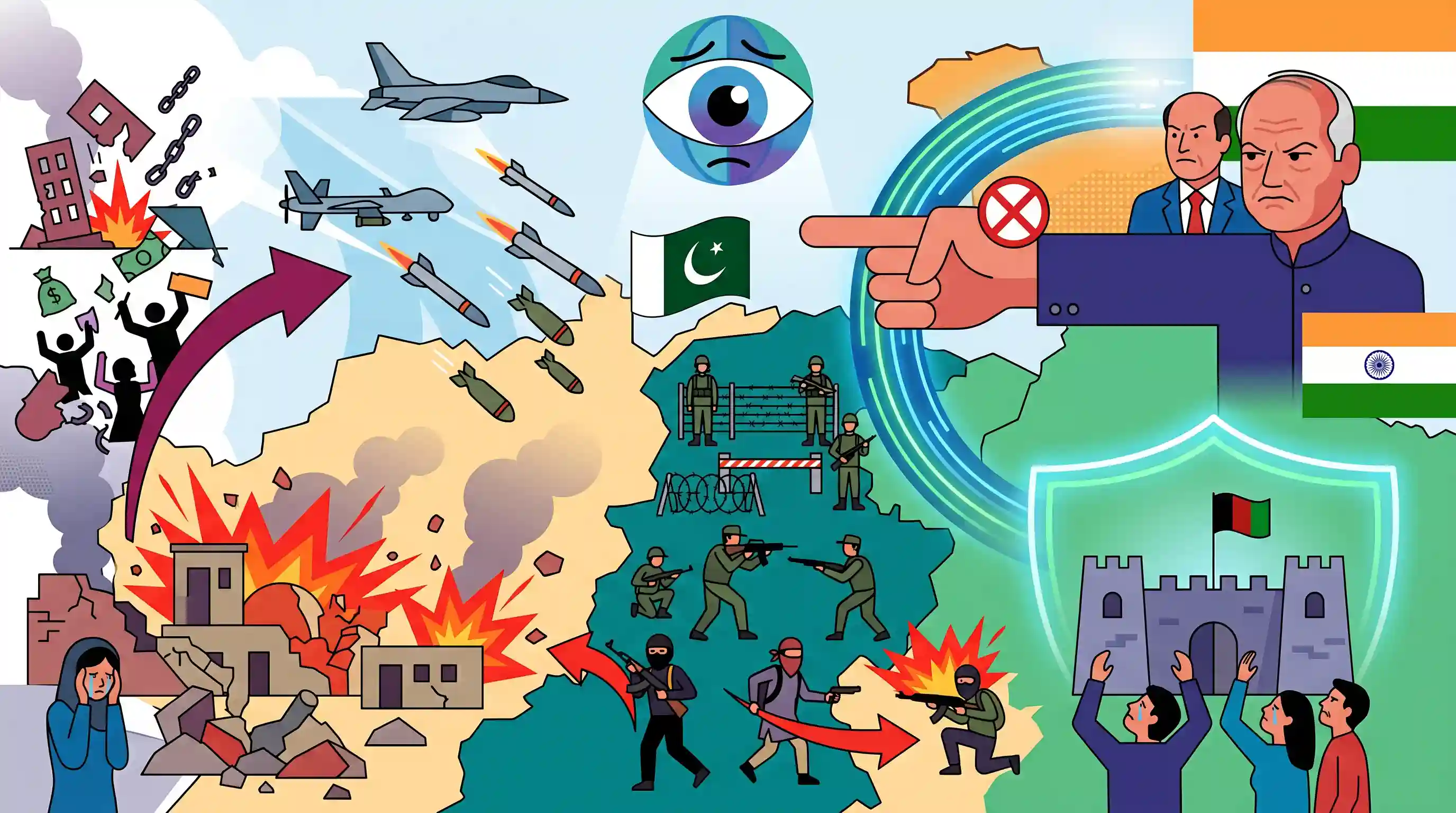
India strongly condemned Pakistan's recent airstrikes on Afghan territory, which resulted in civilian casualties, describing the action as an attempt by Islamabad to deflect from its internal failures. The Ministry of External Affairs reaffirmed India's support for Afghanistan's sovereignty and territorial integrity. Conversely, Pakistan defended the airstrikes as a necessary counter-terrorism measure targeting militant hideouts, claiming retaliation for rebel attacks within its own borders and accusing Afghanistan of exporting terrorism.
Key Points
- India strongly condemned Pakistan's airstrikes on Afghan territory that caused civilian casualties.
- The Ministry of External Affairs described the strikes as Pakistan's attempt to 'externalise its internal failures'.
- India reiterated its support for Afghanistan's sovereignty, territorial integrity, and independence.
- Pakistan claimed the airstrikes targeted militant hideouts and killed at least 70 terrorists in retaliation for rebel attacks.
- Pakistan accused Afghanistan of exporting terrorism, justifying the strikes as measures to secure its citizens.
Important Terms
Ministry of External Affairs (MEA)

The Indian government ministry responsible for managing foreign relations, diplomatic missions, and the formulation of the country's foreign policy.
UPSC context
GS Paper II (International Relations); critical for questions on India's diplomatic strategy and bilateral engagements.
Neighborhood First Policy
A core Indian foreign policy priority aimed at fostering stable, cooperative, and mutually beneficial relations with its immediate geographical neighbors.
UPSC context
GS Paper II (India and its Neighborhood-Relations); essential for understanding regional diplomacy and integration.
Durand Line
The 2,640-km international border between Afghanistan and Pakistan, drawn in 1893, which remains unrecognized by Afghanistan and a major source of tension.
UPSC context
GS Paper II & III; crucial for analyzing Af-Pak relations and regional security dynamics.
Tehrik-i-Taliban Pakistan (TTP)
An umbrella organization of militant Islamist groups based along the Afghan-Pakistan border that seeks to overthrow the Pakistani state.
UPSC context
GS Paper III (Security Challenges); relevant for understanding regional terrorism and its impact on South Asian stability.
Sovereignty and Territorial Integrity
The fundamental principle that a state has supreme authority over its territory and that its borders must be respected by others.
UPSC context
GS Paper II (International Relations); key concept in disputes involving state boundaries and international law.
Cross-border Terrorism
Terrorist activities where planners or executors cross an international border to commit violence, often supported by external state or non-state actors.
UPSC context
GS Paper III (Internal Security); a primary security challenge for India, particularly on its western and northern borders.
Non-State Actors
Individuals or groups that are wholly or partly independent of sovereign state governments yet hold significant political or security influence.
UPSC context
GS Paper III (Internal Security); tests understanding of decentralized threats like insurgent groups and their regional impact.
Prelims Trap
The Durand Line is a mutually recognized international boundary between Afghanistan and Pakistan.
While Pakistan treats it as an official border, Afghanistan historically rejects this 1893 British colonial boundary because it arbitrarily divides ethnic Pashtun and Baloch tribes.
Static Concepts Connected
What is Pakistan's 'Strategic Depth' doctrine regarding Afghanistan?
- Core Objective: A historical military strategy by Islamabad to install a friendly or subservient regime in Kabul.
- Security Rationale: To provide a strategic fallback space for Pakistan's military and prevent a two-front war scenario involving India and Afghanistan.
- Current Status: The doctrine has largely collapsed as the Afghan Taliban now shelters the TTP, leading to cross-border aerial bombardments.
How was the Durand Line historically established?
- 1893 Agreement: It was demarcated following an 1893 memorandum of understanding between Mortimer Durand of British India and Afghan Amir Abdur Rahman Khan.
- Colonial Legacy: The line intentionally cut through the Pashtun tribal areas, leaving a legacy of geopolitical faultlines and border skirmishes that persist today.
Cross-Topic Patterns
Non-State Actors & The Boomerang Effect
Pakistan's historical cultivation of the Afghan Taliban as a proxy has backfired, with the TTP now using Afghan soil to launch strikes against Islamabad. This perfectly illustrates the "boomerang effect" of state-sponsored terrorism.
Humanitarian Aid vs. Diplomatic Recognition
India balances its refusal to formally recognize the Taliban regime with consistent humanitarian engagement, supplying emergency medical aid and wheat to build goodwill and bypass Pakistani influence.

Expect a 2026 question linking the collapse of Pakistan's 'Strategic Depth' doctrine with Durand Line geography and regional instability.
Linked PYQs · 3
Linked PYQs · 3
- 2016MainsGS2
Increasing cross-border terrorist attacks in India and growing interference in the internal affairs of several member-states by Pakistan are not conducive for the future of SAARC (South Asian Association for Regional Cooperation)." Explain with suitable examples.
- 2020MainsGS3
Analyze internal security threats and transborder crimes along Myanmar, Bangladesh and Pakistan borders including Line of Control (LoC). Also discuss the role played by various security forces in this regard.
- 2015MainsGS2
Terrorist activities and mutual distrust have clouded India-Pakistan relations. To what extent the use of soft power like sports and cultural exchanges could help generate goodwill between the two countries? Discuss with suitable examples.
