India condemns Pakistan airstrikes on Afghanistan sovereignty
Source:The Hindu ↗
Why It Matters
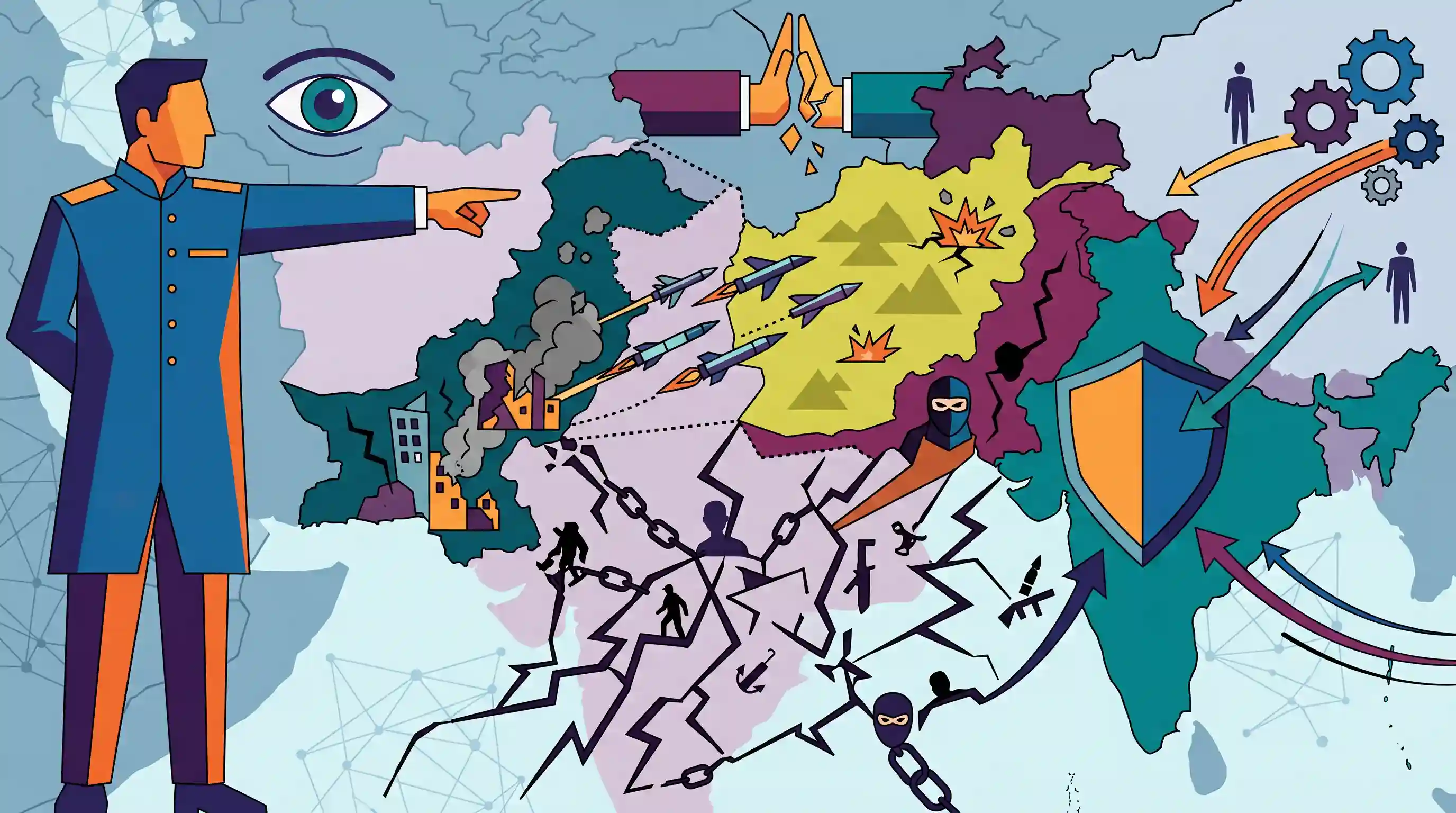
The Af-Pak border tensions directly impact South Asia's security architecture. For UPSC aspirants, India's measured diplomatic response highlights its strategic stance on sovereignty, regional stability, and its ongoing strategy to isolate Pakistan over cross-border terrorism while navigating complex relations with the Taliban-led Afghanistan.
Summary
India has officially condemned Pakistan's recent airstrikes on Afghan soil, interpreting the military action as Islamabad's effort to deflect from its domestic challenges. While Pakistan claims the strikes targeted terrorist hideouts in response to cross-border attacks, India emphasized the necessity of respecting Afghanistan's sovereignty and territorial integrity. The incident underscores the volatile security environment in the Af-Pak region, driven by accusations of state-sponsored militancy and cross-border terrorism, which continues to pose a broader challenge to regional stability and India's strategic neighborhood interests.
Key Points
- India strongly condemned Pakistan's recent airstrikes on Afghan territory, which reportedly caused civilian casualties.
- The Ministry of External Affairs (MEA) described Pakistan's actions as an attempt to "externalise its internal failures."
- India reaffirmed its commitment to Afghanistan's sovereignty, independence, and territorial integrity, urging stability in the region.
- Pakistan justified the strikes as retaliatory measures targeting militant hideouts following recent rebel attacks, illustrating the deepening border tensions and mutual accusations of cross-border terrorism between Pakistan and Afghanistan.
Important Terms
Ministry of External Affairs (MEA)

The government agency responsible for India's foreign relations, led by the External Affairs Minister. It formulates and executes foreign policy, representing India in international forums and bilateral negotiations.
UPSC context
GS Paper II: International Relations. Essential for understanding India's official stance on neighborhood conflicts and global diplomacy.
Territorial Integrity
The principle in international law that a sovereign state's borders are sacrosanct and should not be violated or forcibly altered by another state, as enshrined in Article 2(4) of the UN Charter.
UPSC context
GS Paper II & III: International Relations and Internal Security. Tests knowledge of international norms and border dispute resolutions.
Durand Line
A 2,640-km border established in 1893 between British India and Afghanistan. It currently serves as the international boundary between Pakistan and Afghanistan, though Kabul does not formally recognize its legitimacy.
UPSC context
GS Paper I & II: Geography and IR. A recurring geopolitical flashpoint impacting South Asian security and India's interests.
Af-Pak Region
A geopolitical neologism used to view Afghanistan and Pakistan as a single theater of operations due to their intertwined security challenges, tribal links, and shared border instability.
UPSC context
GS Paper II: International Relations. Relevant for analyzing regional security dynamics and US-India-Pakistan-Afghanistan strategic equations.
Cross-border Terrorism
Terrorist acts where the planning, funding, and logistics occur in one country to carry out attacks in another, often exploiting porous borders and lack of state cooperation.
UPSC context
GS Paper III: Internal Security. A primary challenge for India's border management and a key topic in security debates.
Sovereignty
The supreme, independent authority of a state to govern its people and territory without outside interference. It is a fundamental concept for maintaining the international legal order.
UPSC context
GS Paper II: Political Science and IR. Tests the application of fundamental political principles to modern geopolitical conflicts.
State-sponsored Militancy
The support provided by a government to non-state militant groups, through funding, arms, or sanctuary, to destabilize rivals or achieve specific strategic and foreign policy objectives.
UPSC context
GS Paper III: Internal Security. Evaluates the role of external state actors in fueling domestic insurgencies and regional instability.
Prelims Trap
"Afghanistan recognizes the Durand Line as the official border."
Modern Afghanistan (including previous governments and the Taliban) has consistently refused to recognize the 1893 colonial-era Durand Line as a legitimate international boundary.
Static Concepts Connected
What is Pakistan's 'Strategic Depth' doctrine in IR?
- Military strategy: A geopolitical policy devised by the Pakistani military establishment in the 1980s.
- Buffer zone: Aimed to maintain a pliable, pro-Pakistan regime in Afghanistan to serve as a secure geographical buffer in the event of an Indian invasion.
- Current collapse: Open hostilities and airstrikes between Islamabad and the Afghan Taliban mark the definitive failure of this long-standing doctrine.
What is the historical significance of the Durand Line?
- 1893 Agreement: A 2,640 km boundary established in 1893 by British administrator Sir Mortimer Durand and Afghan Emir Abdur Rahman Khan.
- Ethnic division: It artificially divided ethnic Pashtun and Baloch territories, laying the groundwork for modern insurgencies and trans-border militancy.
- Treaty of Rawalpindi: Following the 1919 Third Anglo-Afghan War, Afghanistan secured full control over its foreign affairs, a treaty often invoked to repudiate colonial borders.
Cross-Topic Patterns
TTP insurgency & Pashtun nationalism
The cross-border conflict highlights the overlap between internal security (TTP's war on Islamabad) and ethnic geopolitics, complicating trans-national connectivity projects like TAPI.
Colonial borders & contemporary conflicts
Just like the McMahon Line (India-China), the Durand Line illustrates how unresolved British-era cartography continues to dictate modern South Asian flashpoints and border security challenges.

Expect a Prelims question matching colonial-era boundaries (Durand, Radcliffe, McMahon) with their respective treaties and current status.
Linked PYQs · 3
Linked PYQs · 3
- 2020MainsGS3
Analyze internal security threats and transborder crimes along Myanmar, Bangladesh and Pakistan borders including Line of Control (LoC). Also discuss the role played by various security forces in this regard.
- 2016MainsGS2
Increasing cross-border terrorist attacks in India and growing interference in the internal affairs of several member-states by Pakistan are not conducive for the future of SAARC (South Asian Association for Regional Cooperation)." Explain with suitable examples.
- 2015MainsGS2
Terrorist activities and mutual distrust have clouded India-Pakistan relations. To what extent the use of soft power like sports and cultural exchanges could help generate goodwill between the two countries? Discuss with suitable examples.
