Pakistan airstrikes in Afghanistan and Indian diplomatic response
Source:Indian Express ↗
Why It Matters
The escalating border conflict between Pakistan and Afghanistan directly impacts South Asian regional stability. For UPSC aspirants, understanding India's diplomatic response helps analyze India's "Neighborhood First" policy, its strategic outreach to Afghanistan, and its broader stance on sovereignty and state-sponsored cross-border military actions.
Summary
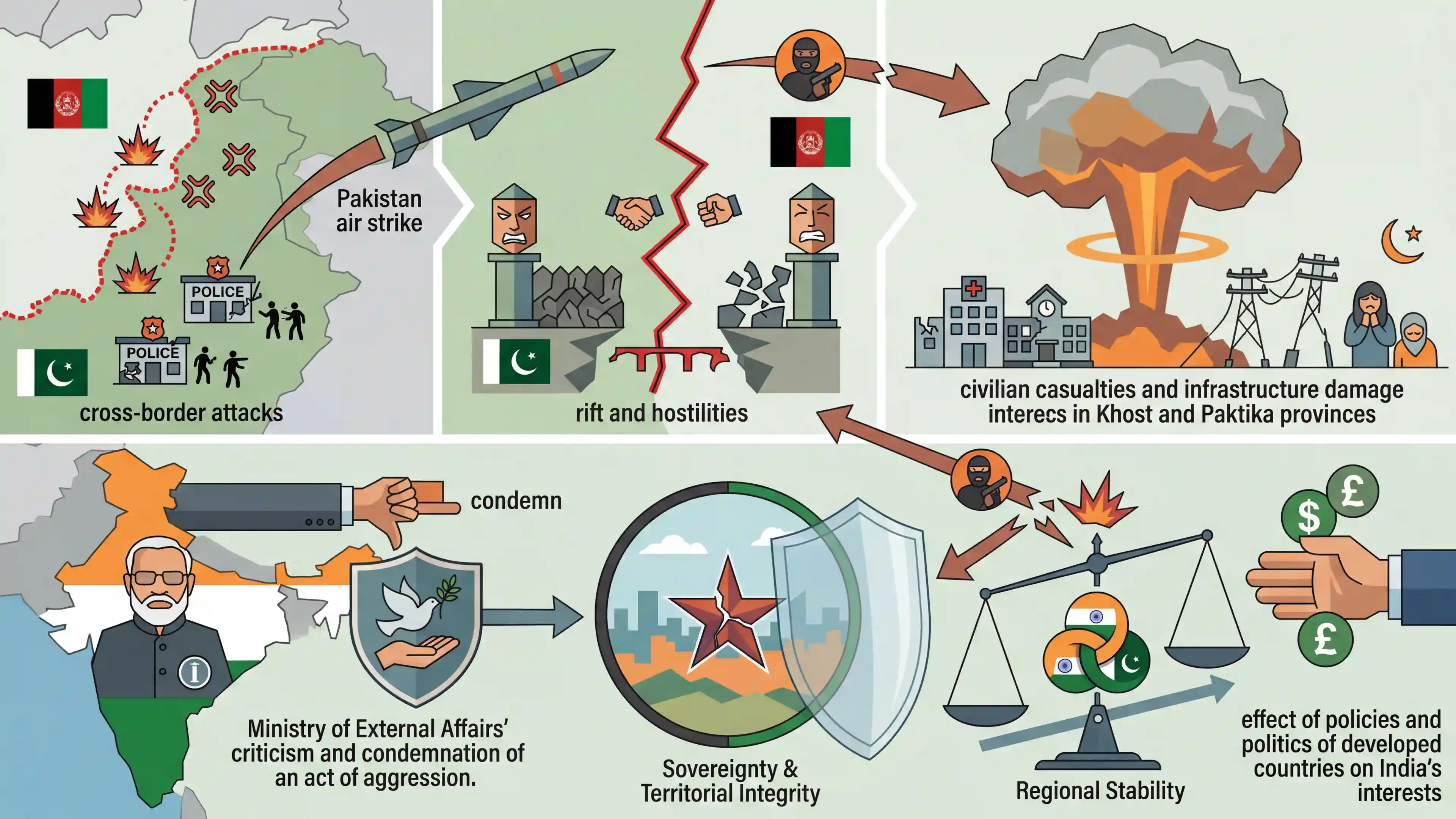
India has strongly condemned Pakistan's recent air strikes inside Afghanistan, asserting that Kabul's sovereignty and territorial integrity must be respected. The strikes, which Pakistan claims targeted militant safe havens responsible for cross-border attacks, resulted in civilian casualties and infrastructure damage in the Khost and Paktika provinces. India's Ministry of External Affairs criticized the strikes as an act of aggression against a sovereign nation. The escalation highlights the deepening rift and border hostilities between Pakistan and Afghanistan, while reaffirming India's strategic interest in regional stability and its opposition to cross-border military interventions.
Key Points
- India officially condemned recent air strikes conducted by Pakistan in Afghanistan's Khost and Paktika provinces, which resulted in civilian casualties.
- The Ministry of External Affairs emphasized that Afghanistan's sovereignty and territorial integrity must be respected, describing Pakistan's actions as a form of external aggression.
- Pakistan justified the cross-border strikes by accusing the Afghan government of providing safe havens to militants (like the TTP) responsible for attacks inside Pakistan.
- The incident marks a severe escalation in the historically strained relations between Pakistan and Afghanistan, leading to border clashes and escalating rhetoric.
- India's condemnation reflects its broader strategic interest in a stable, sovereign Afghanistan and its firm stance against cross-border military interventions in South Asia.
Important Terms
Ministry of External Affairs (MEA)

The central government agency managing India's foreign relations, formulating foreign policy, and overseeing diplomatic missions. It represents India at the UN and other international forums.
UPSC context
GS Paper II: Important for understanding India's official foreign policy stances, bilateral relations, and the institutional framework of diplomacy.
Sovereignty
The supreme and independent authority of a state to govern its territory and affairs without external interference or coercion.
UPSC context
GS Paper II: A fundamental concept in International Relations; tested in contexts like border disputes, UN Charter principles, and national autonomy.
Territorial Integrity
The principle under international law that a state's borders are inviolable and should not be altered by the use of force.
UPSC context
GS Paper II: Essential for analyzing interstate aggression, regional stability, and India’s stance on contested borders like those in Afghanistan or Ukraine.
Durand Line
The 2,640-km border between Pakistan and Afghanistan established in 1893. Afghanistan historically disputes its legitimacy, making it a major source of regional conflict.
UPSC context
GS Paper II/I: A critical colonial-era boundary affecting India-Neighborhood relations, regional security, and the historical 'Great Game' geopolitics.
Tehrik-i-Taliban Pakistan (TTP)
A militant alliance seeking to overthrow the Pakistani state. It operates across the porous Pak-Afghan border, frequently triggering military tensions and cross-border airstrikes.
UPSC context
GS Paper II/III: Relevant for topics on cross-border terrorism, regional security threats, and the impact of the Taliban’s return to power.
Neighborhood First Policy
India's foreign policy priority to foster stable, integrated, and friendly relations with its immediate neighbors through diplomatic, economic, and security cooperation.
UPSC context
GS Paper II: A primary framework for Indian diplomacy, tested regarding regional stability and India’s response to neighborhood crises.
Prelims Trap
India has formally recognized the Taliban regime to protect its strategic interests and sovereignty.
India maintains a 'technical team' in Kabul for humanitarian coordination but has deliberately withheld formal diplomatic recognition of the Taliban regime.
Static Concepts Connected
What is the Durand Line and why is it constantly disputed?
- Colonial Origin: A 2,640 km boundary drawn in 1893 by British diplomat Sir Mortimer Durand to divide Pashtun tribal lands between British India and the Afghan Emirate.
- Afghan Rejection: No Afghan government, including the current Taliban regime, officially recognizes the line, arguing it arbitrarily divides ethnic Pashtun and Baloch populations.
What is the mandate of UNSC Resolution 2593 regarding Afghanistan?
- Indian Presidency: Adopted in August 2021 under India's UNSC presidency, immediately following the Taliban's takeover of Kabul.
- Anti-Terror Mandate: Demands that Afghan territory not be used to threaten or attack any country, or to shelter, finance, or train terrorists.
Cross-Topic Patterns
Afghan instability & Chabahar Port bypass
Instability along the Af-Pak border reinforces India's strategic push to develop Iran's Chabahar port and the INSTC, bypassing Pakistan entirely to access Central Asian markets.
Cross-border strikes and Hot Pursuit doctrines
Pakistan's justification highlights 'hot pursuit' counter-insurgency tactics. UPSC frequently tests the tension in international law between territorial sovereignty and the right to self-defense against non-state actors.

Expect a multi-statement question on Af-Pak border geography (Durand Line, Khost, Paktika) paired with India's UNSC 2593 stance in 2026.
Linked PYQs · 5
Linked PYQs · 5
- 2016MainsGS2
Increasing cross-border terrorist attacks in India and growing interference in the internal affairs of several member-states by Pakistan are not conducive for the future of SAARC (South Asian Association for Regional Cooperation)." Explain with suitable examples.
- 2015MainsGS2
Terrorist activities and mutual distrust have clouded India-Pakistan relations. To what extent the use of soft power like sports and cultural exchanges could help generate goodwill between the two countries? Discuss with suitable examples.
- 2020MainsGS3
Analyze internal security threats and transborder crimes along Myanmar, Bangladesh and Pakistan borders including Line of Control (LoC). Also discuss the role played by various security forces in this regard.
- 2023MainsGS3
The use of unmanned aerial vehicles (UAVs) by our adversaries across the borders to ferry arms/ammunitions, drugs, etc., is a serious threat to the internal security. Comment on the measures being taken to tackle this threat.
- 2020MainsGS3
For effective border area management, discuss the steps required to be taken to deny local support to militants and also suggest ways to manage favourable perception among locals.
