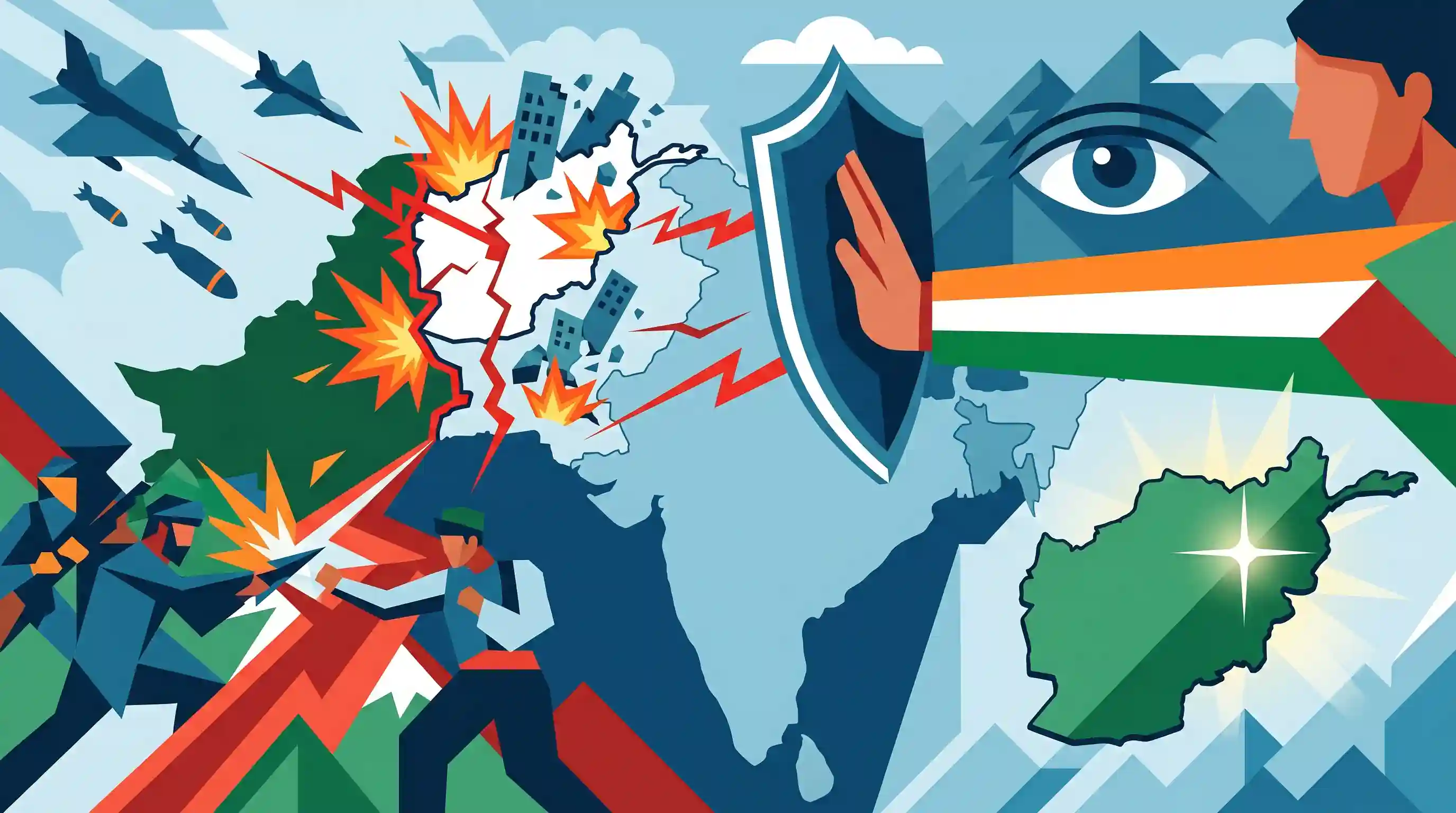
India condemns cross border airstrikes violating Afghan sovereignty
Source:Indian Express ↗
Why It Matters
This event is highly relevant for GS2 (International Relations) as it illustrates the complex geopolitical dynamics in South Asia. India's public condemnation of Pakistan's strikes in Afghanistan reinforces its 'Neighbourhood First' policy and its principled stand on national sovereignty. It provides vital context for UPSC questions dealing with regional instability, cross-border terrorism, and the ongoing friction involving Pakistan, Afghanistan, and India.
Summary
India strongly condemned recent cross-border airstrikes conducted by Pakistan inside Afghanistan. The Ministry of External Affairs labeled the military action an "act of aggression" and emphasized that Afghanistan's sovereignty and territorial integrity must be strictly respected. The strikes, which Pakistan claims targeted militant safe havens following attacks on its troops, have escalated tensions between Islamabad and the Taliban regime. India's swift condemnation highlights its broader strategic stance of supporting a sovereign Afghanistan while continuously opposing Pakistan's interference and aggression in the region.
Key Points
- Pakistan conducted cross-border airstrikes within Afghanistan's territory, citing actions against alleged militant safe havens following an attack on Pakistani troops.
- India's Ministry of External Affairs strongly condemned the strikes, describing them as an act of aggression by a Pakistani establishment hostile to a sovereign Afghanistan.
- India underscored the fundamental international principle that Kabul's sovereignty and territorial integrity must be respected.
- The incident highlights escalating tensions between Pakistan and the Afghan Taliban over cross-border terrorism and border management.
- India's response reflects its strategic posture of supporting a stable Afghanistan while criticizing Pakistan's interference in the internal affairs of neighboring states.
Important Terms
Ministry of External Affairs (MEA)

India’s government ministry responsible for conducting foreign relations, implementing international policy, and representing the nation’s interests in global forums.
UPSC context
GS Paper II: International Relations; critical for understanding India’s official diplomatic responses and foreign policy machinery.
Taliban
An Islamic fundamentalist movement that has served as the de facto governing authority of Afghanistan since the collapse of the Western-backed government in August 2021.
UPSC context
GS Paper II: Regional politics; essential for analyzing India’s security and strategic interests in a post-US withdrawal Afghanistan.
Sovereignty and Territorial Integrity
A core principle of international law asserting a state’s supreme authority over its territory and its right to be free from external military or political interference.
UPSC context
GS Paper II: International Relations; foundational to India’s stance on non-interference and its condemnation of cross-border military aggression.
Cross-Border Terrorism
Terrorism where planning or execution involves crossing national boundaries, typically involving the use of one country's soil to launch attacks against another.
UPSC context
GS Paper III: Internal Security; a major challenge for India and a key driver of volatility in South Asian regional dynamics.
Durand Line
The 2,640-kilometer border between Afghanistan and Pakistan, established in 1893, which remains a source of historical dispute and recent military friction.
UPSC context
GS Paper II: India and its Neighborhood; central to the border disputes and security tensions between Islamabad and Kabul.
Contacts Without Recognition Policy
India’s strategic policy of engaging with the Taliban regime for humanitarian and security purposes while withholding formal political recognition of their government.
UPSC context
GS Paper II: Bilateral Relations; demonstrates India's pragmatic diplomatic maneuvering and balancing of strategic and moral interests.
Prelims Trap
India's official condemnation of the strikes implies its formal diplomatic recognition of the Taliban regime.
India maintains a technical mission in Kabul and advocates for the Afghan state's territorial integrity, but officially, India has NOT formally recognized the Taliban government.
Static Concepts Connected
What is Pakistan's "Strategic Depth" doctrine?
- Core Concept: Formulated by military strategists seeking to install a pliant, pro-Islamabad regime in Kabul.
- Primary Objective: To secure a western fallback buffer zone in the event of a full-scale conventional military conflict with India.
- Current Status: Largely collapsed, as the current Afghan Taliban actively disputes the border and provides ideological/physical space for anti-Pakistan insurgents (TTP).
What are the key colonial-era boundary lines in the Indian subcontinent?
- Durand Line: Demarcated in 1893, it arbitrarily divides ethnic Pashtuns between Afghanistan and Pakistan. Successive Afghan governments have refused to recognize it.
- Radcliffe Line: Drawn in 1947 to partition British India, forming the modern borders between India and Pakistan (as well as present-day Bangladesh).
- McMahon Line: Agreed upon in 1914 at the Simla Convention, marking the boundary between Tibet and British India (currently Arunachal Pradesh).
Cross-Topic Patterns
Non-state actors and blowback terrorism
Pakistan's conflict with the TTP after years of nurturing the Afghan Taliban is a textbook internal security example of the 'blowback effect' of using proxy non-state actors as state policy.
Chabahar Port bypassing Pakistan
Escalating Af-Pak border closures and clashes validate India's strategic investment in Iran's Chabahar port, ensuring uninterrupted transit and humanitarian access to Afghanistan without relying on Pakistani territory.

Mapping of the Durand Line alongside the changing Af-Pak geopolitical dynamics is highly probable for a 2026 multi-statement question.
Linked PYQs · 2
Linked PYQs · 2
- 2016MainsGS2
Increasing cross-border terrorist attacks in India and growing interference in the internal affairs of several member-states by Pakistan are not conducive for the future of SAARC (South Asian Association for Regional Cooperation)." Explain with suitable examples.
- 2020MainsGS3
Analyze internal security threats and transborder crimes along Myanmar, Bangladesh and Pakistan borders including Line of Control (LoC). Also discuss the role played by various security forces in this regard.
