White House reports India commits to halting Russian oil imports
Source:The Hindu ↗
Why It Matters
This agreement represents a massive shift in India's geopolitical and economic strategy, balancing its strategic autonomy with a deepening US partnership. Stopping Russian oil imports and adjusting tariffs reflects the growing transactional nature of global bilateral ties, a critical theme for GS2 (International Relations) and GS3 (Economy/Energy).
Summary
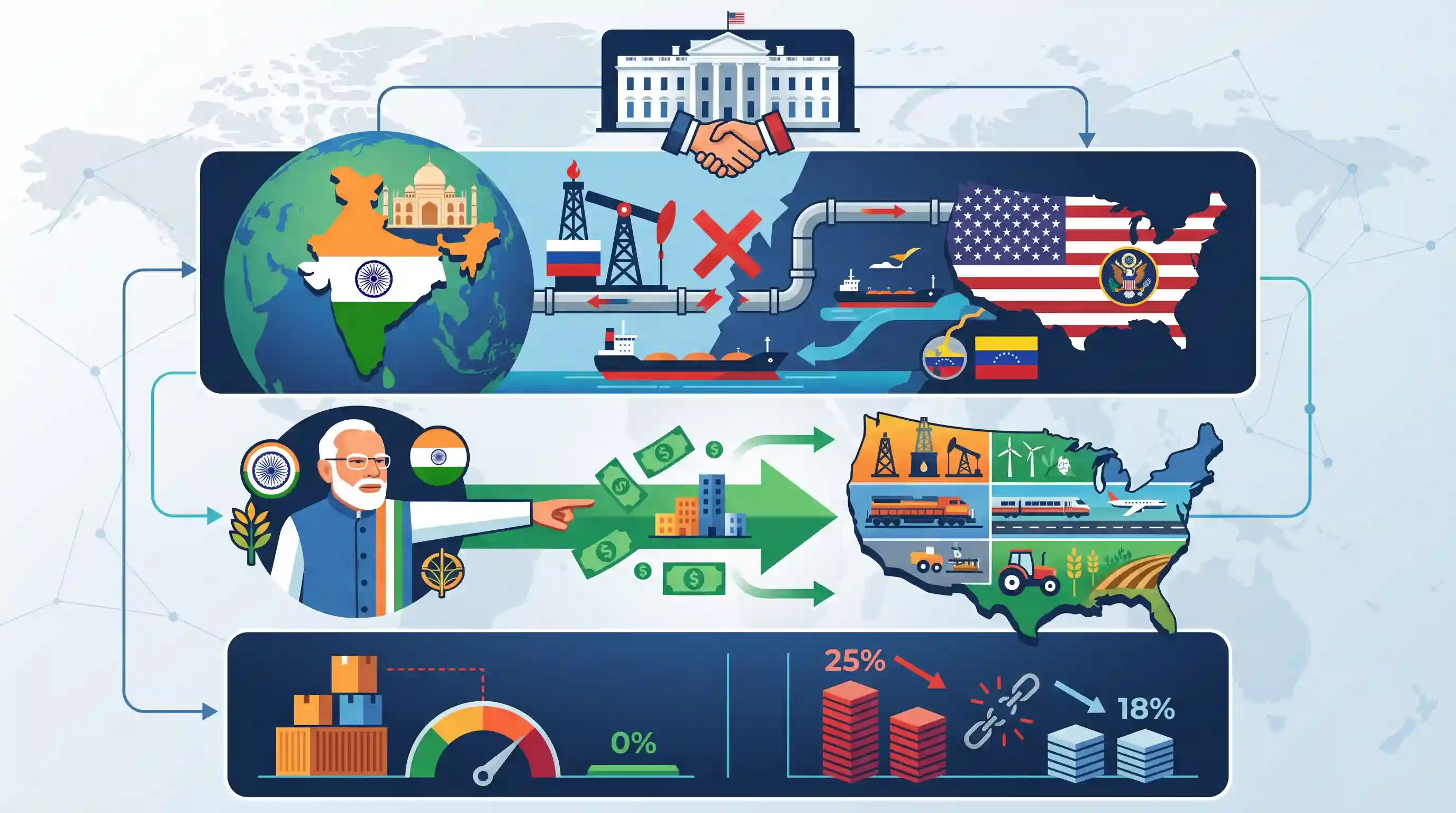
The White House announced a landmark bilateral agreement where India committed to halting its purchase of Russian oil, opting instead to meet its energy needs through the United States and potentially Venezuela. Prime Minister Narendra Modi also pledged a massive $500 billion investment into the US economy, specifically in energy, transportation, and agriculture. The deal includes significant trade adjustments: India will reduce tariffs and non-tariff barriers on US exports to zero. Consequently, the US reduced its reciprocal tariff on Indian imports from 25% to 18%, rolling back previous penalties that were tied to Delhi's Russian oil purchases.
Key Points
- India has committed to halting its purchases of Russian oil, replacing them with imports from the United States and potentially Venezuela.
- Prime Minister Narendra Modi pledged $500 billion in investments into the US economy, targeting the energy, transportation, and agricultural sectors.
- As part of a major trade realignment, India agreed to eliminate tariffs and non-tariff barriers on American exports.
- In response, the US lowered its reciprocal tariff on Indian goods from 25% to 18%, stepping back from previous tariff threats linked to India's Russian oil purchases.
- The agreement underscores a shift towards transactional bilateralism in US-India relations, deeply impacting global energy markets.
Important Terms
Bilateral Trade Agreement (BTA)

A trade treaty between two nations to reduce or eliminate tariffs and other barriers to encourage economic cooperation and market access.
UPSC context
GS Paper 2 (International Relations); tests knowledge of bilateral groupings and agreements affecting India's economic interests.
Reciprocal Tariffs
A 'tit-for-tat' border tax where a country matches the tariff rates imposed by its trading partner to establish trade equality and pressure partners to reduce barriers.
UPSC context
GS Paper 3 (Economy); relevant to trade wars, protectionism, and the impact of US economic policies on India.
Non-Tariff Barriers (NTBs)
Trade restrictions such as quotas, licensing, or technical standards, rather than direct taxes, that hinder the free flow of goods between nations.
UPSC context
GS Paper 3 (Economy); tests understanding of modern trade hurdles and strategies used to protect domestic industries.
Energy Security
The uninterrupted availability of energy sources at an affordable price, often achieved by diversifying fuel types and international supply partners.
UPSC context
GS Paper 3 (Energy/Infrastructure); focuses on India's strategic oil sourcing and transition to reliable energy partners.
Foreign Direct Investment (FDI)
Investment made by a firm or individual in one country into business interests located in another country, often involving significant capital flow.
UPSC context
GS Paper 3 (Economy); key for understanding investment models and India's economic footprint in global markets.
Tariff
A tax or duty imposed by a government on imported or exported goods to generate revenue or protect local industries from foreign competition.
UPSC context
GS Paper 3 (Economy); fundamental concept for questions on international trade, revenue models, and economic protectionism.
Prelims Trap
The US and India eliminated all reciprocal tariffs via a formal Free Trade Agreement.
The tariff reduction is unequal (US only reduced to 18%, India to zero) and represents a transactional geopolitical deal, not a formalized FTA.
Static Concepts Connected
What are the main types of Non-Tariff Barriers (NTBs) under WTO?
- SPS Measures: Sanitary and Phytosanitary standards aimed at protecting human, animal, or plant health, historically a friction point for US agricultural exports to India.
- TBT Regulations: Technical Barriers to Trade covering specific product standards, testing, packaging, and certification requirements that can restrict market entry.
- Import Licensing: Administrative procedures requiring prior approval before importing goods, historically used by India to protect domestic industries.
How is Outward Foreign Direct Investment (OFDI) from India regulated?
- FEMA Rules 2022: Overseas investments are governed by the unified Foreign Exchange Management (Overseas Investment) Rules, 2022, which significantly eased outward capital flows.
- Automatic Route: Most OFDI is permitted under the automatic route up to specific limits tied to the Indian entity's net worth, requiring no prior RBI approval.
Cross-Topic Patterns
Energy security vs. Strategic Autonomy
India's shift from discounted Russian crude to US and Venezuelan oil highlights how energy dependencies now drive deep geoeconomic concessions and reshape traditional non-aligned postures.
NTBs and US agricultural market access
Removing Indian NTBs directly impacts GS-3 agriculture by opening domestic markets to US dairy and poultry, which were previously blocked citing religious, technical, or sanitary (SPS) standards.

The shift from WTO rules to transactional bilateralism in US-India trade and energy deals is a highly probable 2026 GS-2 Mains theme.
Linked PYQs · 3
Linked PYQs · 3
- 2025MainsGS3
What are the challenges before the Indian economy when the world is moving away from free trade and multilateralism to protectionism and bilateralism? How can these challenges be met?
- 2012MainsGS2
How have the US sanctions against Iran affected India's bilateral relations with Iran?
- 2023MainsGS2
‘The expansion and strengthening of NATO and a stronger US-Europe strategic partnership works well for India.’ What is your opinion about this statement ? Give reasons and examples to support your answer.
