India Co Sponsors UNGA Resolution Against Child Marriage
Source:The Hindu ↗
Why It Matters
This development is important for UPSC GS Paper 2 as it connects international human rights frameworks, multilateral diplomacy, and domestic social justice issues concerning child rights and gender equality.
Summary
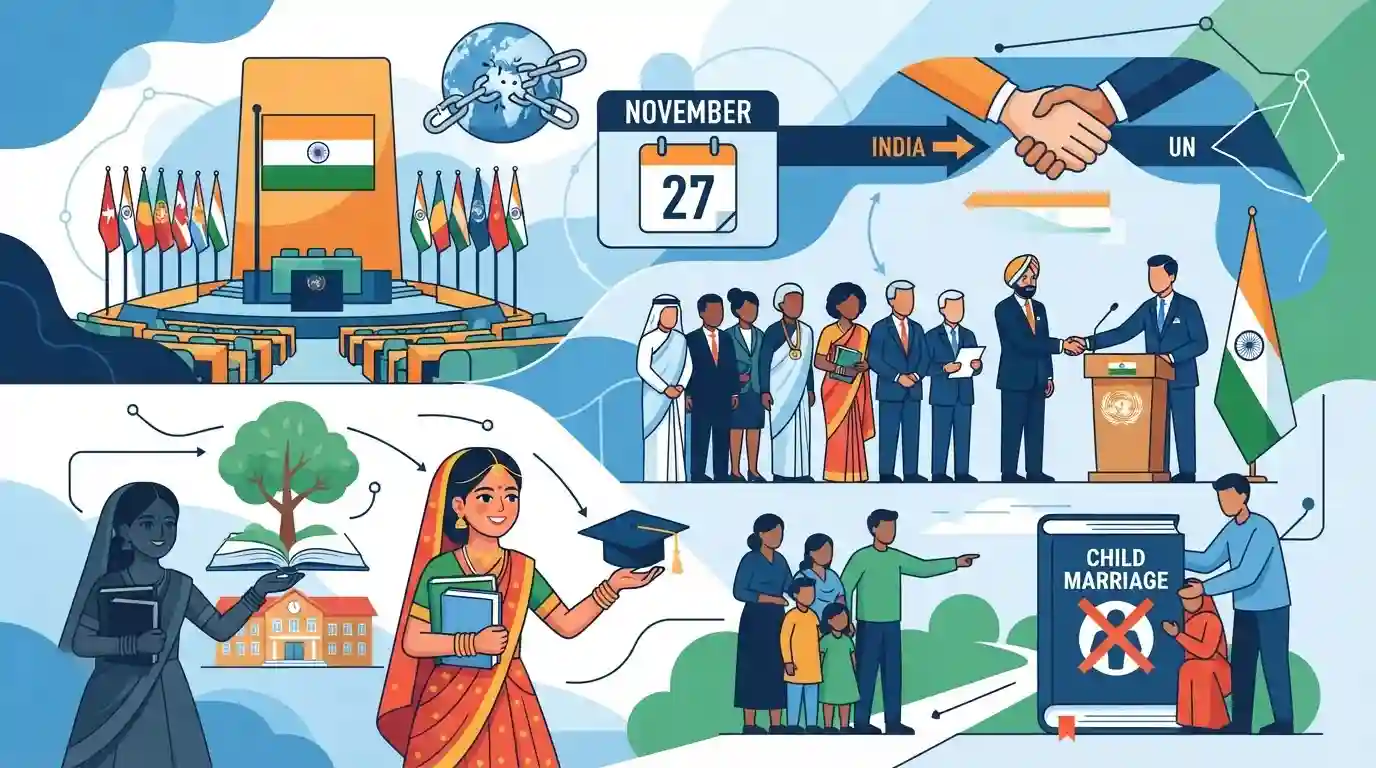
India has co-sponsored a United Nations General Assembly (UNGA) resolution designating November 27 as the International Day Against Child Marriage, reinforcing its international and domestic commitment to eradicating the practice and protecting child rights.
Key Points
- India co-sponsored a United Nations General Assembly (UNGA) resolution declaring November 27 as the International Day Against Child Marriage.
- The move highlights India's global commitment to ending child marriage, protecting child rights, and advancing gender equality.
- Child marriage remains a critical social and human rights challenge globally, impacting education, health, and economic potential of young girls.
Important Terms
International Day for the Elimination of Child, Early and Forced Marriage

A landmark UN General Assembly resolution establishing November 27 annually as the International Day for the Elimination of Child, Early and Forced Marriage, co-sponsored by India.
UPSC context
UPSC Mains Paper II / Social Justice / Vulnerable Sections: Tests knowledge of international conventions, legal protections, and global initiatives against child rights violations.
United Nations General Assembly (UNGA)
The principal deliberative, policymaking, and representative organ of the United Nations comprising all 193 member states, which adopts resolutions on global human rights and social development issues.
UPSC context
UPSC Mains Paper II / International Relations: Tests understanding of the role, resolutions, and structural function of key UN organs in shaping global policies.
Bal Vivah Mukt Bharat Campaign
India's nationwide programmatic initiative launched on November 27, 2024, to combat child marriage and drive policy measures to eradicate the practice domestically.
UPSC context
UPSC Mains Paper II / Social Justice: Important for evaluating domestic welfare schemes, child protection frameworks, and government interventions against social evils.
Static Concepts Connected
What are the key constitutional and statutory frameworks addressing child marriage in India?
- PCMA 2006: Prohibition of Child Marriage Act (PCMA) 2006: Defines legal minimum age of marriage for women (18) and men (21), making child marriages voidable at the option of the contracting party.
- Constitutional Basis: Constitutional Safeguards: Article 21 (Right to Life and Personal Liberty) and Article 39(f) (protection of childhood and youth against exploitation) under Directive Principles of State Policy.
- POSCO Act: POSCO Act 2012: Criminalizes sexual acts involving minors under 18, overriding customary practices of child marriage where statutory rape laws apply.
Cross-Topic Patterns
UN Resolutions + Domestic Social Justice Schemes
UN human rights resolutions link with domestic campaigns like Bal Vivah Mukt Bharat, showing how international advocacy directly operationalizes SDG 5.3 (eliminating child marriage by 2030) at the grassroots level.

Expect a match-the-following or statement-based question linking UN observance days to specific domestic campaigns like Bal Vivah Mukt Bharat.
Linked PYQs · 1
Linked PYQs · 1
- 2023MainsGS2
Explain the constitutional perspectives of Gender Justice with the help of relevant Constitutional Provisions and case laws.
