Cabinet approves procurement of Rafale Marine fighter jets for navy
Source:The Hindu ↗
Why It Matters
Highlights the ongoing modernization of the Indian Armed Forces and the strategic emphasis on securing the Indian Ocean Region (IOR) through capable aircraft carriers. It is crucial for understanding the balance between defence indigenisation (Make in India) and necessary off-the-shelf foreign procurements, as well as India's deepening defence partnership with France.
Summary
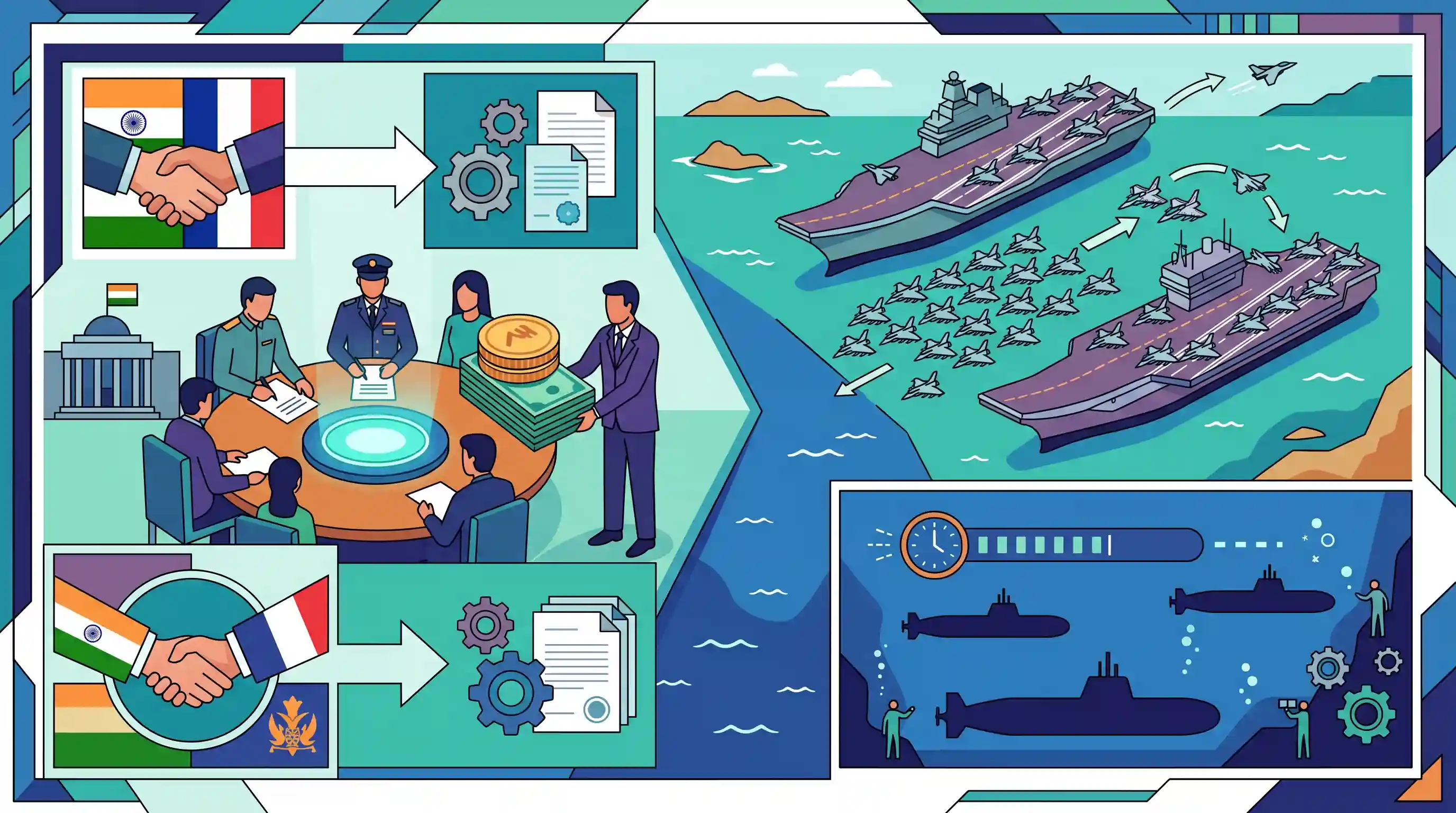
The Cabinet Committee on Security (CCS) has cleared a ₹63,000-crore government-to-government deal to procure 26 Rafale Marine fighter jets from France. Intended to bolster the Indian Navy's strike capabilities, the jets will be deployed on aircraft carriers INS Vikramaditya and INS Vikrant. The contract, expected to be signed during the French Defence Minister’s upcoming visit, involves 22 single-seater combat jets and four twin-seater trainers. Meanwhile, a separate defence agreement for three additional Scorpene-class submarines awaits final approval.
Key Points
- The Cabinet Committee on Security (CCS) approved a ₹63,000-crore government-to-government deal to purchase 26 Rafale-M fighter jets from France for the Indian Navy.
- The procurement includes 22 single-seater, carrier-compatible combat jets and 4 twin-seater trainers.
- The Rafale Marine jets will be deployed on India's two operational aircraft carriers: the Russian-procured INS Vikramaditya and the indigenously built INS Vikrant.
- Deliveries will commence 3.5 years post-signing and are slated for completion within 6.5 years.
- A separate major deal for three additional Scorpene-class conventional submarines from France is pending final CCS approval.
Important Terms
Cabinet Committee on Security (CCS)

The Prime Minister-led apex body responsible for final decisions on India’s national security, defense policy, and major military expenditures exceeding specific financial thresholds.
UPSC context
GS-II/III: Tests executive decision-making hierarchy and the national security architecture for high-value strategic procurements.
Defence Acquisition Council (DAC)
Chaired by the Defence Minister, it is the highest decision-making body for capital acquisitions. It grants the 'Acceptance of Necessity' (AoN), initiating the procurement process.
UPSC context
GS-III: Crucial for topics on defense procurement policy, modernization, and institutional reforms post-Kargil War.
Rafale-M deal
A ₹63,000-crore government-to-government agreement for 26 naval fighter jets. These 4.5-generation aircraft will operate from India's carriers, INS Vikrant and INS Vikramaditya.
UPSC context
GS-II/III: Focuses on bilateral strategic ties with France and enhancing carrier-borne strike capabilities for maritime superiority.
Scorpene-class submarine deal
A proposed follow-on procurement for three additional diesel-electric submarines to be built at Mazagon Dock under 'Project 75' to address the Navy’s underwater capability gap.
UPSC context
GS-III: Related to 'Atmanirbhar Bharat' in defense, indigenous manufacturing, and the critical status of India’s submarine fleet.
Varuna naval exercise
An annual bilateral naval exercise between India and France initiated in 1983. It focuses on interoperability, anti-submarine warfare, and security in the Indian Ocean Region.
UPSC context
GS-II: Important for international relations; exemplifies the Indo-French Joint Strategic Vision for maritime cooperation.
Indian Navy
The maritime branch of India’s Armed Forces, currently transitioning into a 'blue-water' force through indigenous carrier development and advanced multi-role fighter acquisitions.
UPSC context
GS-III: Central to maritime security, the SAGAR vision, and India's role as a net security provider.
Prelims Trap
Both INS Vikramaditya and INS Vikrant are India's indigenously designed and built aircraft carriers.
Only INS Vikrant is indigenously built (IAC-1). INS Vikramaditya is a retrofitted Russian carrier (Admiral Gorshkov). UPSC often swaps these origins to trick candidates.
Static Concepts Connected
How do the roles of DAC and CCS differ in defence procurement?
- DAC Role: Headed by the Defence Minister, it grants the initial Acceptance of Necessity (AoN) for procurement.
- CCS Role: Headed by the Prime Minister, it is the apex body that gives final financial approval for mega-deals exceeding ₹1,000 crore.
What are the key features of the Indian Navy's Project-75?
- Objective: Construction of six conventional diesel-electric attack submarines (Kalvari-class).
- Technology Transfer: Manufactured in India by Mazagon Dock Shipbuilders Limited (MDL) via technology transfer from France's Naval Group.
- Submarines Delivered: Includes Kalvari, Khanderi, Karanj, Vela, Vagir, and Vagsheer.
Cross-Topic Patterns
France as an IOR resident power
France’s overseas territories (Reunion, Mayotte) make it an Indian Ocean resident power. Defence acquisitions heavily align with joint Indo-French maritime security to secure IOR sea lanes of communication.
STOBAR vs CATOBAR launch systems
Rafale-M jets are configured for India's STOBAR (Short Take-Off But Arrested Recovery) carriers, providing a tech-comparison angle against the catapult-based CATOBAR systems used by the US Navy.

Expect a 2026 matched-pair question mapping naval assets (Vikrant, Kalvari) to their foreign collaborators or launch technologies.
Linked PYQs · 3
Linked PYQs · 3
- 2020MainsGS2
What is the significance of Indo-US defence deals over Indo-Russian defence deals? Discuss with reference to stability in the Indo-Pacific region.
- 2022MainsGS3
What are the maritime security challenges in India ? Discuss the organisational, technical and procedural initiatives taken to improve the maritime security.
- 2025MainsGS3
Why is maritime security vital to protect India's sea trade? Discuss maritime and coastal security challenges and the way forward.
