Resumption of India China Cross Border Trade Through Shipki La Pass
Source:The Hindu ↗
Why It Matters
Himalayan passes and border trade routes hold dual significance for UPSC: geographically (as key passes like Shipki La, Nathu La, and Lipulekh are frequently tested in Prelims) and strategically/economically (since local border trade acts as a vital tool for security, stabilizing border populations, and managing bilateral ties with China under GS2 and GS3).
Summary
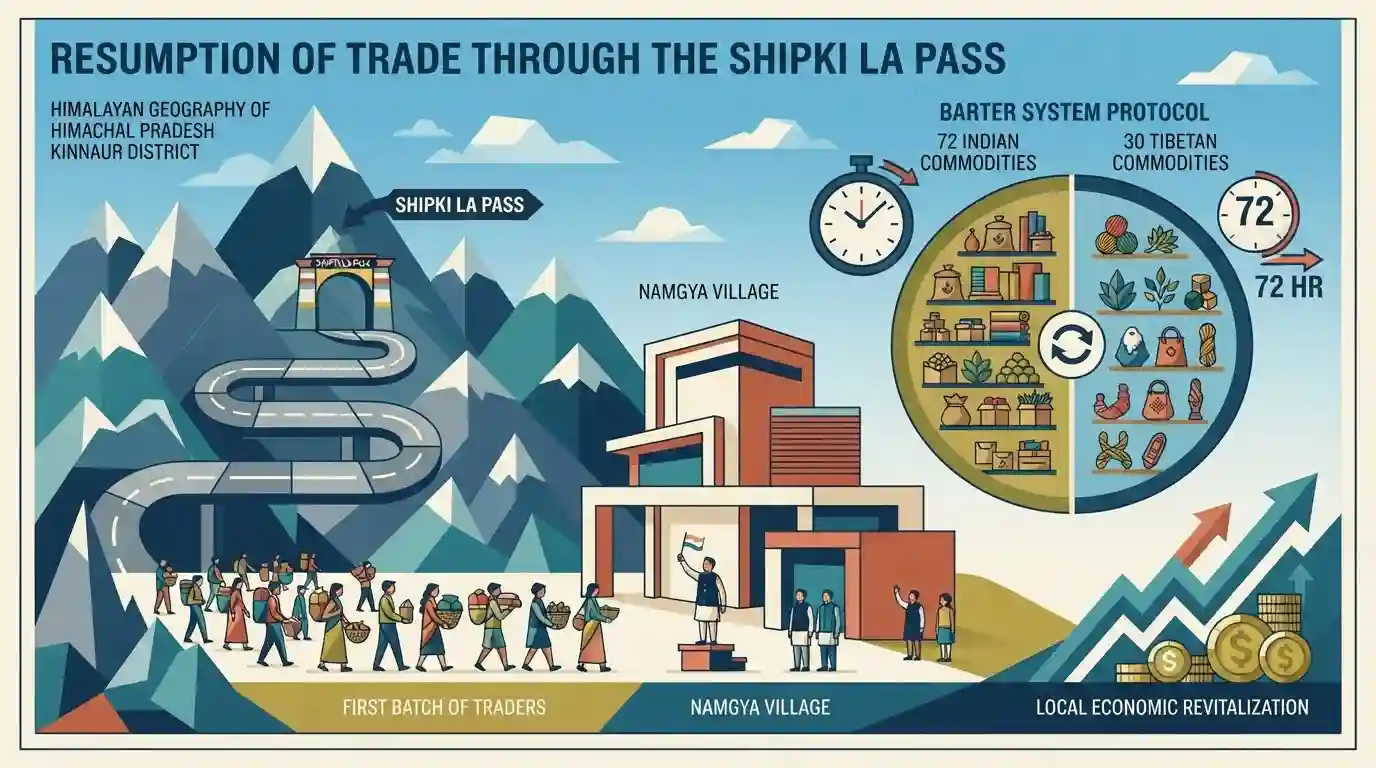
Cross-border trade between India and China through the Shipki La pass, located in Himachal Pradesh's Kinnaur district, has resumed after a six-year hiatus. Himachal Pradesh Revenue and Horticulture Minister Jagat Singh Negi flagged off the first batch of 16 local traders to Tibet and inaugurated the newly built ₹1.70 crore 'Chhuppan Trade Mart' in Namgya village. Operating on a strict 72-hour barter trade protocol, the route allows the exchange of 72 Indian commodities and 30 Tibetan commodities. This resumption is projected to revitalize the local economy and strengthen India's border area development efforts in remote regions.
Key Points
- Resumption of Trade: India-China bilateral cross-border trade through the Shipki La pass resumed on August 1, 2026, after a six-year suspension.
- Location and Strategic Significance: Shipki La is located in the Kinnaur district of Himachal Pradesh, serving as an ancient Silk Route link between India and Tibet.
- Barter System Mechanism: The trade operates on a barter model under which traders from the Indian side are allowed to travel to Shipki village in Tibet, conduct trade for up to 72 hours, and then return.
- Permitted Commodities: Local traders are permitted to trade 72 types of commodities from the Indian side and 30 types from the Tibetan/Chinese side, subject to guidelines from the Union Ministry of Commerce.
- Local Infrastructure Support: A modern 'Chhuppan Trade Mart' was constructed in the Namgya border Gram Panchayat at a cost of ₹1.70 crore to facilitate trade, security, and administrative clearance.
- Border Area Development: The resumption of trade is expected to significantly boost the rural economy of border regions, generate self-employment for local youth, and incentivize better physical and digital connectivity in remote villages.
Important Terms
Shipki La Pass

A strategic high-altitude mountain pass in Himachal Pradesh's Kinnaur district on the India-Tibet border. It operates as one of India's traditional, designated points for cross-border barter commerce with China.
UPSC context
Highly relevant for GS Paper 1 (Geography) and GS 3 (Security). Tests knowledge of Himalayan passes and strategic border locations.
Cross-Border Barter System
A traditional, non-monetary economic mechanism where border communities directly exchange notified goods without cash. At Shipki La, registered traders currently swap items under a strict 72-hour operational window.
UPSC context
Important for GS Paper 3 (Economy). Focuses on localized frontier commerce, unique trade treaties, and customs challenges like IGST.
Chhuppan Trade Mart
A newly inaugurated ₹1.70 crore modern trading facility in Namgya village, Kinnaur. It centralizes India-China border commerce by allowing traders from both nations to exchange goods at a single location.
UPSC context
Relevant to GS Paper 3 (Border Area Development). Highlights infrastructure initiatives designed to integrate and formalize remote frontier economies.
Union Ministry of Commerce
The central government body that formulates foreign trade policy, oversees import-export regulations, and officially notifies the specific categories of commodities permitted for exchange along international border trade routes.
UPSC context
Relevant for GS Paper 2 (Governance) and GS 3 (Economy), testing understanding of bilateral trade frameworks and regulatory authorities.
Ministry of External Affairs
The Union ministry directing India's foreign policy. It handles bilateral trade agreements, diplomatic negotiations, and confidence-building measures required to sustain or resume cross-border commerce with neighboring countries like China.
UPSC context
Crucial for GS Paper 2 (International Relations). Evaluates knowledge of diplomatic treaties, neighborhood first policies, and border dispute management.
Himachal Pradesh Government
The state authority responsible for facilitating local logistics, conducting background verifications for traders, and deploying state police to jointly supervise border security alongside central paramilitary forces during trade seasons.
UPSC context
Important for GS Paper 2 (Federalism). Illustrates the collaborative role of state administrations in managing national border security and development.
Prelims Trap
"Cross-border trade through Shipki La is settled using a dual-currency exchange mechanism managed by the RBI."
Trade at Shipki La operates strictly on a traditional, non-monetary barter system for a limited number of notified commodities, not via a formalized currency exchange or forex mechanism.
Static Concepts Connected
Which major river enters India through Shipki La, and where is the pass located?
- Geographical Location: Shipki La is located in the Kinnaur district of Himachal Pradesh, situated in the Zanskar range of the Greater Himalayas.
- River Entry Point: The Sutlej River, an antecedent river originating near Lake Rakshastal in Tibet, enters India through this specific mountain pass.
- LAC Sector: It falls within the Middle Sector of the Line of Actual Control (LAC), historically considered the least contentious border segment.
What are the officially designated land border trade points between India and China?
- Shipki La: Located in Himachal Pradesh, serving the Middle Sector. Reopened for trade in 2026 after a six-year hiatus.
- Nathu La: Located in Sikkim, connecting the Indian state to Tibet in the Eastern Sector of the boundary.
- Lipulekh Pass: Located in Uttarakhand, functioning as both a border trade point and a route for the Kailash Mansarovar Yatra.
Cross-Topic Patterns
Border Trade + Vibrant Villages Programme
Building trade marts at remote passes aligns with the Vibrant Villages Programme, aiming to check out-migration by boosting local economies and rebranding border settlements as India's "first villages."
Barter Trade + IGST Complexities
Protests over levying Integrated GST (IGST) on Shipki La's barter trade highlight the legal and administrative complexities of applying modern indirect tax frameworks to traditional, non-monetary cross-border exchanges.

Map-based questions pairing LAC passes (Shipki La, Nathu La, Lipulekh) with their corresponding rivers or states are highly likely in 2026.
Linked PYQs · 2
Linked PYQs · 2
- 2007PrelimsGS1
Which one of the following Himalayan passes was reopened around in the middle of the year 2006 to facilitate trade between India and China?
- 2012MainsGS2
Do you think that China's emergence as one of the largest trading partners of India has adversely affected the settlement of the outstanding border problem?
