India China bilateral relations and global economic stability
Source:Indian Express ↗
Why It Matters
India-China relations are a central pillar of Asian geopolitics and global economic stability. Understanding the dual nature of this relationship—characterized by both economic interdependence and strategic competition—is vital for answering questions in GS2 (International Relations) and GS3 (Border Security).
Summary
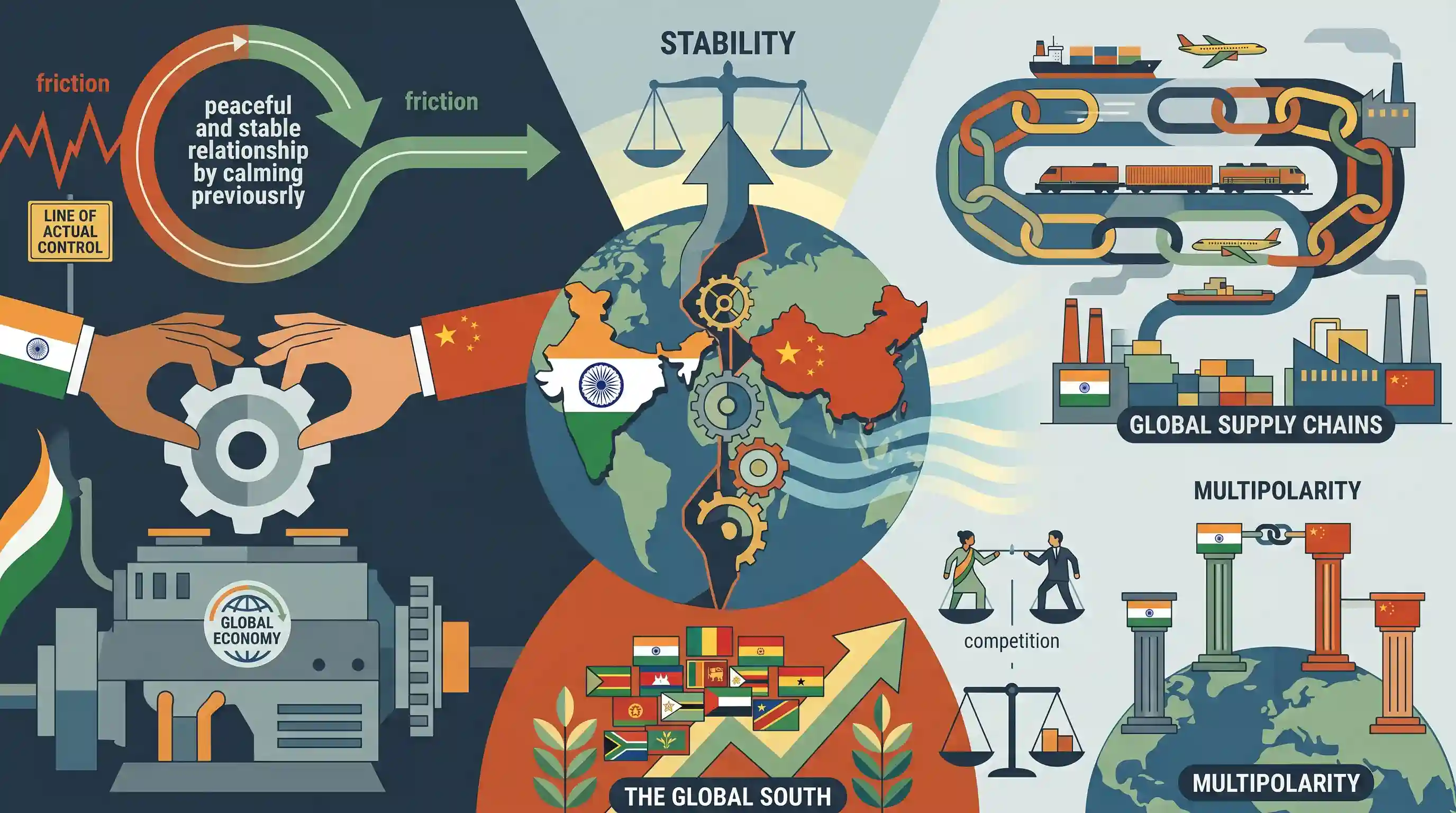
The article highlights Prime Minister Narendra Modi's assertion that India and China need to collaborate to bring stability to the global economy. He emphasizes that a peaceful and stable relationship between the two nations is critical not just bilaterally, but for the entire world. Despite ongoing border frictions along the Line of Actual Control (LAC), the massive economic scale of both countries means their interactions significantly influence global supply chains, multipolarity, and the prospects of the Global South. The statement reflects a strategic effort to balance geopolitical competition with necessary economic cooperation.
Key Points
- PM Modi emphasized that India and China must work together to ensure stability and growth in the global economy.
- Peaceful and stable bilateral ties between the two Asian giants are deemed essential for the broader region and global prosperity.
- Cooperation between the two nations is positioned as crucial for mitigating global supply chain vulnerabilities and supporting the Global South.
- The statement highlights a pragmatic diplomatic approach: acknowledging border tensions while recognizing the unavoidable economic interdependence of both countries.
Important Terms
Line of Actual Control (LAC)

The 3,488 km de facto boundary between India and China. It remains undemarcated, leading to differing perceptions and military friction across three sectors.
UPSC context
GS Paper 2; border security, sovereignty, and bilateral agreements.
Global South
A geopolitical group of developing nations in Asia, Africa, and Latin America sharing common developmental challenges and a history of colonialism.
UPSC context
GS Paper 2; India's leadership role and South-South cooperation.
Multipolarity
An international order where power is dispersed among several major states rather than dominated by a single superpower (unipolar) or two (bipolar).
UPSC context
GS Paper 2; evolving global order and India's strategic vision.
Global Supply Chains
Interconnected international systems of production and trade. India aims to become a resilient alternative to China through the 'China Plus One' strategy.
UPSC context
GS Paper 3; trade interdependence and manufacturing hubs.
Strategic Autonomy
A foreign policy principle where a nation makes sovereign decisions based on national interest, avoiding binding military alliances with major power blocs.
UPSC context
GS Paper 2; India's multi-alignment and independent decision-making.
Shanghai Cooperation Organisation (SCO)
A Eurasian political and security alliance. It facilitates multilateral engagement between India and China on regional stability and counter-terrorism.
UPSC context
GS Paper 2; regional groupings and Eurasian diplomacy.
Prelims Trap
India has successfully decoupled from China, making the US the largest source of India's imports to ensure supply chain resilience.
China remains India's largest import source. Aspirants often confuse India's overall largest trading partner (frequently the US) with the largest source of imports (consistently China).
Static Concepts Connected
What distinguishes the Line of Actual Control (LAC) from the Line of Control (LoC)?
- Legal Status: The LoC is legally delineated (1972 Simla Agreement); the LAC is a de facto military demarcation lacking a mutually agreed boundary map.
- Geography: The LoC divides India and Pakistan in J&K; the LAC divides India and China across the Western, Middle, and Eastern sectors.
- Friction Type: Un-demarcated overlapping claims on the LAC lead to recurring physical face-offs, whereas LoC friction typically involves cross-border firing.
What drives the "China Plus One" supply chain strategy?
- Diversification Rationale: Multinational corporations are diversifying investments away from exclusively relying on China to mitigate geopolitical risks, tariffs, and pandemic-like supply disruptions.
- India's Response: India actively utilizes Production Linked Incentive (PLI) schemes and infrastructure upgrades to capture these migrating global supply chains.
Cross-Topic Patterns
Geopolitics vs. Climate Diplomacy
Despite LAC tensions, India and China frequently form a united front at the UNFCCC and WTO to advocate for the Global South, demanding CBDR and structural climate finance.
Asian Century & Multipolarity
Both nations leverage BRICS and the SCO to challenge Western-dominated global financial institutions, proving that their shared multipolar goals make complete diplomatic decoupling impossible.

Expect a 2026 Mains question analyzing the paradox of India's 'China Plus One' ambitions alongside its rising import dependency on Beijing.
Linked PYQs · 3
Linked PYQs · 3
- 2024MainsGS2
‘The West is fostering India as an alternative to reduce dependence on China's supply chain and as a strategic ally to counter China's political and economic dominance.’ Explain this statement with examples.
- 2012MainsGS2
Do you think that China's emergence as one of the largest trading partners of India has adversely affected the settlement of the outstanding border problem?
- 2024MainsGS3
India has a long and troubled border with China and Pakistan fraught with contentious issues. Examine the conflicting issues and security challenges along the border. Also give out the development being undertaken in these areas under the Border Area Development Programme (BADP) and Border Infrastructure and Management (BIM) Scheme.
