India China Talks to Ease Arunachal Pradesh LAC Tensions
Source:The Hindu ↗
Why It Matters
Important for understanding the trajectory of bilateral relations, confidence-building measures, and border management strategies between India and China along the Eastern Sector of the LAC.
Summary
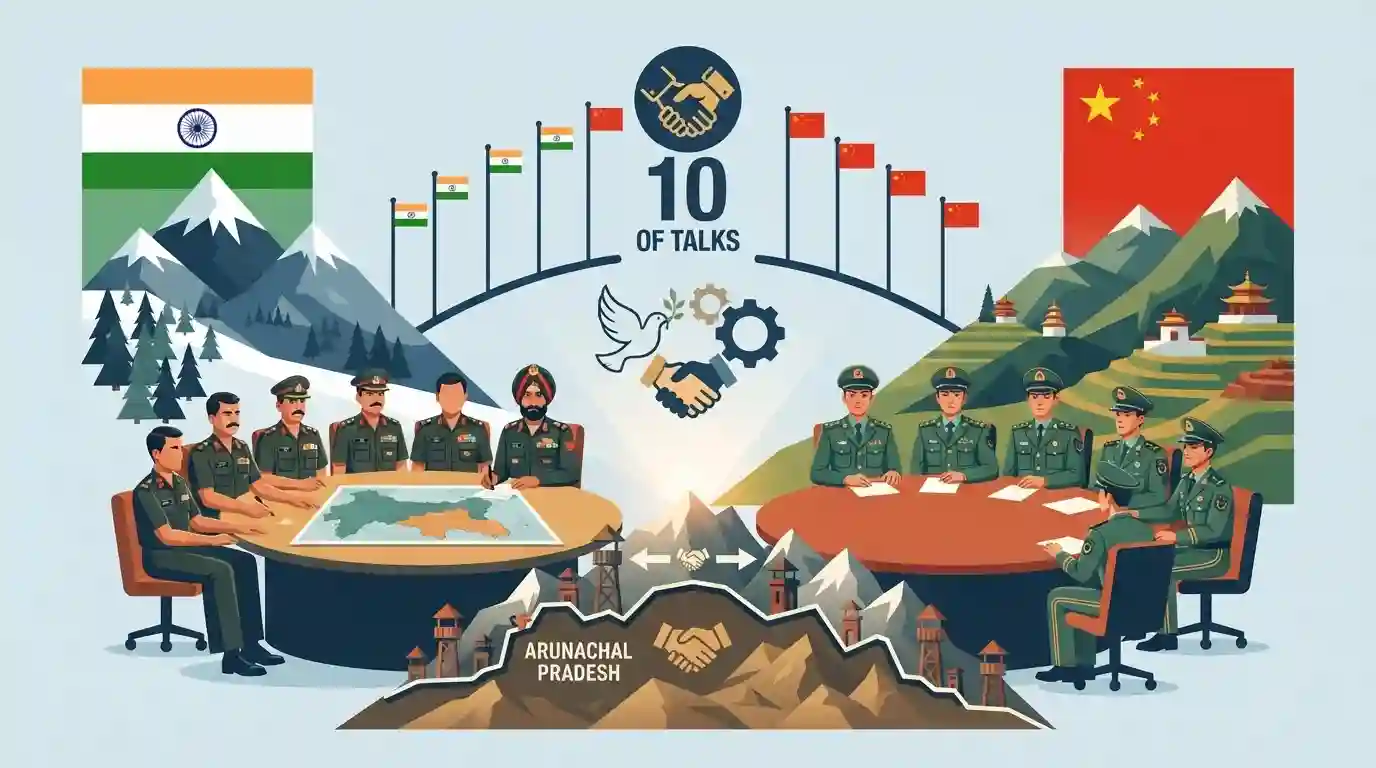
India and China conducted a 10-day series of talks aimed at easing tensions and managing border friction along the Line of Actual Control (LoAC) in Arunachal Pradesh, highlighting continued diplomatic and military engagement to stabilize bilateral frontiers.
Key Points
- India and China held a 10-day round of talks to ease tensions along the Line of Actual Control (LoAC) in Arunachal Pradesh.
- The engagement reflects ongoing diplomatic and military efforts to stabilize border sectors following previous disengagement pacts.
- Arunachal Pradesh remains a strategically sensitive sector along the India-China border, making local-level commander talks crucial for managing friction points.
Important Terms
Line of Actual Control LAC

The un-demarcated de facto military boundary separating Indian and Chinese controlled areas across three sectors, whose differing perceptions cause ongoing border standoffs.
UPSC context
GS Paper II (International Relations) & GS Paper III (Security) – tests India-China boundary disputes and management.
Indian Army
The land-based land warfare branch of the Indian Armed Forces, responsible for national security and border defense along the LAC.
UPSC context
GS Paper III (Internal Security / Defence) – tests India's operational preparedness and border force deployments.
People's Liberation Army
The principal military force of the People's Republic of China, responsible for external defense and border operations along the disputed Sino-Indian frontier.
UPSC context
GS Paper II (International Relations) & GS Paper III (Security) – tests regional security dynamics and China's military posture.
Prelims Trap
The Line of Actual Control in Arunachal Pradesh is legally identical to and universally recognized as the 1914 McMahon Line.
Aspirants often confuse the McMahon Line with the Line of Actual Control itself; while they overlap in the eastern sector, China officially rejects the McMahon Line entirely.
Static Concepts Connected
What are the key sectors of the India-China border and their respective geographical challenges?
- Western Sector: Western sector covers Ladakh, defined by the Johnson Line and the Pangong Tso region, marked by high-altitude plateaus.
- Middle Sector: Middle sector spans Himachal Pradesh and Uttarakhand, which is relatively stable with fewer active friction points.
- Eastern Sector: Eastern sector covers Arunachal Pradesh, largely following the disputed 1914 McMahon Line, which China claims as Southern Tibet.
Cross-Topic Patterns
LoAC Talks + Border Infrastructure Planning
Border negotiations in high-altitude terrain test both military diplomacy and strategic infrastructure development (like Vibrant Villages Programme) under extreme weather constraints.
India-China Relations + Economic Diplomacy
Military disengagement pacts along the northern border directly interface with trade dependencies and economic decoupling strategies examined in International Relations.

Expect statements matching McMahon Line legal status with Chinese sovereignty claims in the eastern sector of the LAC.
Linked PYQs · 2
Linked PYQs · 2
- 2012MainsGS2
Do you think that China's emergence as one of the largest trading partners of India has adversely affected the settlement of the outstanding border problem?
- 2014MainsGS2
With respect to the South China sea, maritime territorial disputes and rising tension affirm the need for safeguarding maritime security to ensure freedom of navigation and over flight throughout the region. In this context, discuss the bilateral issues between India and China.
