India China Diplomatic Talks on LAC Situation and Border Management
Source:The Hindu ↗
આ શા માટે મહત્વનું છે
The continuous dialogue on the LAC dispute and trans-border river management highlights India's strategic imperatives in stabilizing its northern borders and securing its geopolitical and hydro-diplomatic interests against China.
સારાંશ
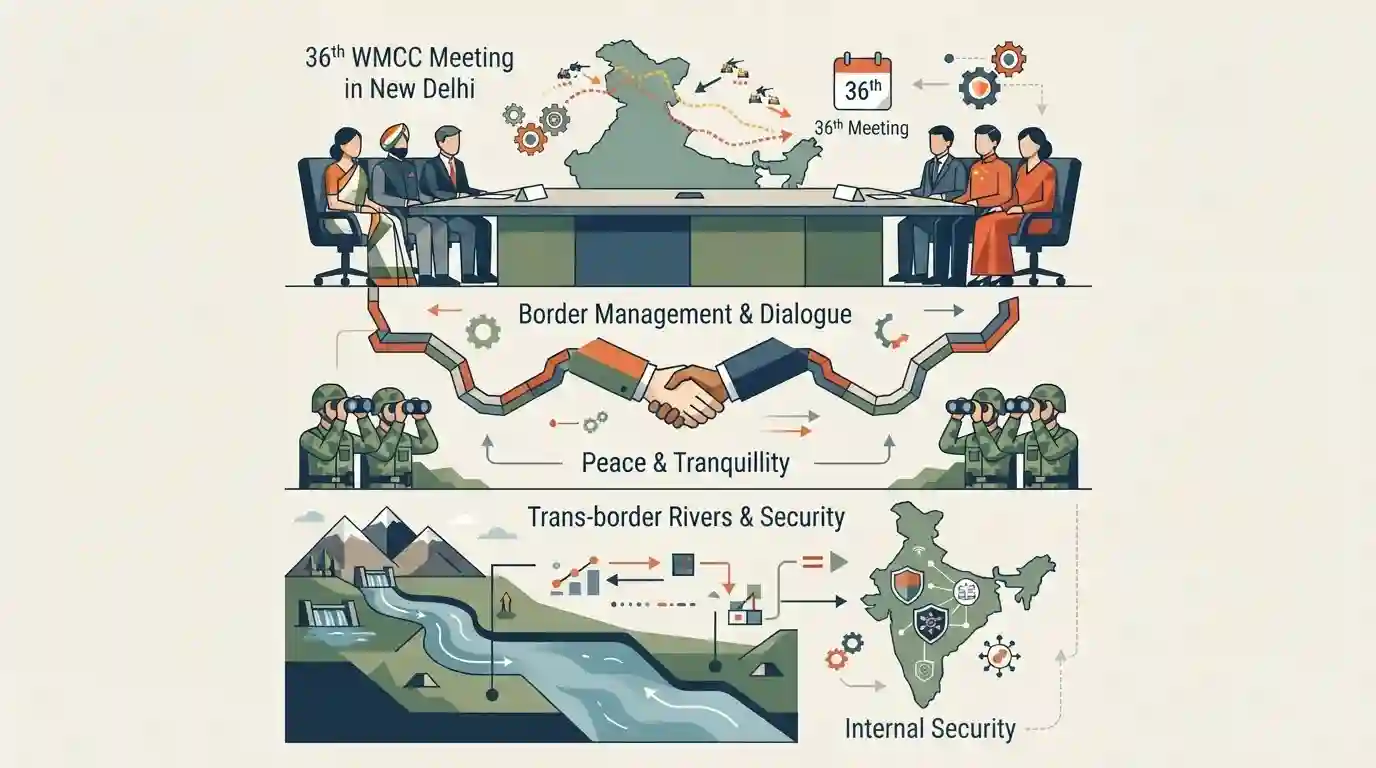
India and China recently concluded the 36th meeting of the Working Mechanism for Consultation and Coordination on India-China Border Affairs (WMCC) in New Delhi. The diplomatic talks centered on reviewing the situation along the Line of Actual Control (LAC), focusing on boundary delimitation, effective border management, and the implementation of recent disengagement understandings. Recognizing that peace and tranquillity along the border are prerequisites for normal bilateral ties, both sides committed to maintaining regular dialogue. Additionally, India pressed for the early convening of an expert-level mechanism to discuss trans-border rivers and the sharing of technical data concerning upstream projects.
મુખ્ય મુદ્દા
- India and China held the 36th WMCC meeting in New Delhi to review the situation along the Line of Actual Control (LAC) and discuss border management.
- Both sides focused on implementing recent disengagement agreements to maintain peace and tranquillity in border areas, viewing it as essential for the broader bilateral relationship.
- India emphasized the need for an early convening of the expert-level mechanism on trans-border rivers to share technical details regarding upstream hydro projects.
- The two countries agreed to continue regular diplomatic and military dialogues and coordinate on mechanism-building for effective border management.
મહત્વપૂર્ણ શબ્દો
Working Mechanism for Consultation and Coordination on India-China Border Affairs (WMCC)

Established in 2012, the WMCC is an institutional framework between India and China for diplomatic and military consultation on border affairs, aimed at managing the LAC and maintaining peace without directly resolving boundary disputes.
UPSC context
Crucial for GS Paper 2 (International Relations) to analyze bilateral dispute management, border negotiations, and confidence-building measures between India and China.
Line of Actual Control (LAC)
The LAC is the de facto border separating Indian-controlled territory from Chinese-controlled territory, spanning approximately 3,488 km across three sectors. It remains an unofficial and disputed boundary pending a final border settlement.
UPSC context
Highly relevant for GS Paper 2 (IR) and GS Paper 3 (Internal Security) to understand border disputes, military standoffs, and regional security dynamics.
Expert Level Mechanism (ELM) on Trans-Border Rivers
Established in 2006, the ELM is a bilateral India-China forum addressing trans-boundary water issues. It focuses on sharing hydrological data during flood seasons and coordinating emergency management for shared rivers like the Brahmaputra.
UPSC context
Important for GS Paper 2 (IR) and GS Paper 1 (Geography) when studying hydro-diplomacy, trans-boundary resource sharing, and disaster management.
Ministry of External Affairs (MEA)
The Government of India agency responsible for implementing foreign policy, conducting diplomatic relations, managing bilateral dialogues, and representing Indian interests at international and regional forums.
UPSC context
Foundational for GS Paper 2 (IR) regarding the institutional mechanisms and executing actors of India's foreign policy and bilateral diplomacy.
પ્રિલિમ્સ ટ્રેપ
India and China are guided by a binding water-sharing treaty for trans-border rivers like the Brahmaputra.
India and China do not have a legally binding water treaty like the Indus Waters Treaty. They rely solely on non-binding MoUs for flood-season data.
સંલગ્ન સ્થિર ખ્યાલો
How does India manage trans-border river data with China?
- Expert Level Mechanism (ELM): Established in 2006 to institutionalize the sharing of technical details, emergency management, and flood-season hydrological data.
- No Binding Treaty: Unlike the Indus Water Treaty with Pakistan, India and China rely entirely on non-binding Memorandums of Understanding (MoUs).
- Key Rivers: The data sharing primarily covers the Brahmaputra (Yarlung Zangbo) and Sutlej (Langqen Zangbo) rivers.
What is the WMCC in India-China border management?
- Diplomatic Framework: Established in 2012 as a Joint Secretary-level diplomatic platform, distinct from the military-led Corps Commander-level talks.
- Core Mandate: Tasked with timely communication and coordination to manage recurring friction and maintain peace and tranquillity along the LAC.
આંતર-વિષય પેટર્ન
Hydro-hegemony and Internal Security
China's upper riparian status and upstream dams (e.g., Zangmu) link military border standoffs directly to India's northeastern ecological security, flood management, and overall internal security posture.
Bilateral Prerequisites vs Multilateral Fora
India firmly ties overall bilateral normalcy to border peace, directly impacting its willingness to cooperate with China in multilateral forums like BRICS and SCO where China prefers to compartmentalize disputes.

A 2026 prelims question will likely combine the WMCC's diplomatic mandate, historical LAC agreements, and the lack of a binding water treaty.
સંલગ્ન PYQ · 3
સંલગ્ન PYQ · 3
- 2024MainsGS3
India has a long and troubled border with China and Pakistan fraught with contentious issues. Examine the conflicting issues and security challenges along the border. Also give out the development being undertaken in these areas under the Border Area Development Programme (BADP) and Border Infrastructure and Management (BIM) Scheme.
- 2014MainsGS2
With respect to the South China sea, maritime territorial disputes and rising tension affirm the need for safeguarding maritime security to ensure freedom of navigation and over flight throughout the region. In this context, discuss the bilateral issues between India and China.
- 2012MainsGS2
Do you think that China's emergence as one of the largest trading partners of India has adversely affected the settlement of the outstanding border problem?
