India China Border Disengagement and Persistent Strategic Frictions
Source:Indian Express ↗
Why It Matters
India-China relations are central to India's foreign policy and national security. Understanding the distinction between tactical border disengagement and long-term strategic competition is crucial for analyzing India's shifting geopolitical alignments and border management strategies in UPSC exams.
Summary
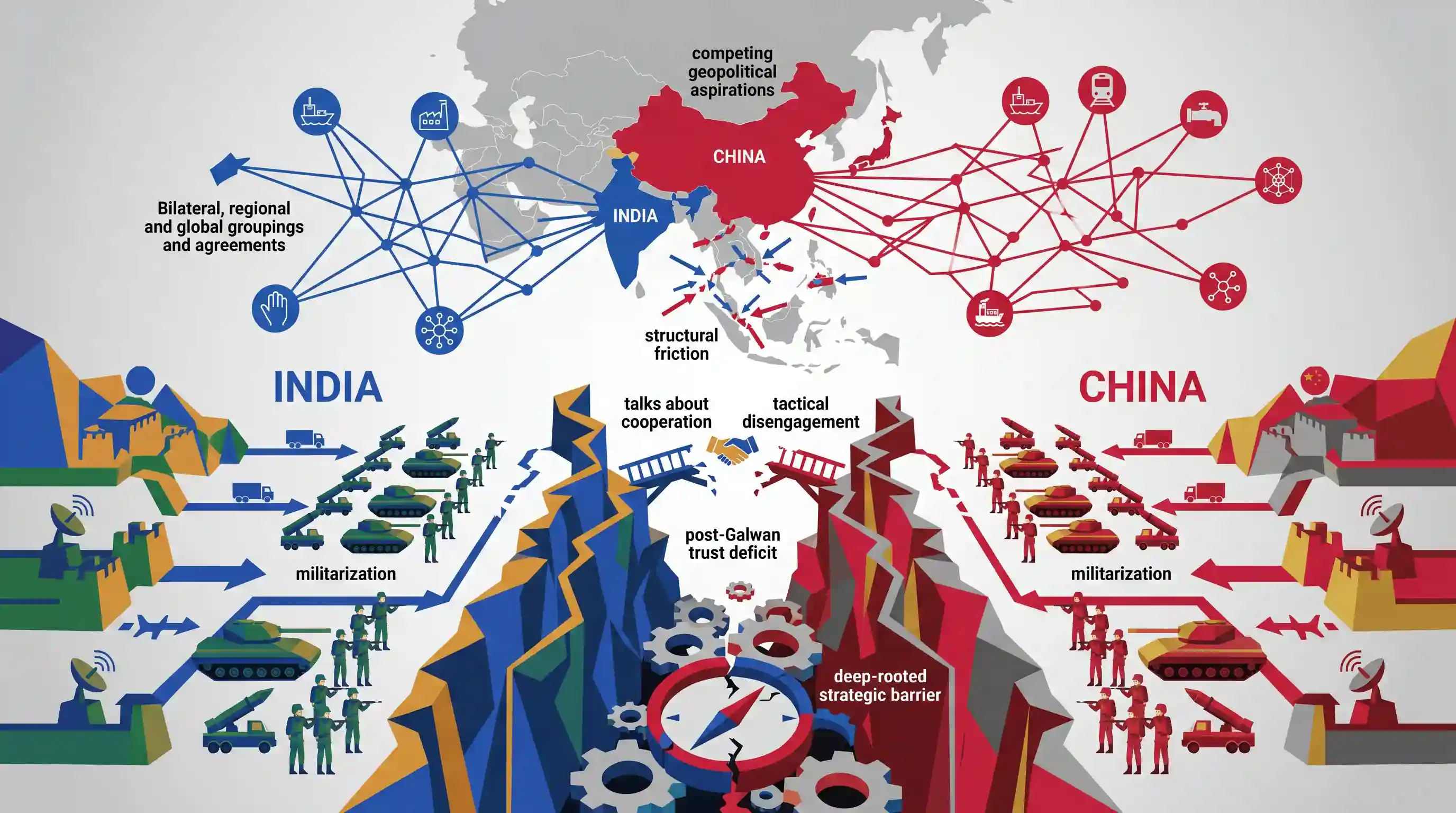
The article analyzes the ongoing complexities in India-China relations, noting that while both nations engage in talks about cooperation and have achieved some tactical disengagement along the border, deep-rooted strategic barriers prevent a true normalization of ties. The post-Galwan trust deficit, continued militarization of the Line of Actual Control (LAC), and competing geopolitical aspirations in Asia mean that structural frictions will persist despite diplomatic posturing.
Key Points
- Despite recent diplomatic engagements and limited border disengagements, the fundamental trust deficit between India and China remains unresolved since the 2020 Galwan clash.
- Strategic barriers, including China's assertive posture in the Indo-Pacific and its deep ties with Pakistan, continue to hinder meaningful bilateral cooperation.
- Both nations have heavily fortified their positions along the Line of Actual Control (LAC), indicating a shift from border management to sustained military deterrence.
- India's foreign policy has adapted by strengthening partnerships with the US and the Quad to counterbalance China's regional hegemony, further solidifying the strategic divide.
Important Terms
Line of Actual Control (LAC)

The de facto border separating Indian-controlled territory from Chinese-controlled territory, divided into Western (Ladakh), Middle, and Eastern sectors. It remains undemarcated, leading to differing perceptions of its exact alignment.
UPSC context
GS Paper 2 (International Relations) & GS Paper 3 (Security); tests knowledge of border management and territorial integrity.
Galwan Valley Clash
A violent hand-to-hand confrontation in June 2020 between Indian and Chinese troops in Eastern Ladakh. It ended a 45-year period without fatalities on the LAC and caused a severe trust deficit.
UPSC context
GS Paper 2 (Neighborhood relations) & GS Paper 3; critical for understanding the "post-Galwan" shift in India's China policy.
Quadrilateral Security Dialogue (Quad)
An informal strategic forum of India, the US, Japan, and Australia aimed at ensuring a "free and open Indo-Pacific." China perceives it as a tool for encirclement or containment.
UPSC context
GS Paper 2 (Global groupings); tests India's balancing act between Western partnerships and Asian regional stability.
People's Liberation Army (PLA)
The unified military force of the People's Republic of China. Its increased presence and infrastructure development along the LAC are primary drivers of India-China military tension.
UPSC context
GS Paper 3 (Security challenges); essential for analyzing military threats and border incursions.
Strategic Autonomy
India's policy of making independent foreign policy decisions based on national interests rather than being forced by external alliances, particularly in the US-China rivalry.
UPSC context
GS Paper 2 (Foreign Policy); a core principle tested in the context of multi-alignment and major power relations.
String of Pearls
A strategic theory regarding China's network of military and commercial facilities along its sea lines of communication, intended to encircle India in the Indian Ocean Region.
UPSC context
GS Paper 2 (International Relations); important for maritime security and China's regional dominance strategies.
Trade Deficit
The significant gap where India imports far more from China than it exports to it, creating economic dependency and vulnerability in critical supply chains.
UPSC context
GS Paper 3 (Indian Economy); tests structural imbalances in bilateral trade and domestic manufacturing goals like "Atmanirbhar Bharat."
Prelims Trap
"The Line of Actual Control (LAC) is a legally recognized and physically demarcated boundary between India and China."
The LAC is merely a conceptual line with differing territorial perceptions. Unlike the LoC, it is neither formally mapped nor mutually agreed upon on the ground.
Static Concepts Connected
What differentiates the LAC, LoC, and McMahon Line?
- LAC: De facto, undemarcated border with China based on differing perceptions and no comprehensive mutual agreement on the ground.
- LoC: India-Pakistan military control line in J&K, clearly delineated on maps and mutually recognized post the 1972 Shimla Agreement.
- McMahon Line: Historic 1914 boundary in the Eastern sector (Arunachal Pradesh), legally recognized by India but officially rejected by China.
What are India's major initiatives to secure the Northern border?
- Infrastructure: Border Roads Organisation's rapid construction of strategic all-weather roads (e.g., DS-DBO road) and tunnels (Atal, Sela).
- Vibrant Villages Programme: Comprehensive development of border villages to prevent out-migration, effectively turning them into the first line of defense.
- ITBP Deployment: Deployment of the Indo-Tibetan Border Police (ITBP) as the specialized Central Armed Police Force guarding the high-altitude LAC.
Cross-Topic Patterns
Strategic decoupling vs Economic dependency
Despite military deterrence at the LAC and strategic pushback via the Quad, India's structural reliance on China for APIs, electronics, and critical minerals continues to drive a record trade deficit.
Border infrastructure as geopolitical deterrence
Connects GS3 border management (Vibrant Villages Programme, Sela Tunnel) with GS2 bilateral relations, showing how domestic infrastructure acts as a direct physical counter to China's 'Xiaokang' border villages.

Expect a multi-statement Prelims question in 2026 contrasting the legal/demarcated status of LAC vs LoC alongside recent friction points.
Linked PYQs · 4
Linked PYQs · 4
- 2014MainsGS2
With respect to the South China sea, maritime territorial disputes and rising tension affirm the need for safeguarding maritime security to ensure freedom of navigation and over flight throughout the region. In this context, discuss the bilateral issues between India and China.
- 2024MainsGS3
India has a long and troubled border with China and Pakistan fraught with contentious issues. Examine the conflicting issues and security challenges along the border. Also give out the development being undertaken in these areas under the Border Area Development Programme (BADP) and Border Infrastructure and Management (BIM) Scheme.
- 2012MainsGS2
Do you think that China's emergence as one of the largest trading partners of India has adversely affected the settlement of the outstanding border problem?
- 2016MainsGS3
Border management is a complex task due to difficult terrain and hostile relations with some countries. Elucidate the challenges and strategies for effective border management.
